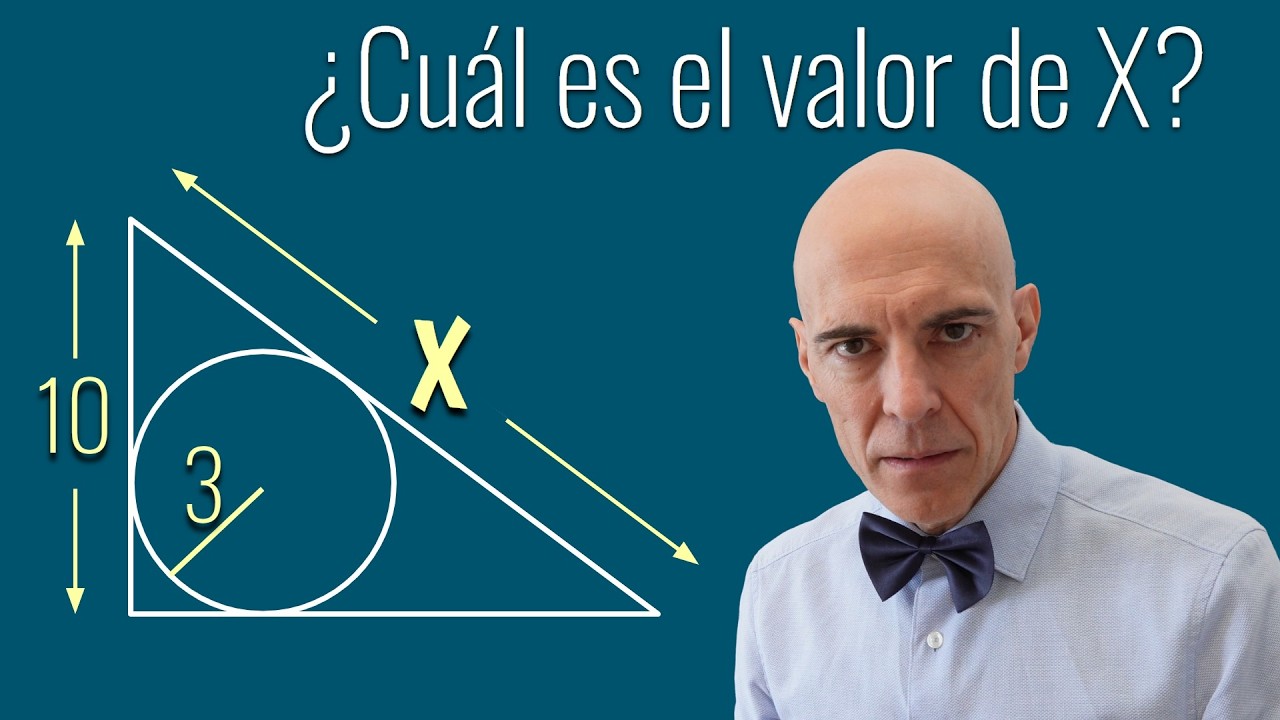
¿Eres capaz de hallar la hipotenusa de este triángulo rectángulo? Geometría Básica
Keywords
Summary
134 words
Critical Evaluation
The video excels in pedagogical clarity, breaking down a seemingly complex problem into intuitive steps. The ‘umbrella’ analogy effectively conveys the tangent segment property, making it accessible to a wide audience. The reasoning is rigorous, and the algebraic manipulation is transparent, reinforcing the Pythagorean theorem and equation solving. The instructor’s engaging style, including humor and asides, maintains viewer interest. The solution is correct, and the method is generalizable. However, the video does not delve into alternative approaches or discuss the underlying theorem in formal terms, which might be a minor limitation for advanced learners. The sources cited are the channel’s own resources, not external references, but the mathematical content is standard and verifiable. The title accurately reflects the content, and the video fulfills its promise. Overall, it is a high-quality educational resource that effectively teaches geometric reasoning.
137 words
Title / Content Match
The title accurately reflects the content: a geometry problem asking to find the hypotenuse of a right triangle with an inscribed circle.
Quality & Reliability
8/10
The video presents a clear, step-by-step geometric solution based on well-established theorems (tangent segments from a common point, Pythagorean theorem). The reasoning is sound and the final answer is correct. The use of an intuitive 'umbrella' analogy aids understanding without compromising rigor. The channel is dedicated to mathematics education and has a consistent track record.
Key Moments
Markers derived by PSI from the transcript: the creator did not define chapters.
- Introduction of the problem: right triangle with inscribed circle, radius 3 cm, one leg 10 cm, find hypotenuse.
- Explanation of the 'umbrella and ball' analogy for equal tangent segments.
- Application of tangent property to mark equal segments on the triangle sides.
- Derivation of the side lengths in terms of x: one leg becomes x-4, the other is 10.
- Setting up the Pythagorean theorem equation: x² = (x-4)² + 10².
- Solving the equation step-by-step, simplifying to a linear equation.
- Final answer: hypotenuse = 14.5 cm.
- Proposal of a similar practice problem for the viewer.
Cited Sources
- Matemáticas con Juan - Official Website — The channel's official website, likely containing additional resources and exercises.
- Telegram Channel — The channel's Telegram group for community interaction and updates.
- Playlist: Geometría Básica — A playlist of basic geometry problems, as mentioned in the video description.
Concurring Sources
- Tangent segments from a common point are equal — This property is the key to the solution and is well-documented in geometry literature.
- Pythagorean theorem — The theorem used to set up the equation, universally accepted and verified.
Contribution & Novelties
The video’s contribution lies in its pedagogical approach, using a memorable analogy (‘umbrella and ball’) to explain a fundamental geometric property. It demonstrates how a seemingly underdetermined problem can be solved by systematically applying tangent segment equality and the Pythagorean theorem. The method is clear and replicable, making it valuable for students.
Pour aller plus loin :
- Tangent lines to circles — This Wikipedia article provides a formal treatment of tangent properties, including the equal tangent segments theorem.
- Pythagorean theorem — The foundational theorem used in the solution, with historical context and various proofs.
- Incircle and excircles of a triangle — This article discusses the incircle, its radius, and relationships with triangle sides, offering deeper insight into the problem.
119 words
Radar Profile
The radar chart shows a balanced profile with high scores in quality and reliability, moderate in quantity and technical level. This indicates a focused, well-explained tutorial that is accessible to beginners while maintaining mathematical rigor.
💬 Très positif. Sur les 30 commentaires analysés, la grande majorité exprime des remerciements et des éloges pour la clarté et la pédagogie du professeur, certains partageant des réussites personnelles en mathématiques.