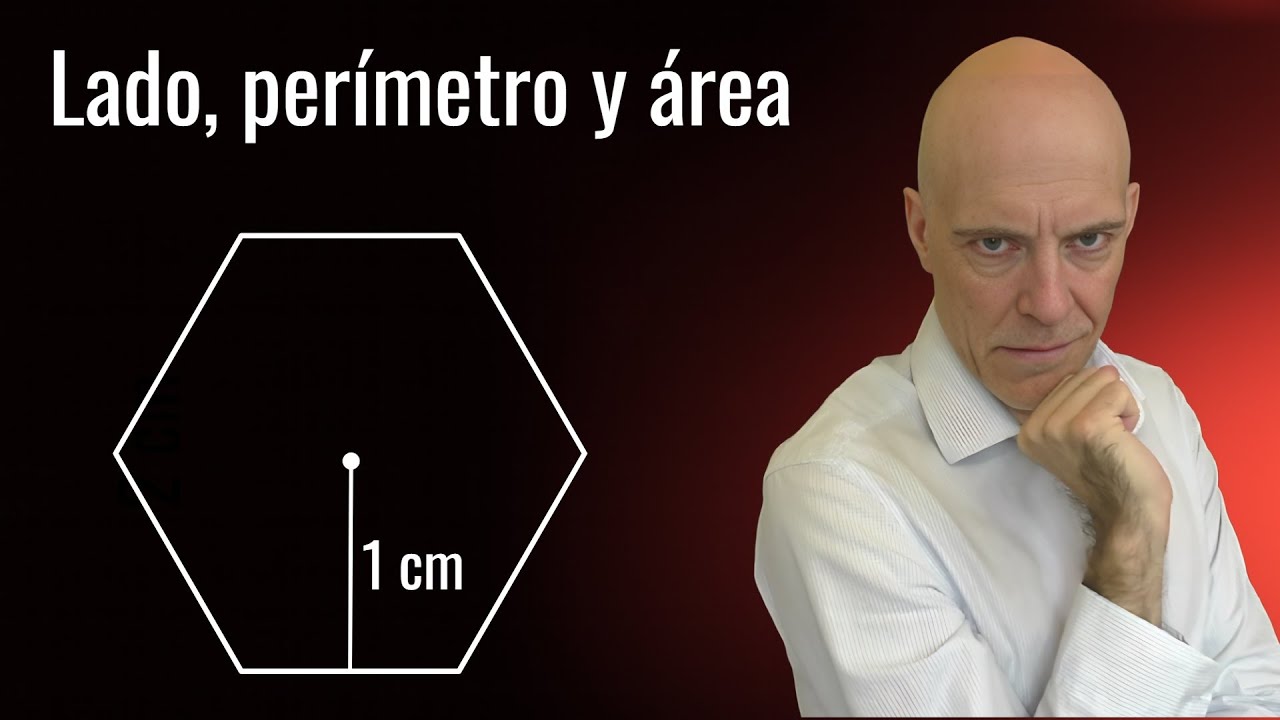
Ponte a prueba con este problema de geometría de un hexágono regular🧠
Keywords
Summary
176 words
Critical Evaluation
The video is a well-structured tutorial that effectively demonstrates the solution to a standard geometry problem. The mathematical reasoning is sound: the decomposition of the regular hexagon into six equilateral triangles is correct, and the application of the Pythagorean theorem is appropriate. The instructor carefully explains each algebraic step, including rationalizing the denominator, which is helpful for learners. The presentation is clear and engaging, with a conversational tone that makes the content accessible. However, the video does not provide any formal citations or references to external sources, which limits its scholarly depth. The problem itself is elementary, so the video is best suited for students learning basic geometry. The adéquation between title and content is excellent, as the title accurately describes the problem. The video also includes a brief sponsored segment, which is not penalized in the evaluation. Overall, the video is a reliable educational resource for its intended audience, but it does not offer novel insights or advanced material. The lack of references and the simplicity of the problem prevent it from achieving a higher score in terms of scientific rigor, but it excels in clarity and pedagogical effectiveness.
190 words
Title / Content Match
The title accurately reflects the content: a geometry problem involving a regular hexagon, presented as a challenge.
Quality & Reliability
8/10
The video provides a clear, step-by-step solution to a classic geometry problem, correctly applying the Pythagorean theorem and area formulas. The reasoning is sound and the mathematical steps are accurate. The presentation is pedagogical, though it lacks formal citations or references to external sources.
Key Moments
Markers derived by PSI from the transcript: the creator did not define chapters.
- Introduction and statement of the problem: given the apothem of a regular hexagon, find side, perimeter, and area.
- Explanation that a regular hexagon is composed of six equilateral triangles.
- Focus on one equilateral triangle and its division into two right triangles by the apothem.
- Application of the Pythagorean theorem to set up the equation L² = 1² + (L/2)².
- Algebraic manipulation to solve for L, including multiplying by 4 and simplifying.
- Derivation of L = 2√3/3 cm and rationalization of the denominator.
- Calculation of the perimeter as 6L = 4√3 cm.
- Calculation of the area of one equilateral triangle and then the total area of the hexagon as 2√3 cm².
- Conclusion and presentation of a similar challenge: area of a square inscribed in a circle with radius 1 cm.
Cited Sources
- Playlist: Cálculo de áreas planas — Referenced in the video description as a resource for more exercises on calculating areas of plane figures.
Concurring Sources
- Regular hexagon - Wikipedia — Confirms the decomposition of a regular hexagon into six equilateral triangles and provides standard formulas for area and perimeter.
Contribution & Novelties
The video provides a clear, step-by-step solution to a classic geometry problem, reinforcing fundamental concepts such as the Pythagorean theorem and area calculations. Its pedagogical approach is effective for learners, but it does not introduce new mathematical ideas or methods. The main value lies in its clarity and accessibility.
Pour aller plus loin :
- Regular hexagon — Provides comprehensive information on hexagons, including formulas for area and perimeter.
- Pythagorean theorem — Essential for understanding the geometric reasoning used in the video.
- Apothem — Defines the apothem and its role in polygon geometry.
92 words
Radar Profile
The radar profile shows strong scores in quality of information and reliability, with slightly lower scores in quantity and technical level, reflecting the focused scope and elementary nature of the content.