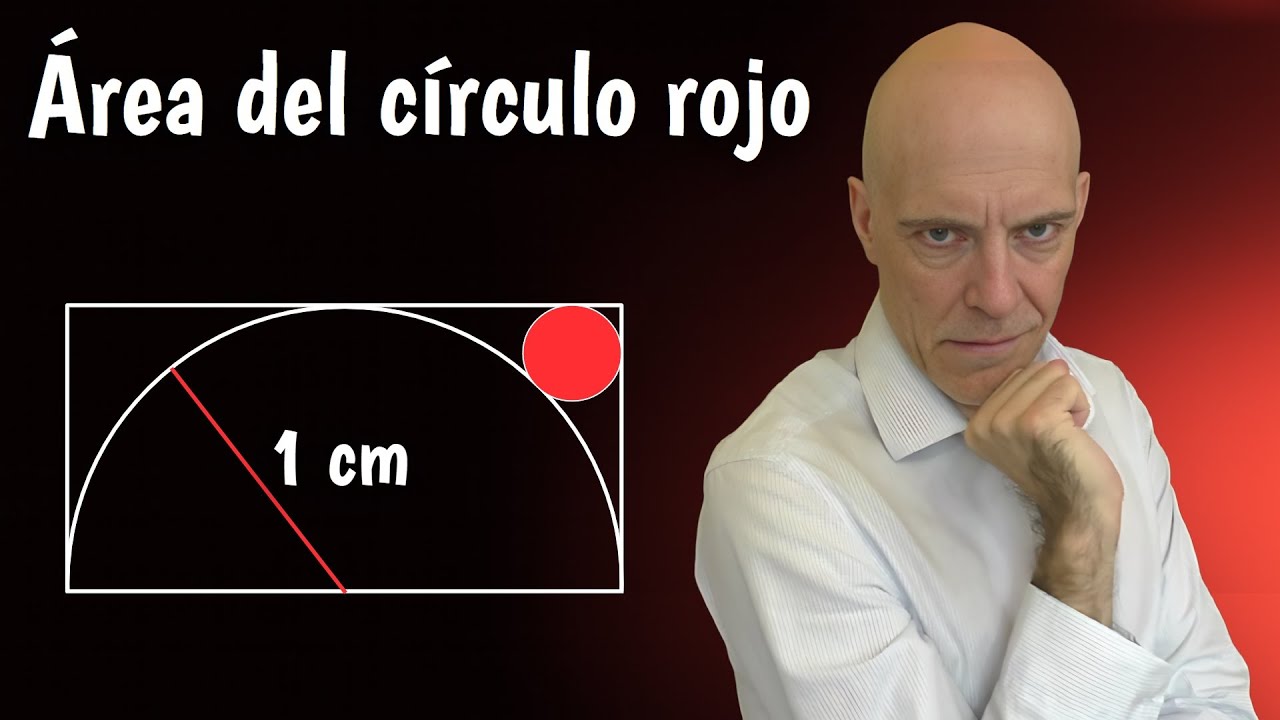
Los estudiantes no saben calcular el área del círculo rojo
Keywords
Summary
183 words
Critical Evaluation
The video provides a clear and rigorous solution to a classic geometry problem. The presenter, Juan, demonstrates a solid understanding of the underlying mathematical concepts, including the Pythagorean theorem and algebraic manipulation. The step-by-step approach is pedagogically sound, breaking down the problem into manageable parts and explaining each step thoroughly. The key insight—recognizing the square formed by the radius of the small circle and its diagonal—is highlighted as a common stumbling block, which adds educational value. The solution is correct, and the final answer is neatly simplified. However, the video lacks formal citations or references to external sources, which is typical for educational content but might be a limitation for those seeking further verification. The presentation style is engaging, with the presenter’s enthusiasm evident, but it occasionally digresses into motivational commentary, which could be distracting for some viewers. The title accurately reflects the content, and the video successfully addresses the common misconception. Overall, the video is a valuable resource for students learning geometry, offering a clear and correct solution to a challenging problem. The comments from viewers are overwhelmingly positive, with many expressing appreciation for the clear explanation and some offering alternative solution methods. The video does not contain any controversial or misleading information, and the mathematical reasoning is sound. The only minor critique is the lack of formal references, but this does not detract from the overall quality of the content.
232 words
Title / Content Match
The title accurately reflects the content: a geometric challenge to find the area of a red circle, which is indeed a common stumbling block for students.
Quality & Reliability
8/10
The video presents a clear, step-by-step geometric solution using the Pythagorean theorem and algebraic manipulation. The reasoning is rigorous and the final answer is correct. The explanation is thorough, though it lacks formal citations and relies on the presenter's expertise.
Key Moments
Markers derived by PSI from the transcript: the creator did not define chapters.
- Introduction of the problem: find the area of the red circle inscribed in a rectangle with a semicircle.
- Identification of a right triangle with legs 1 cm and hypotenuse D.
- Decomposition of D into the radius of the semicircle, the radius of the small circle, and the diagonal of a square.
- Application of the Pythagorean theorem to find D = √2.
- Setting up the equation √2 = 1 + r + √2 r and solving for r.
- Rationalizing the denominator to simplify r to 3 - 2√2.
- Calculating the area as π(3 - 2√2)² and simplifying to (17 - 12√2)π.
- Highlighting the common mistake of overlooking the square and its diagonal.
- Conclusion and challenge problem for viewers.
Cited Sources
- Matemáticas con Juan - YouTube Channel — The channel's membership link provided in the video description, supporting the creator.
Concurring Sources
- Pythagorean theorem — The theorem is used to relate the sides of the right triangle in the problem.
- Area of a circle — The formula A = πr² is used to compute the area of the red circle.
Contribution & Novelties
The video offers a clear, step-by-step solution to a classic geometry problem, emphasizing a common pitfall. It provides a rigorous derivation using the Pythagorean theorem and algebraic simplification. The approach is original in its pedagogical focus on the hidden square, which is often overlooked.
Pour aller plus loin :
- Pythagorean theorem — Fundamental theorem used in the solution.
- Circle area — Formula applied to find the area.
- Rationalization (mathematics) — Technique used to simplify the expression for r.
78 words
Radar Profile
The radar profile shows high scores in quality and reliability, with moderate scores in quantity and technical level. This indicates a well-explained, accurate tutorial that may not cover a broad range of topics but is focused and rigorous.
💬 Très positif. Sur les 30 commentaires analysés, les spectateurs expriment une grande appréciation pour la clarté de l'explication et la pédagogie de Juan, certains partageant des méthodes alternatives et des remerciements.