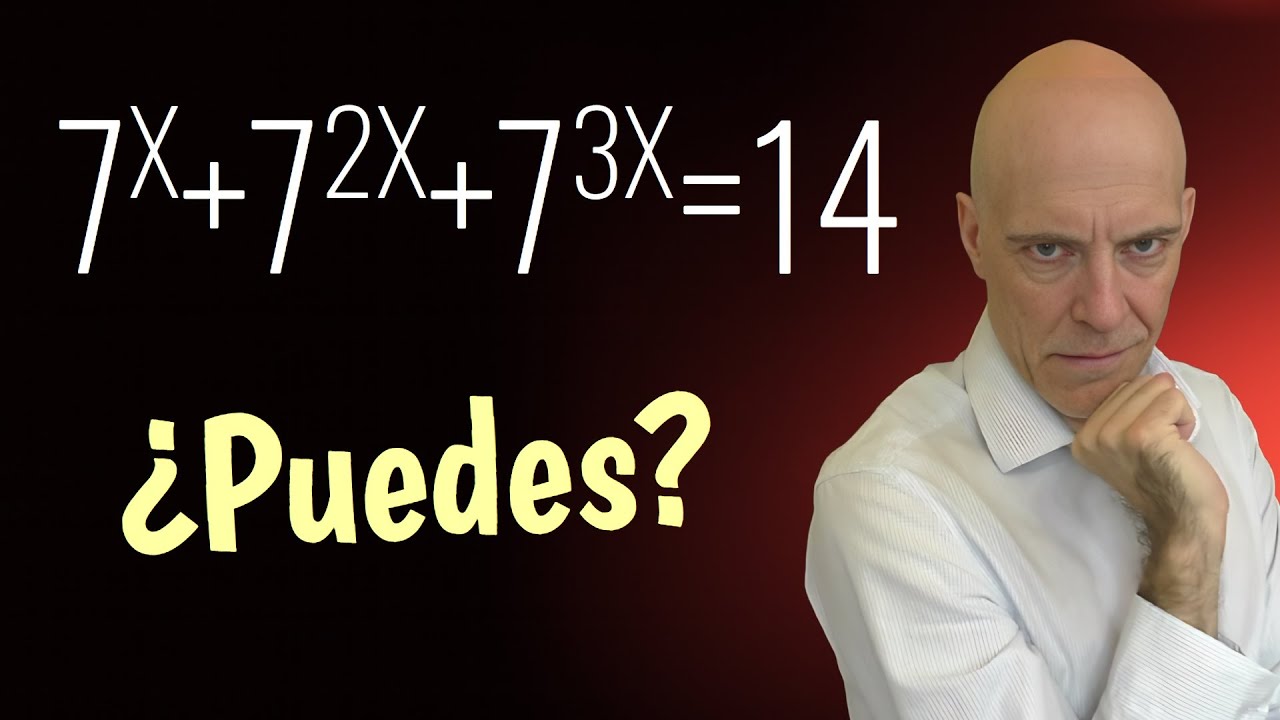
Tremenda ecuación que pocos resuelven💡
Keywords
Summary
158 words
Critical Evaluation
The video provides a clear and rigorous solution to a challenging exponential equation. The instructor’s approach is methodical, breaking down the problem into manageable steps and explaining each algebraic manipulation. The use of a change of variable is standard and effective, transforming the exponential equation into a cubic polynomial. The factorization step is particularly elegant, leveraging the decomposition of 14 to apply difference of cubes and squares identities. This demonstrates a deep understanding of algebraic structures and provides a valuable teaching moment. The instructor correctly identifies that the quadratic factor yields complex solutions and explains why they are not valid in the context of real-valued exponential functions. The verification step is thorough, reinforcing the properties of logarithms and exponentials. The video is well-suited for an audience with a solid foundation in algebra and logarithms, as it assumes familiarity with these concepts. The presentation style is engaging, with the instructor’s enthusiasm for mathematics evident throughout. However, the video lacks external references or citations, relying solely on the instructor’s expertise. The only link provided is to a playlist of similar problems, which is useful for further practice but does not offer additional sources for verification. Overall, the mathematical content is accurate and well-explained, making it a valuable resource for students seeking to master exponential equations. The title accurately reflects the content, and the video delivers on its promise of solving a challenging equation. The absence of a formal structure or citations is a minor drawback, but the pedagogical quality is high.
249 words
Title / Content Match
The title accurately reflects the content: a challenging exponential equation that is solved in detail.
Quality & Reliability
8/10
The video presents a rigorous step-by-step solution of an exponential equation, using standard algebraic techniques and properties of logarithms. The reasoning is clear and correct, with no apparent mathematical errors. The source is a single YouTube video from an established educational channel, but no external references are provided beyond a playlist link.
Key Moments
Markers derived by PSI from the transcript: the creator did not define chapters.
- Introduction and presentation of the equation 7^x + 7^(2x) + 7^(3x) = 14.
- Change of variable t = 7^x, transforming the equation into a cubic polynomial.
- Decomposition of 14 as 8+4+2 and factorization using difference of cubes and squares.
- Factoring the cubic into (t-2)(t^2+3t+7)=0 and solving for t.
- Discarding complex solutions and solving 7^x = 2 using logarithms.
- Verification of the solution by substitution and use of logarithmic identities.
- Presentation of a similar exercise for the viewer to solve.
Cited Sources
- Playlist: Ecuaciones exponenciales — Referenced in the video description as a playlist of similar exponential equation problems.
Concurring Sources
- Playlist: Ecuaciones exponenciales — The playlist contains similar problems and solutions, consistent with the methods shown in the video.
Contribution & Novelties
The video offers a clear and elegant solution to a non-trivial exponential equation, demonstrating the power of change of variables and algebraic factorization. It highlights the importance of recognizing patterns and using properties of logarithms. The verification step reinforces the fundamental identity a^(log_a(b)) = b.
Pour aller plus loin :
- Logarithm — Provides the definition and properties of logarithms used in the solution.
- Exponential function — Background on exponential functions and their properties.
- Cubic equation — General methods for solving cubic equations, including factorization techniques.
85 words
Radar Profile
The radar profile shows high scores in quality of information and reliability, with moderate scores in quantity and technical level. This indicates a focused, well-explained tutorial that is mathematically sound but limited in scope and depth.