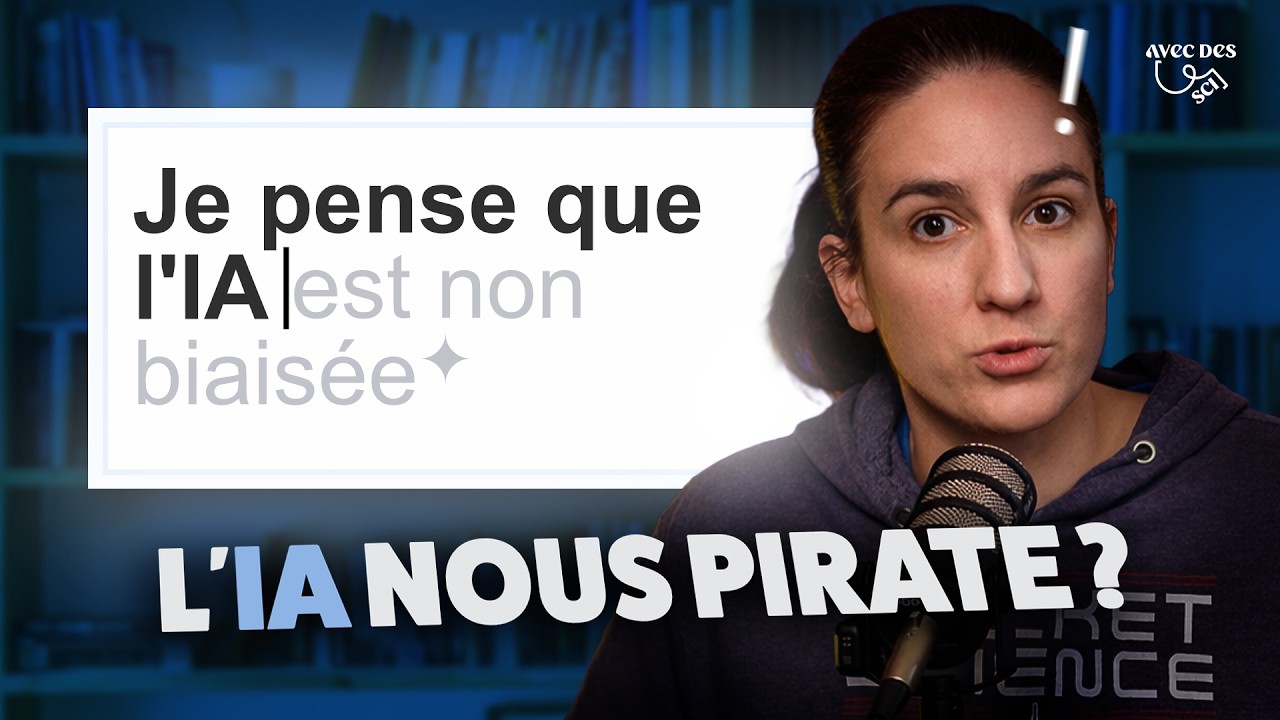
Une étude montre comment l'IA nous fait changer d'opinion
Keywords
Summary
142 words
Critical Evaluation
The video provides a thorough and critical analysis of a recent scientific study on AI’s influence on opinion formation. The hosts, Viviane Lalande and Thomas Milan, demonstrate a strong understanding of the research methodology and its implications. They clearly explain the experimental design, including the use of control groups, biased AI suggestions, and the measurement of opinion shifts. The discussion of psychological mechanisms, such as cognitive dissonance and self-perception, adds depth to the explanation. Importantly, they highlight the study’s limitations, such as the short-term nature of the effect and the artificial setting of the experiment, which prevents overgeneralization. The inclusion of the warning and debriefing conditions, which failed to mitigate the influence, is a crucial point that underscores the potential risks of AI-assisted writing. The hosts also contextualize the findings within broader societal concerns about AI bias and manipulation. The other segments, on rocket pollution and the microscopic robot, are presented with similar rigor, citing specific scientific papers and providing clear explanations. The production quality is high, with good pacing and visual aids. The only minor critique is that the title focuses on the AI study, but the video covers multiple topics, which might mislead some viewers. Overall, this is an excellent science communication piece that balances depth and accessibility.
210 words
Title / Content Match
The title accurately reflects the main topic, which is the study on AI's influence on opinion change, though the video also covers other science news.
Quality & Reliability
8/10
The video presents a rigorous scientific study on AI influence on opinions, citing primary sources (Science Advances, Nature) and other reputable outlets. The hosts provide balanced analysis, acknowledge limitations, and maintain a critical perspective. The production is well-researched and transparent about funding.
Key Moments
Markers derived by PSI from the transcript: the creator did not define chapters.
Cited Sources
- AI Autocomplete Doesn’t Just Change How You Write—It Changes How You Think — Article about the study on AI influence on opinion
- Science Advances paper on AI influence — Original study on AI writing assistance and opinion change
- Nature paper on rocket pollution — Study on lithium plume from rocket re-entry
- Quanta Magazine article on Turing Award — News about Turing Award for quantum cryptography
- ScienceAlert article on microscopic robot — News about the world's smallest programmable robot
- Science Robotics paper on microscopic robot — Original research on the microscopic autonomous robot
- ScienceDaily release on microscopic robot — Press release about the microscopic robot
- Radio-Canada article on chin evolution — News about the evolution of the chin
- PMC article on chin evolution — Scientific paper on the evolution of the chin
Concurring Sources
- Scientific American article — Summarizes the same study, consistent with the video's presentation.
- Science Advances paper — Original research, the video accurately represents its findings.
Dissenting Sources
- No discordant sources found — The video's claims align with the cited sources and no contradictory evidence was presented.
External References
Contribution & Novelties
This episode provides a comprehensive and critical overview of recent scientific findings, with a strong focus on the implications of AI on human cognition. The main study on AI influence is presented with clarity, highlighting the subtle yet significant effects of AI-assisted writing on opinion shifts. The hosts also bring attention to the first direct evidence of rocket pollution, a topic of growing importance with the increase in space launches. The inclusion of a microscopic autonomous robot showcases cutting-edge robotics. The episode stands out for its balanced approach, acknowledging limitations and encouraging critical thinking.
Pour aller plus loin :
- Cognitive dissonance — Relevant to the psychological mechanisms discussed.
- Self-perception theory — Another proposed mechanism for the opinion shift.
- Large language model — Context for AI writing assistants.
- Lidar — Technology used to detect the lithium plume.
- SpaceX Falcon 9 — The rocket involved in the pollution study.
147 words
Radar Profile
The radar profile shows high scores in information quality and reliability, with slightly lower scores in technical level and quantity, indicating a well-balanced presentation that is accessible yet scientifically sound.
💬 Très positif. Sur les 30 commentaires analysés, la grande majorité exprime un fort enthousiasme pour l'émission, avec des éloges récurrents pour l'humour de Thomas et la qualité des explications. Plusieurs commentaires soulignent l'impact de l'étude sur l'IA et expriment une inquiétude mesurée, mais globalement le climat est chaleureux et reconnaissant.