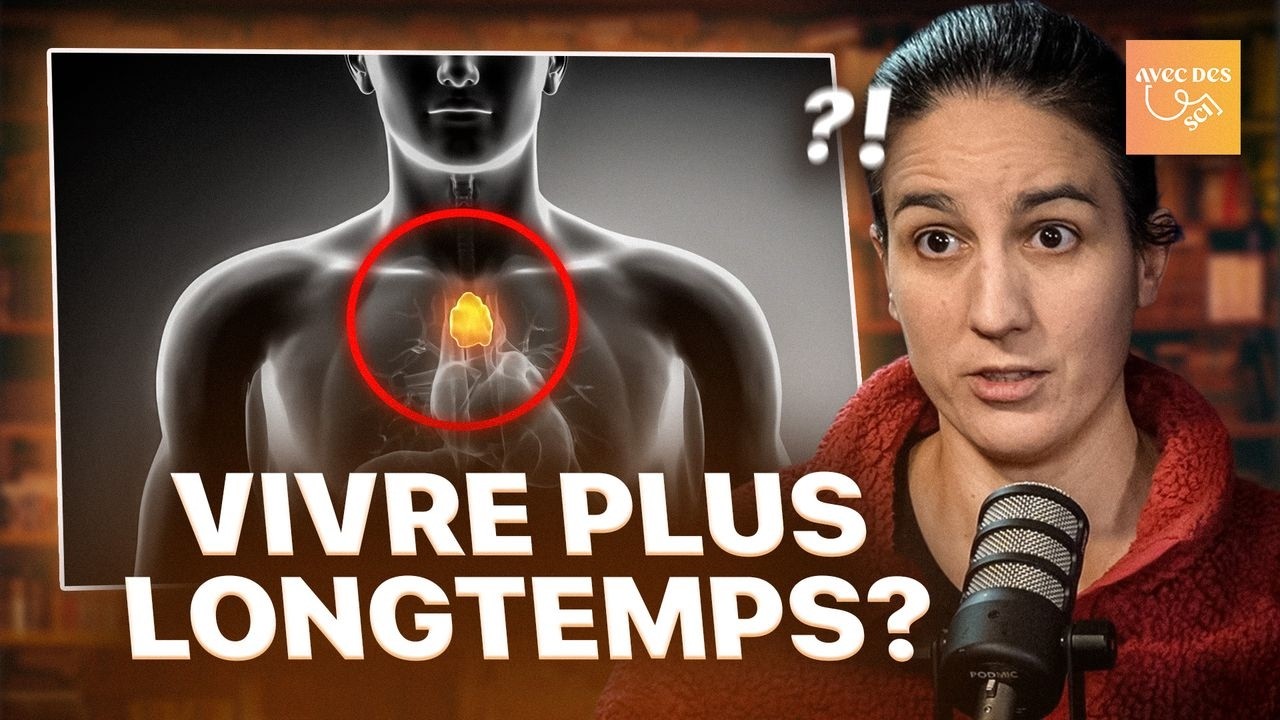
Un organe oublié pourrait nous aider à vivre en meilleure santé
Keywords
Summary
151 words
Critical Evaluation
Value of the Information & Strength of the Argument
The value of the information is high, as it covers recent, peer-reviewed studies with significant implications. The hosts provide clear explanations of the scientific context and methods, and they critically evaluate the evidence, noting limitations such as animal models and the need for further research. The argumentation is solid, as they distinguish between established facts and hypotheses, and they avoid sensationalism by explicitly stating when results are preliminary. The discussion of the thymus study, for example, includes a balanced view of its potential and the long road to clinical application.
Scientific Rigor, Source Quality, Title Accuracy
The scientific rigor is commendable: each news item is based on a specific study published in a reputable journal, and the hosts provide direct links in the description. They also mention the limitations of each study, such as the use of animal models or the need for further investigation. The title of the video is somewhat misleading as it focuses on the first story, but the content covers multiple topics. The adequacy between title and content is partial, but this does not significantly affect the overall quality.
192 words
Title / Content Match
The title focuses on the first news item about the thymus and aging, which is a central topic, but the video also covers other stories, making the title slightly narrower than the content.
Quality & Reliability
8/10
The video presents three scientific news items, each based on peer-reviewed studies published in reputable journals (Nature, Nature Communications, Science Advances). The hosts provide critical context, clearly distinguish between preliminary findings and established knowledge, and explicitly caution against overinterpretation. The information is accurate and well-sourced, though the format is a popular science review rather than a deep technical analysis.
Chapters
Cited Sources
- Thymus and thymulin in aging and cancer — Study on thymus and thymulin's role in inflammation and cancer
- Scientific American article on the thymus — Popular science article summarizing the thymus study
- Naked mole rat queen pheromone study — Study on isopropyl myristate as a queen pheromone in naked mole rats
- New Scientist article on naked mole rat queen smell — News article about the naked mole rat study
- Meteorite Hillsborough study — Study on the meteorite that hit a house in New Jersey
- La Presse article on the meteorite — French-language news article about the meteorite
- La Presse article on whale graveyard — Article about the whale graveyard discovery (used in the mystery game)
- La Presse article on Terra Nova wreck — Article about the Terra Nova shipwreck (used in the mystery game)
Concurring Sources
- Scientific American article on the thymus — Corroborates the thymus study findings
- New Scientist article on naked mole rat queen smell — Corroborates the naked mole rat study
- La Presse article on the meteorite — Corroborates the meteorite story
External References
Contribution & Novelties
The video provides a concise and accessible overview of three recent scientific discoveries, highlighting their potential implications. It adds value by critically discussing the limitations of each study and by presenting the information in an engaging format. The mystery game encourages viewer engagement and scientific thinking.
Pour aller plus loin :
- Inflammaging — Concept of age-related chronic inflammation, central to the first story.
- Thymulin — The peptide hormone discussed in the thymus study.
- Naked mole rat — Species featured in the second story, known for its eusocial structure.
- Carbonaceous chondrite — Meteorite class mentioned in the third story.
98 words
Radar Profile
The radar profile shows high scores in information quantity and quality, with a moderate technical level and high reliability. This indicates a well-balanced science communication video that is both informative and trustworthy, suitable for a general audience interested in recent scientific developments.
💬 Sur les 0 commentaires analysés, aucune tendance n'est disponible.