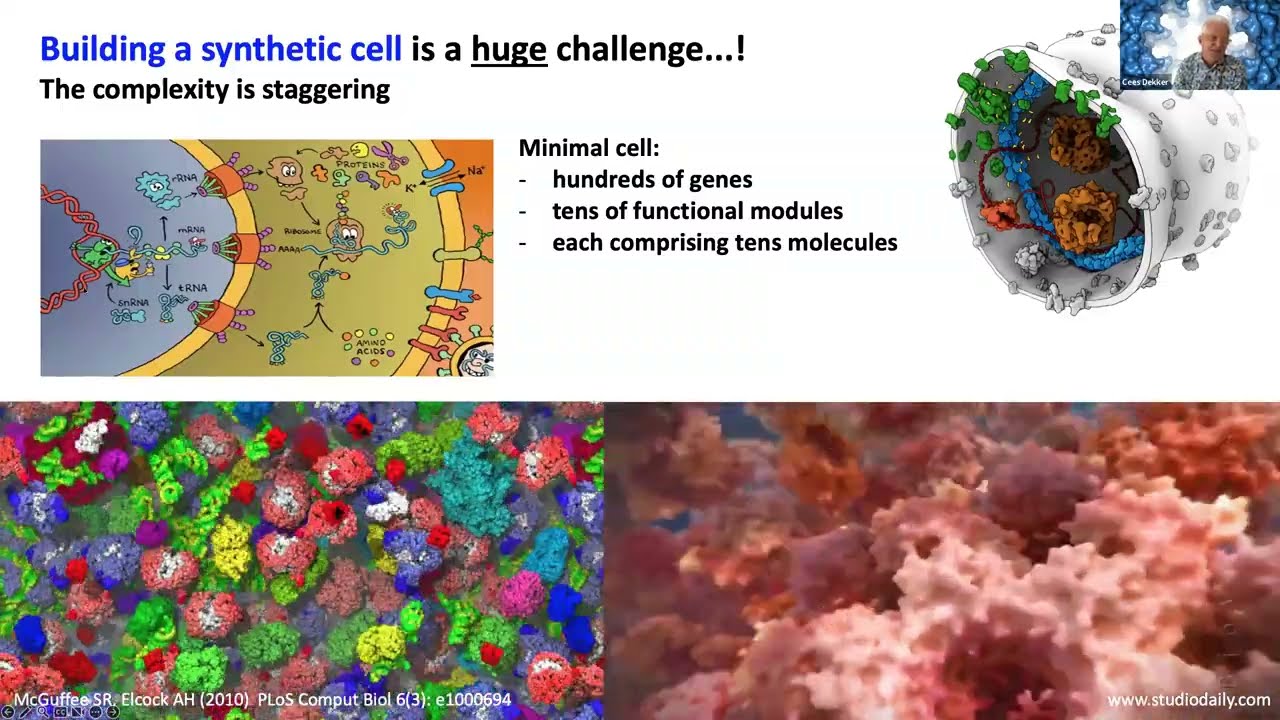
Build-a-Cell seminar Cees Dekker: EVOLF bottom up approach to building synthetic cell & our research
Keywords
Summary
122 words
Critical Evaluation
Value of the Information & Strength of the Argument
The seminar provides valuable insights into the current state of bottom-up synthetic cell research, particularly the EVOLF project’s strategy and Dekker’s lab’s specific contributions. The argumentation is solid, grounded in experimental results and published work. Dekker clearly explains the rationale behind the bottom-up approach and the challenges involved, such as the complexity of integrating modules. He presents concrete examples, like the machine learning optimization of gene expression and the microfluidic techniques for vesicle manipulation, which strengthen the credibility of the claims. The talk is well-structured and accessible to a scientifically literate audience.
Scientific Rigor, Source Quality, Title Accuracy
The seminar demonstrates scientific rigor through its reference to specific research projects, publications, and consortium efforts. Dekker mentions the EVOLF consortium, the Build-a-Cell community, and various techniques (e.g., OLA, clean DNA) that are part of ongoing research. The sources cited are primarily his own and collaborators’ work, which is appropriate for a research seminar. The title accurately reflects the content, covering both the EVOLF project and his lab’s research. No comments were provided for analysis.
182 words
Title / Content Match
The title accurately reflects the content: the seminar covers the EVOLF bottom-up approach and presents recent research from Dekker's lab.
Quality & Reliability
8/10
The seminar is presented by a leading researcher (Cees Dekker) with extensive experience in biophysics and synthetic biology. The content is well-structured, based on published research and ongoing projects, and includes references to specific techniques and consortium efforts. However, as a seminar, it is not peer-reviewed and some claims are presented without detailed experimental evidence.
Key Moments
Markers derived by PSI from the transcript: the creator did not define chapters.
- Introduction and speaker background
- Motivation for synthetic cell research and definition of terms
- Overview of EVOLF project and modular approach
- Use of AI and directed evolution in EVOLF
- Synthetic genome design: clean DNA and promoters
- Microfluidics for liposome production and manipulation
- Mechanical division of liposomes and future directions
Cited Sources
- Build-a-Cell contact page — Mentioned for community engagement and questions
- Build-a-Cell seminar page — Mentioned as the seminar series context
Concurring Sources
- Build-a-Cell — The seminar is part of the Build-a-Cell community, which promotes synthetic cell research.
Contribution & Novelties
The seminar provides an overview of the EVOLF project and recent advances in bottom-up synthetic cell research, particularly in the areas of synthetic genome design, microfluidic manipulation of liposomes, and cell division. The emphasis on using AI and directed evolution to optimize synthetic cell components is a notable contribution. The talk also highlights the importance of interdisciplinary collaboration and societal considerations.
Pour aller plus loin :
- Synthetic cell — Overview of synthetic cell research.
- Liposome — Background on liposome technology.
- Microfluidics — Principles and applications.
- Directed evolution — Method used in EVOLF.
- Minimal genome — Related to top-down approaches.
99 words
Radar Profile
The radar profile shows high scores in information quantity, quality, and reliability, with a slightly lower technical level, indicating a comprehensive and credible seminar that is accessible to a broad scientific audience.