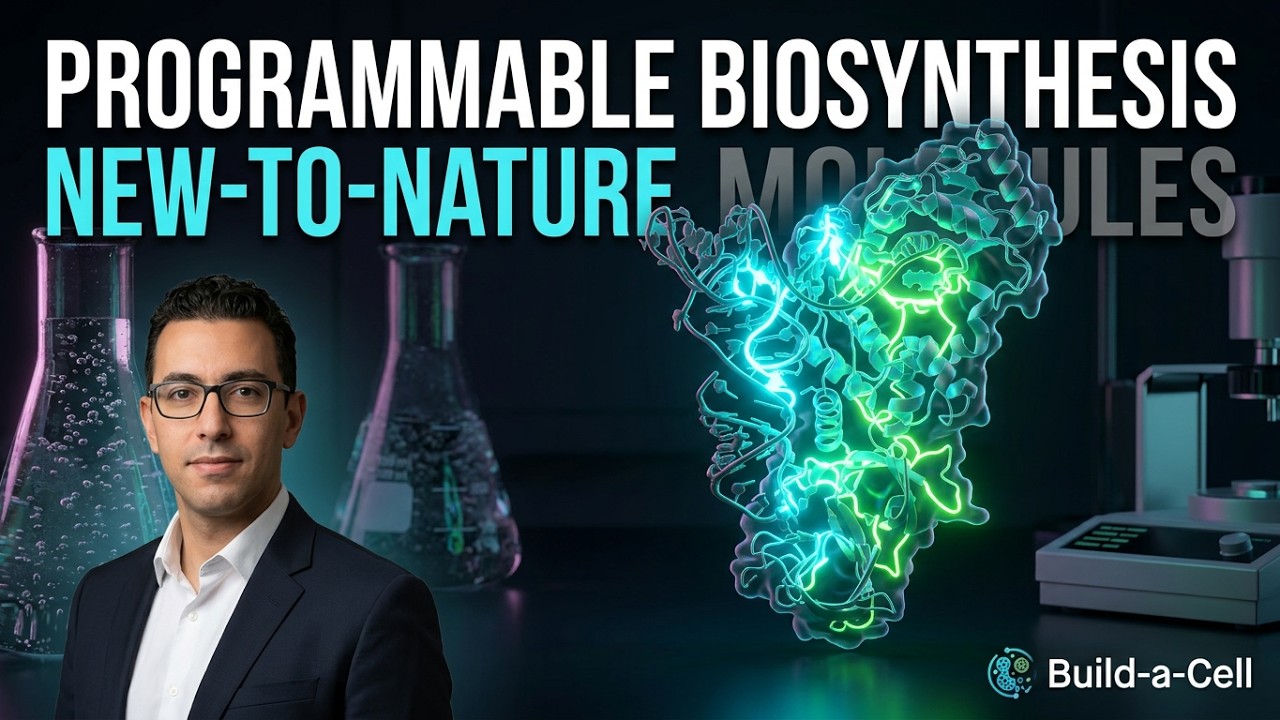
Build-a-Cell seminar Ahmed Badran: Programmable Biosynthesis of New-to-Nature Molecules
Keywords
Summary
143 words
Critical Evaluation
Value of the Information & Strength of the Argument
The seminar provides valuable insights into the engineering of quadruplet codon decoding, a relatively underexplored area in synthetic biology. Badran presents a clear rationale for using quadruplet codons over other strategies, backed by experimental data. The argumentation is solid, with logical progression from problem identification to solution via directed evolution. He acknowledges limitations and discusses potential improvements, demonstrating scientific rigor. The use of PACE to evolve tRNAs is a significant methodological contribution, and the results showing high efficiency and processivity are compelling. However, the presentation is a seminar, so some details are summarized, and the audience is assumed to have a background in molecular biology.
Scientific Rigor, Source Quality, Title Accuracy
The seminar is scientifically rigorous, with references to historical studies and contemporary techniques. Badran cites specific studies on quadruplet decoding from the 1970s-80s and mentions PACE as a technology he co-developed. The title accurately reflects the content, focusing on programmable biosynthesis. The presentation is well-structured, and the methods are described in sufficient detail for an expert audience. However, no external sources are explicitly cited in the video, and the description only provides links to Build-a-Cell resources. The lack of formal citations is typical for a seminar, but it limits the ability to verify claims independently.
215 words
Title / Content Match
The title accurately reflects the content, which focuses on programmable biosynthesis of new-to-nature molecules using genetic code expansion and quadruplet codons.
Quality & Reliability
8/10
The seminar presents original research from a recognized expert, with detailed methodology and references to published work. The content is technical and appears scientifically sound, though it is a single presentation without external verification.
Key Moments
Markers derived by PSI from the transcript: the creator did not define chapters.
- Introduction to the seminar and overview of the lab's research interests.
- Discussion of natural product macrocycles and the challenges of re-engineering NRPSs.
- Introduction to genetic code expansion and the use of orthogonal tRNA synthetase pairs.
- Explanation of the codon problem and strategies like stop codon suppression, genome rewriting, and synthetic nucleobases.
- Historical background on quadruplet decoding and its inefficiency.
- Description of the lab's approach to engineer quadruplet decoding tRNAs using PACE.
- Results showing evolved tRNAs with high efficiency and orthogonality.
- Demonstration of processivity and multiplexing of quadruplet codons.
- Exploration of mRNA context effects on quadruplet decoding efficiency.
- Summary and implications for programmable biosynthesis of new-to-nature molecules.
Cited Sources
- Build-a-Cell Contact — Provided in the video description for contacting the Build-a-Cell community.
- Build-a-Cell Seminar — Provided in the video description as the seminar series page.
Concurring Sources
- Build-a-Cell Seminar — The seminar is part of the Build-a-Cell series, which aligns with the topic of synthetic cell engineering.
Contribution & Novelties
The seminar presents original research on using quadruplet codons for genetic code expansion, with a focus on engineering tRNAs via PACE to achieve high efficiency and processivity. The work addresses a long-standing bottleneck in the field and offers a new approach to synthesizing new-to-nature molecules.
Pour aller plus loin :
- Phage-assisted continuous evolution (PACE) — Background on the directed evolution technology used.
- Genetic code expansion — Overview of the field and its applications.
- Non-canonical amino acids — Information on the building blocks incorporated.
83 words
Radar Profile
The radar profile shows high scores in technical level and information quality, indicating a specialized and detailed presentation. The lower scores in quantity and reliability suggest that while the content is rich, it may not cover all aspects comprehensively and relies on the presenter's expertise without external verification.
💬 No comments were provided for analysis.