Build-a-Cell seminar Doron Lancet: A lipid-centric spontaneous build-a-protocell in primordial soup
Keywords
Summary
167 words
Critical Evaluation
Value of the Information & Strength of the Argument
The value of the information lies in its integrative perspective, combining systems chemistry, computational modeling, and origin-of-life research. Lancet provides a coherent argument for a lipid-centric origin, supported by references to experimental work (e.g., Fletcher’s flow cell experiments) and his own computational simulations. The argumentation is logically structured, though it relies heavily on theoretical reasoning and extrapolation from limited experimental data. He critically evaluates existing approaches, such as the overemphasis on RNA and the use of single-lipid systems, and offers a novel alternative. However, the lack of direct experimental validation for his model weakens the empirical grounding.
Scientific Rigor, Source Quality, Title Accuracy
The seminar demonstrates scientific rigor through its use of computational chemistry and references to published work. Lancet cites specific researchers and papers, such as those by Cornish-Bowden, Cárdenas, and Fletcher, and discusses their relevance. The title accurately reflects the content, focusing on a lipid-centric spontaneous protocell formation. The presentation is well-structured and technically detailed, though it assumes a certain level of background knowledge. The speaker’s expertise is evident, and the content aligns with current debates in origin-of-life research. The recording is unedited, which may affect production quality but not scientific content.
203 words
Title / Content Match
The title accurately reflects the content, focusing on a lipid-centric spontaneous protocell formation in primordial soup, as presented by Doron Lancet.
Quality & Reliability
8/10
The seminar presents a theoretical model grounded in computational chemistry and systems chemistry, with references to experimental work by others. The speaker is a senior scientist with a long career, and the content is consistent with published literature on protocells and origin of life. However, the presentation is largely conceptual and lacks direct experimental validation of the proposed model.
Key Moments
Markers derived by PSI from the transcript: the creator did not define chapters.
- Introduction: Lancet's scientific background and the scope of the talk.
- Discussion of the chemical diversity of primordial soup and the irrelevance of specific prebiotic syntheses.
- Comparison with Kate Adamala's bottom-up approach and the importance of lipid-centric protocells.
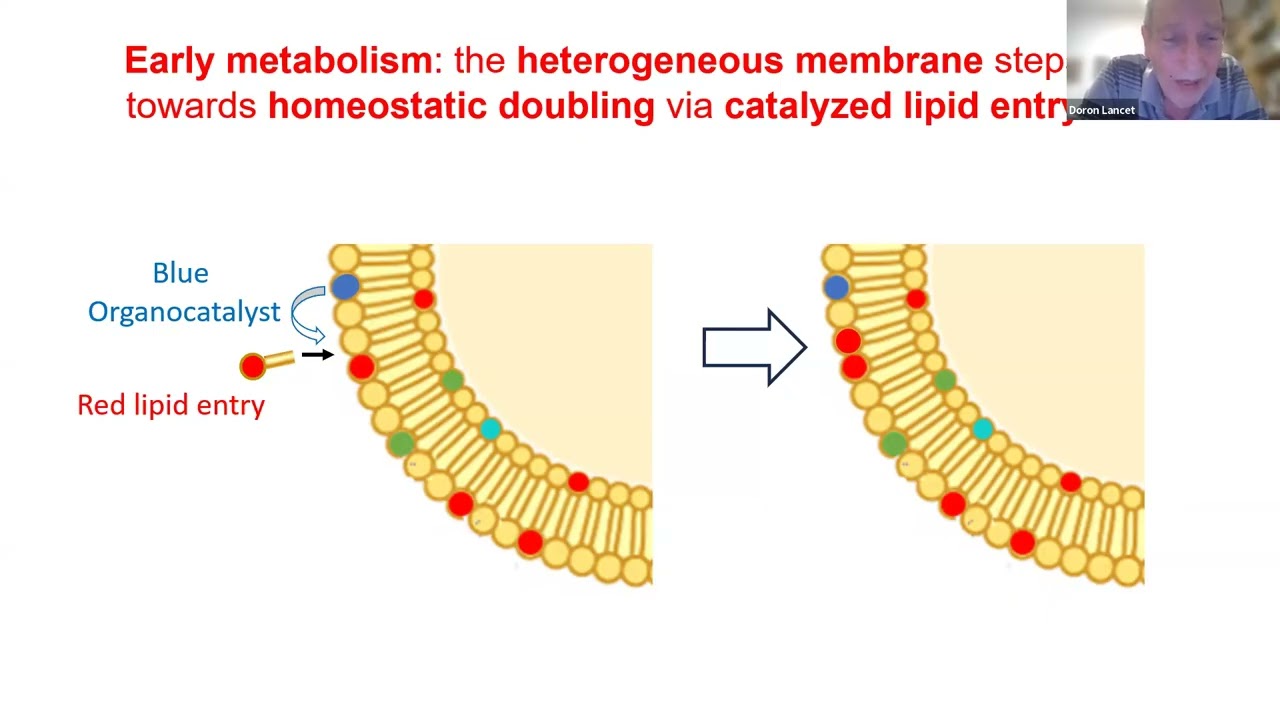
- Introduction of the concept of compositional information and the need for homeostatic growth.
- Discussion of the challenges of two-phase synchronization and the role of mutual stabilization.
- Presentation of the computational model: the graded autocatalysis replication domain and the matrix of catalytic strengths.
- Results of simulations showing self-reproducing composomes and the emergence of homochirality.
- Discussion of the abundance of composomes on early Earth and the transition from micelles to vesicles.
- Speculative timeline from micelles to LUCA, with RNA appearing later.
- Conclusion: the centrality of metabolism and the definition of life as self-reproduction with Darwinian evolution.
Cited Sources
- Build-a-Cell contact page — Mentioned for community engagement and questions.
- Build-a-Cell seminar page — Reference for the seminar series.
Concurring Sources
- Build-a-Cell seminar page — The seminar is part of the Build-a-Cell series, which aligns with the topic of synthetic cells and origin of life.
Dissenting Sources
- RNA World hypothesis — The RNA world hypothesis posits that RNA was the first self-replicating molecule, contrasting with Lancet's lipid-centric view.
Contribution & Novelties
The seminar offers a novel theoretical framework for a lipid-centric origin of life, emphasizing compositional information and homeostatic growth. It introduces the concept of ‘composomes’ as self-reproducing compositional assemblies and uses computational models to demonstrate their feasibility. The argument that metabolism is the sole pillar of life, encompassing compartmentalization and information, provides a unifying perspective. The proposal that micelles can serve as simpler precursors to vesicles, and that homochirality can emerge spontaneously, adds new dimensions to the discussion.
Pour aller plus loin :
- Protocell — Overview of protocell research.
- Systems chemistry — Relevant to the network approach.
- Günter Wächtershäuser — Proponent of metabolism-first origin of life.
106 words
Radar Profile
The radar profile shows high scores in information quantity and quality, reflecting the depth of the seminar's content. The technical level is moderately high, indicating a specialized audience. The overall reliability is strong due to the speaker's expertise and references, though the theoretical nature of the model slightly reduces the empirical grounding.