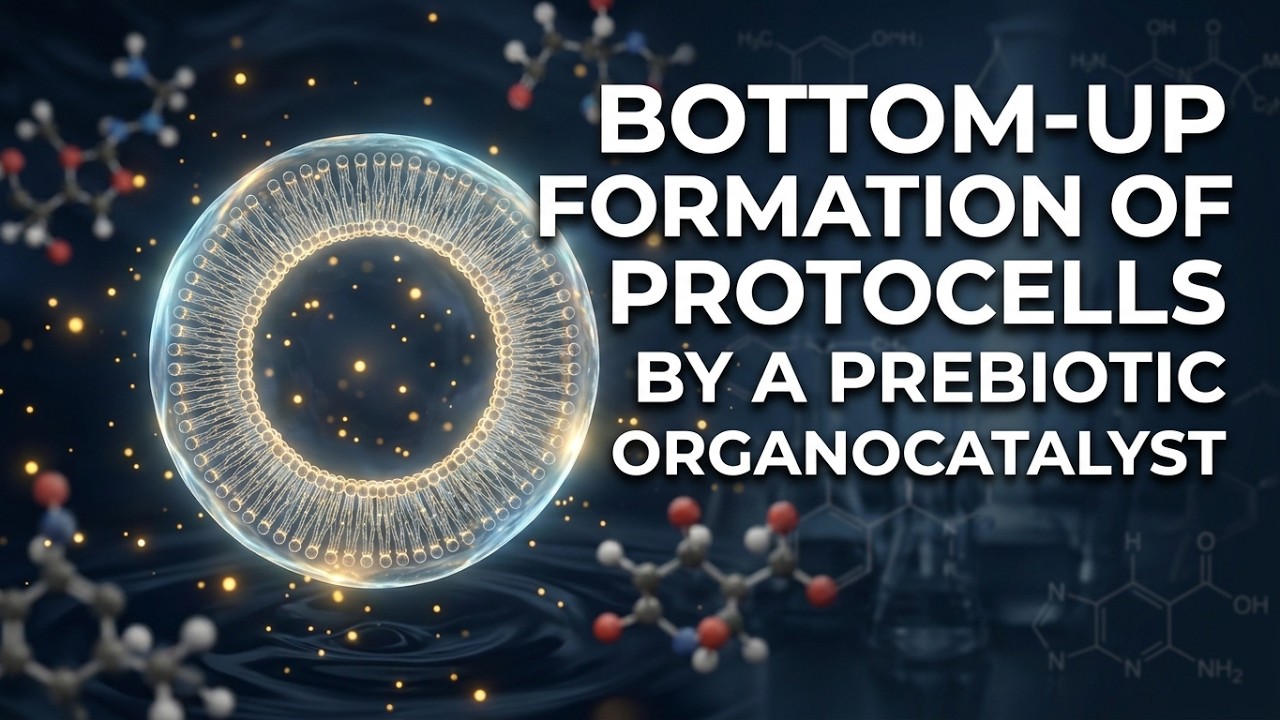
Build-a-Cell seminar Oliver Trapp: Bottom-up Formation of Protocells by a Prebiotic Organocatalyst
Keywords
Summary
132 words
Critical Evaluation
Value of the Information & Strength of the Argument
The seminar provides valuable insights into a plausible prebiotic pathway from simple molecules to complex building blocks. The argumentation is well-structured, starting with a historical overview and then presenting experimental evidence for each step. The speaker effectively connects his findings to broader questions in origins of life research, such as the origin of homochirality and the selective formation of ribose. The presentation of kinetic data and reaction mechanisms strengthens the scientific rigor. However, some claims are presented as conclusive without extensive peer-reviewed support, and the talk is a raw seminar recording, which may lack the polish of a curated presentation.
Scientific Rigor, Source Quality, Title Accuracy
The seminar demonstrates strong scientific rigor, with references to historical experiments (Miller-Urey, Butlerov) and contemporary work (Sutherland, Carell). The speaker clearly explains his own experimental methods and results. The title accurately reflects the content, focusing on the bottom-up formation of protocells via a prebiotic organocatalyst. The video is a raw recording without editing, which is transparent but may include minor technical issues. No comments are provided for analysis.
183 words
Title / Content Match
The title accurately reflects the content, focusing on the bottom-up formation of protocells via a prebiotic organocatalyst.
Quality & Reliability
8/10
The seminar presents original research from a recognized academic group, with detailed experimental procedures and references to established literature. The speaker is a professor at LMU Munich, and the content is consistent with current scientific understanding. However, the video is a raw recording without editing, and some claims are presented without full peer-reviewed context.
Key Moments
Markers derived by PSI from the transcript: the creator did not define chapters.
- Introduction to the timeline of Earth's formation and the role of meteorites.
- Historical overview of origins of life research, from Aristotle to Miller-Urey.
- Presentation of meteorite catalysis experiments and formation of aldehydes.
- Discussion of the formose reaction and the challenge of ribose selectivity.
- Introduction of organocatalytic pathway for nucleotide formation using nucleobases.
- Discovery of imidazolidine-4-thiones as prebiotic organocatalysts.
- Explanation of photochemical activation and potential for homochirality.
- Summary of challenges and the need for compartmentalization in protocell formation.
Cited Sources
- Build-a-Cell contact page — Mentioned for community engagement and questions.
- Build-a-Cell seminar page — Referenced as the source for the seminar series.
Concurring Sources
- Sutherland, J. D. (2016). The origin of life—out of the blue. Angewandte Chemie International Edition, 55(1), 104-121. — Supports the plausibility of prebiotic synthesis pathways.
- Carell, T. et al. (2019). Prebiotic synthesis of purine nucleosides. Nature Chemistry, 11(7), 623-630. — Related to nucleotide formation pathways.
Dissenting Sources
- Benner, S. A. (2017). Detecting Darwinism from molecules in the Enceladus plumes. Astrobiology, 17(9), 840-851. — Raises questions about the availability of necessary compounds and conditions.
Contribution & Novelties
The seminar presents a novel bottom-up approach to protocell formation, integrating meteorite catalysis with organocatalytic pathways. The discovery of imidazolidine-4-thiones as prebiotic organocatalysts is a significant contribution, offering a potential mechanism for asymmetric catalysis and photochemical activation without metals. The work addresses key challenges in prebiotic chemistry, such as selective ribose formation and the origin of homochirality.
Pour aller plus loin :
- Prebiotic chemistry — Overview of the field.
- Formose reaction — Background on sugar formation.
- Organocatalysis — General concept of organocatalysts.
- MacMillan catalyst — Related to the discovered prebiotic catalyst.
- Miller-Urey experiment — Historical context.
96 words
Radar Profile
The radar profile shows high scores across all dimensions, indicating a well-balanced and informative seminar. The strong technical level and reliability are complemented by substantial information quantity and quality, making it a valuable resource for researchers in origins of life and synthetic biology.