Build-a-Cell seminar Michael Booth: Remote-controlled synthetic cells for biology and medicine
Keywords
Summary
153 words
Critical Evaluation
Value of the Information & Strength of the Argument
The talk provides valuable insights into the development of remote-controlled synthetic cells, showcasing novel methods for light and magnetic activation. The argumentation is solid, with clear explanations of the design principles and experimental validations. The presenter demonstrates the orthogonality of light activation and the potential for patterning and biocomputing. The magnetic activation approach is particularly innovative, addressing the need for deep tissue penetration. The quorum sensing communication system is well-designed, with directed evolution improving its performance. The presentation is logically structured, building from basic components to integrated systems.
Scientific Rigor, Source Quality, Title Accuracy
The scientific rigor is high, with detailed experimental procedures and controls. The presenter mentions obtaining plasmids from a specific lab and using methods from colleagues, but does not provide specific citations during the talk. The title accurately reflects the content, focusing on remote-controlled synthetic cells. The talk is a seminar, so it presents original research without extensive literature review. The lack of explicit citations in the talk is a minor weakness, but the methods are reproducible and the results are convincing.
184 words
Title / Content Match
The title accurately reflects the content, which focuses on remote-controlled synthetic cells for biomedical applications.
Quality & Reliability
8/10
Presentation of original research with detailed methods and results, but limited external validation and no peer-reviewed references provided in the talk.
Key Moments
Markers derived by PSI from the transcript: the creator did not define chapters.
- Introduction to synthetic cells and their applications.
- Discussion of one-pot cell-free expression system and plasmid issues.
- Light-activated DNA for orthogonal control of gene expression.
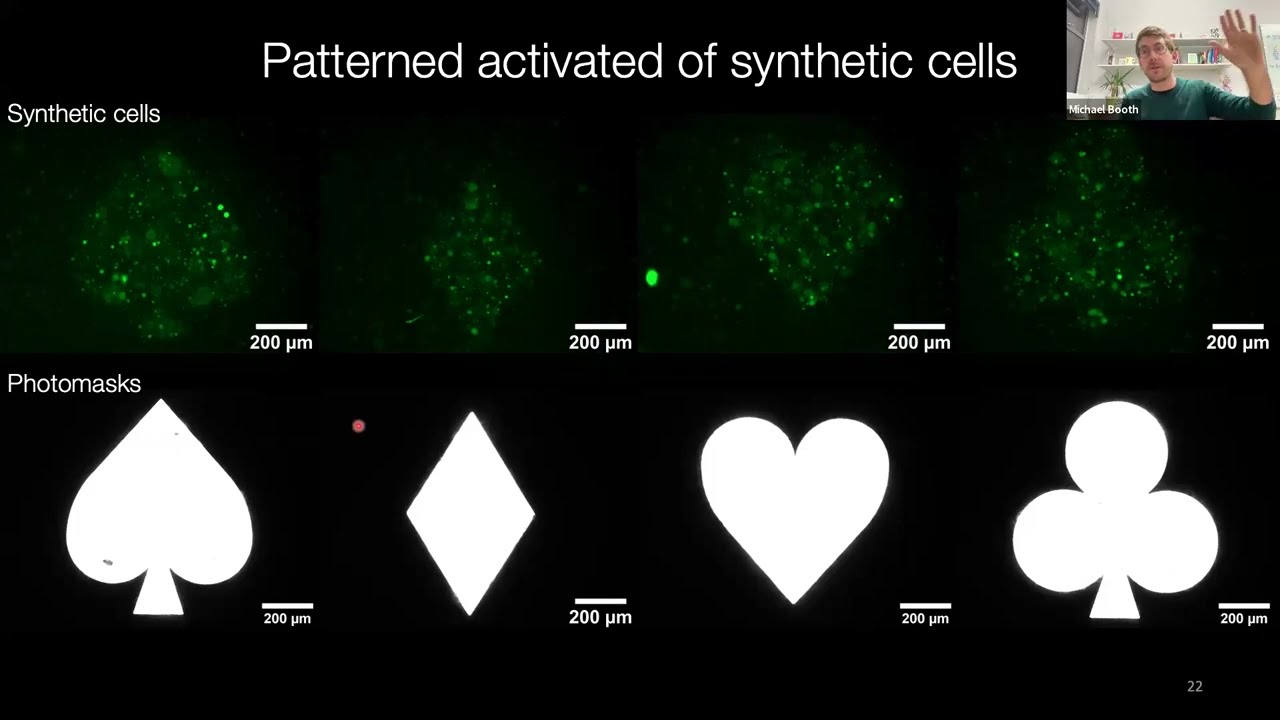
- Demonstration of AND gates and patterning in synthetic cells.
- Development of off-switch using antisense oligonucleotides.
- Magnetic activation using nanoparticles and alternating magnetic fields.
- Quorum sensing communication between synthetic cells and bacteria.
Cited Sources
- Build-a-Cell contact page — Mentioned for community engagement and questions.
- Build-a-Cell seminar page — Mentioned as the source of the seminar recording.
Concurring Sources
- Build-a-Cell seminar page — The seminar is part of the Build-a-Cell series, which focuses on synthetic cell research.
Contribution & Novelties
The talk presents original contributions to the field of synthetic cells, including the development of orthogonal light-activated DNA templates for precise control of gene expression, the use of magnetic nanoparticles for remote activation, and the engineering of a quorum sensing system for communication between synthetic and living cells. These innovations enable new applications in biocomputing, patterning, and potential therapeutic uses.
Pour aller plus loin :
- Synthetic biology — Overview of the field.
- Cell-free protein synthesis — Background on the technology used.
- Optogenetics — Related light-based control methods.
- Magnetic nanoparticles — Basis for magnetic activation.
- Quorum sensing — Communication mechanism used.
100 words
Radar Profile
The radar profile shows high scores in information quantity, quality, and technical level, with slightly lower reliability due to the lack of explicit citations. This indicates a technically rich presentation with strong experimental evidence, but the reliability could be improved by providing more references.