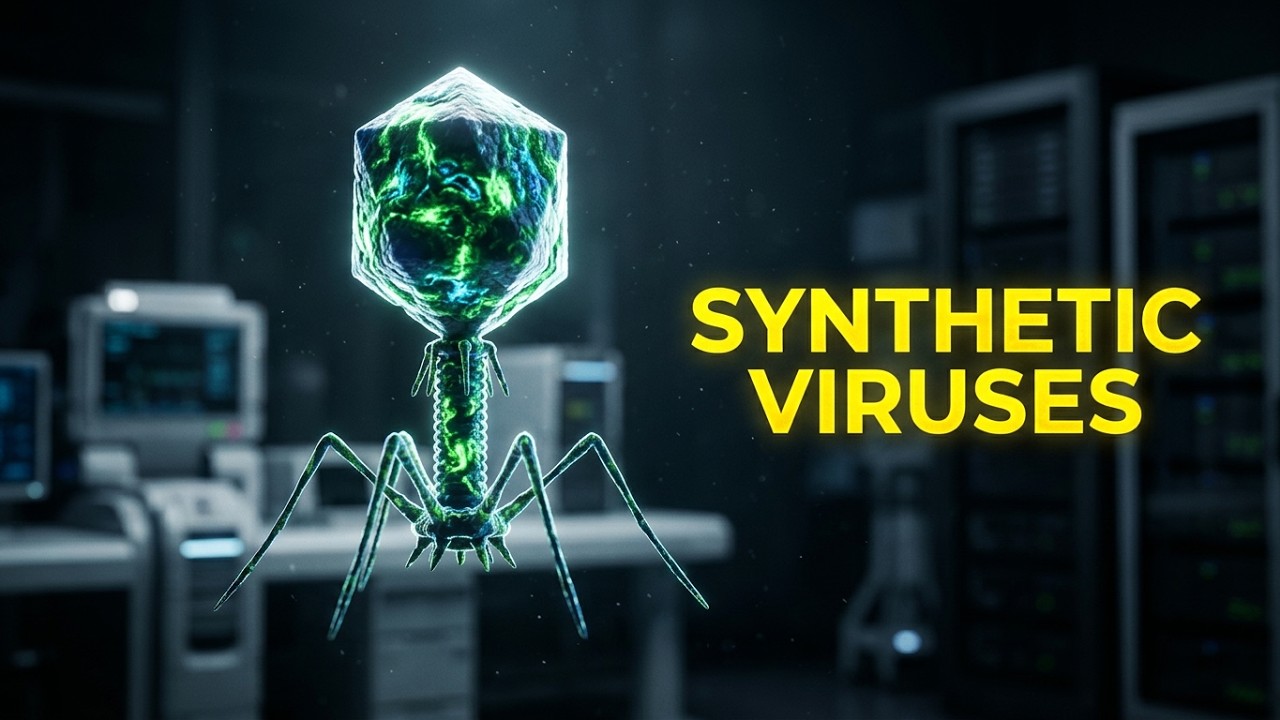
Build-a-Cell seminar Ariel Lindner: Building Life-Like Systems: Synthetic Viruses & Organization
Keywords
Summary
104 words
Critical Evaluation
Value of the Information & Strength of the Argument
The value of the information is high, as it presents novel experimental approaches and results in synthetic biology. The argumentation is solid, with clear logical progression from phage engineering to reconstitution of the life cycle. The speaker provides evidence for each step, using controls and quantitative data. The discussion of genotype-phenotype coupling is particularly insightful, challenging conventional evolutionary assumptions.
Scientific Rigor, Source Quality, Title Accuracy
The scientific rigor is high, with detailed methods and references to classic experiments by Delbrück and Kornberg. The sources cited are primarily the speaker’s own work and established literature, though specific citations are not provided in the talk. The title accurately reflects the content, and the seminar is well-structured. The lack of peer-reviewed publication details for the presented work slightly reduces the score.
137 words
Title / Content Match
The title accurately reflects the content, which focuses on synthetic viruses and programmable cellular organization.
Quality & Reliability
8/10
The seminar presents original research from a recognized expert, with detailed experimental descriptions and references to established literature. The methodology is sound, though the lack of peer-reviewed publication details and the informal seminar format slightly reduce the score.
Key Moments
Markers derived by PSI from the transcript: the creator did not define chapters.
- Introduction to synthetic viruses and the goal of reconstituting phage life cycle in synthetic cells.
- Discussion of the importance of phages and the challenges of understanding phenotypic variability.
- Description of the in vitro phage engineering system using PCR and TX-TL.
- Engineering phages to infect short LPS and fluorescent labeling of phages.
- Preparation of synthetic cells (liposomes) with LPS and verification of receptor display.
- Demonstration of phage adsorption and infection of liposomes, with mCherry expression.
- Observation of DNA injection and replication using Cy5 and labeled nucleotides.
- Packaging of new phages visualized with split GFP, showing concatamer resolution.
- Quantification of new phage production via biotinylation, yielding ~3 phages per input.
- Lysis of liposomes by holin, with LPS protecting the membrane.
- Discussion of genotype-phenotype coupling in TX-TL without compartmentalization.
Cited Sources
- Build-a-Cell contact page — Mentioned for community contact and questions.
- Build-a-Cell seminar page — Mentioned as the source for the seminar series.
Concurring Sources
- Build-a-Cell seminar page — The seminar is part of the Build-a-Cell series, which focuses on synthetic cell engineering.
Contribution & Novelties
The talk presents original research on reconstituting the T7 phage life cycle in synthetic cells, demonstrating infection, replication, and lysis in liposomes. This is a significant step towards building minimal synthetic cells and understanding viral biology in a controlled environment. The observation of genotype-phenotype coupling without compartmentalization is a novel insight with implications for in vitro evolution.
Pour aller plus loin :
- Synthetic biology — Overview of the field.
- T7 phage — Background on the phage used.
- Cell-free protein synthesis — Relevant to TX-TL systems.
- Liposome — Synthetic vesicle used as cell model.
- Genotype-phenotype distinction — Conceptual background for the coupling discussion.
102 words
Radar Profile
The radar profile shows high scores in information quantity and technical level, with slightly lower but still strong scores in information quality and reliability. This indicates a technically dense seminar with substantial content, though the informal format may limit some aspects of rigor.
💬 Comments are disabled on this video, so no public comments are available for analysis.