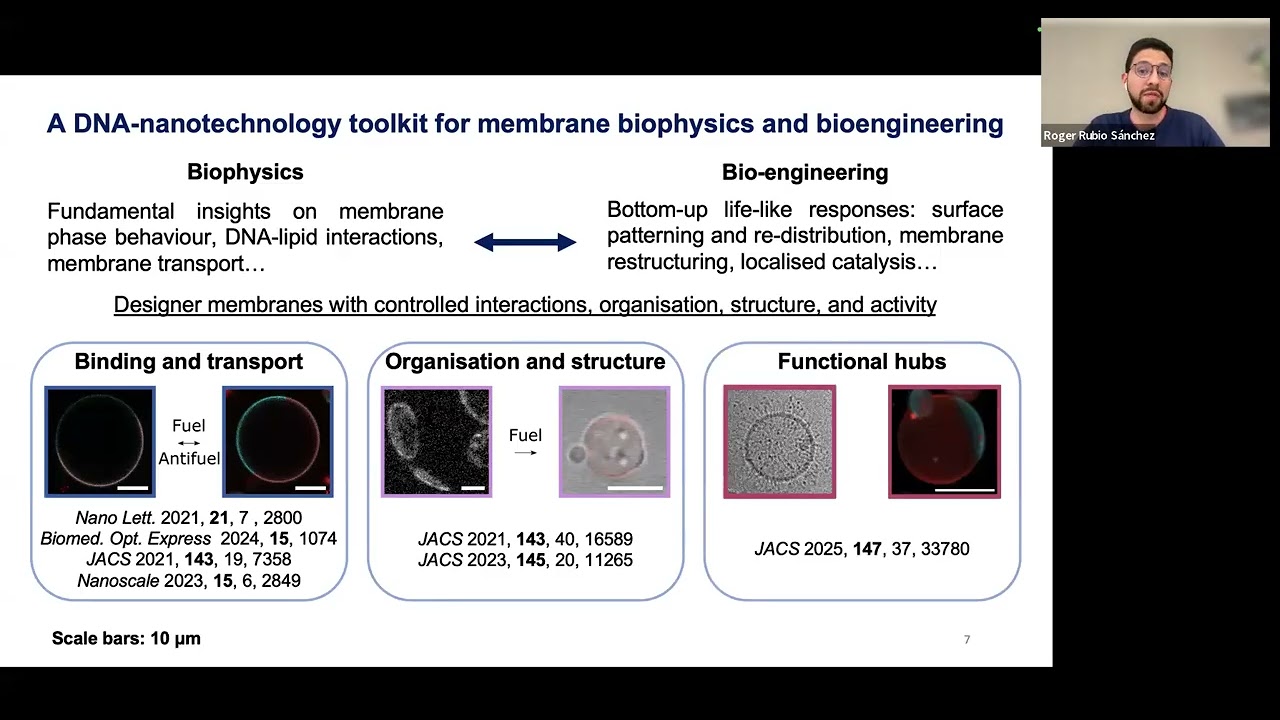
Build-a-Cell seminar Roger Rubio-Sánchez: Lipid membrane bioengineering using DNA nanostructures
Keywords
Summary
172 words
Critical Evaluation
Value of the Information & Strength of the Argument
The value of the information is high for researchers in synthetic biology and biophysics, as it presents novel quantitative methods for controlling membrane organization. The argumentation is solid, based on experimental data and thermodynamic principles. The speaker systematically builds from simple systems to complex DNA origami structures, providing clear evidence for each claim. The use of free energy calculations and partitioning coefficients adds rigor to the design principles. However, the talk is a seminar, so it lacks the depth of a full research paper, and some details are simplified for a live audience.
Scientific Rigor, Source Quality, Title Accuracy
The scientific rigor is high: the speaker is a recognized researcher, and the methods are well-established in the field. The talk does not explicitly cite specific papers, but it relies on standard techniques in DNA nanotechnology and lipid biophysics. The title accurately reflects the content. The description provides links to the Build-a-Cell community and seminar page, but no direct references to the research. No comments are available as they are disabled.
179 words
Title / Content Match
The title accurately reflects the content: a seminar on lipid membrane bioengineering using DNA nanostructures.
Quality & Reliability
8/10
The seminar presents original research with quantitative data and references to established methods (DNA nanotechnology, lipid phase separation). The speaker is a BBSRC Discovery Fellow at Cambridge, and the content is technical and detailed. However, it is a recorded seminar without peer review or external verification, and no specific sources are cited in the talk.
Key Moments
Markers derived by PSI from the transcript: the creator did not define chapters.
- Introduction: importance of synthetic cells and membrane functions.
- Explanation of membrane phase behavior: fluid vs gel phase.
- Introduction to DNA nanotechnology and hydrophobic anchors.
- Quantitative analysis of DNA partitioning into lipid domains.
- Dynamic control using toehold-mediated strand displacement.
- Design of DNA origami lineactants for domain boundary targeting.
- Experimental results showing lineactant accumulation at boundaries.
- Discussion of future applications for synthetic cell engineering.
Cited Sources
- Build-a-Cell community — Mentioned in the video description as a way to contact the community for questions.
- Build-a-Cell seminar page — Mentioned in the video description as the source for the seminar series.
Concurring Sources
- Build-a-Cell community — The community supports synthetic cell research, aligning with the seminar's topic.
- Build-a-Cell seminar page — The seminar series is part of Build-a-Cell, which focuses on synthetic cell engineering.
Contribution & Novelties
The seminar presents a novel approach to engineering lipid membranes using DNA nanostructures, specifically by controlling the lateral distribution of membrane inclusions via hydrophobic anchors and DNA origami lineactants. This allows for programmable organization of membrane domains, which is a key step towards building functional synthetic cells. The work combines quantitative biophysics with DNA nanotechnology, offering a predictive design framework.
Pour aller plus loin :
- DNA origami — Foundational technique used in the talk.
- Lipid phase separation — Key concept for membrane organization.
- Synthetic cell — Context for the research goals.
91 words
Radar Profile
The radar profile shows high scores in quantity and quality of information, and technical level, with a slightly lower score in global reliability due to the lack of explicit citations. This indicates a technically dense and informative seminar that is likely reliable but not fully verifiable from the video alone.