Build-a-Cell seminar Ashty Karim: Data-driven design of cell-free metabolism
Keywords
Summary
160 words
Critical Evaluation
Value of the Information & Strength of the Argument
The seminar provides valuable insights into the application of cell-free systems for metabolic engineering, showcasing concrete examples and results. The argumentation is solid, based on the presenter’s own research and references to established literature. The speaker effectively demonstrates the utility of cell-free systems for prototyping pathways and optimizing enzyme combinations, and highlights the importance of data-driven approaches. The talk is well-structured and persuasive, though some claims could benefit from more detailed evidence.
Scientific Rigor, Source Quality, Title Accuracy
The seminar demonstrates scientific rigor by referencing historical milestones (Buchner, Nirenberg, etc.) and contemporary studies. The sources cited are primarily from the presenter’s own work and well-known publications in the field. The title accurately reflects the content, focusing on data-driven design of cell-free metabolism. The talk is presented by an expert, and the content is consistent with current knowledge in the field.
149 words
Title / Content Match
The title accurately reflects the content, which focuses on data-driven design of cell-free metabolism.
Quality & Reliability
8/10
The seminar is presented by an expert in the field (Ashty Karim, assistant professor at Northwestern University) and covers a well-established research area with references to historical and contemporary work. The content is technical and detailed, but as a seminar, it may lack peer review and some claims are based on the presenter's own research.
Key Moments
Markers derived by PSI from the transcript: the creator did not define chapters.
- Introduction to cell-free systems and their applications.
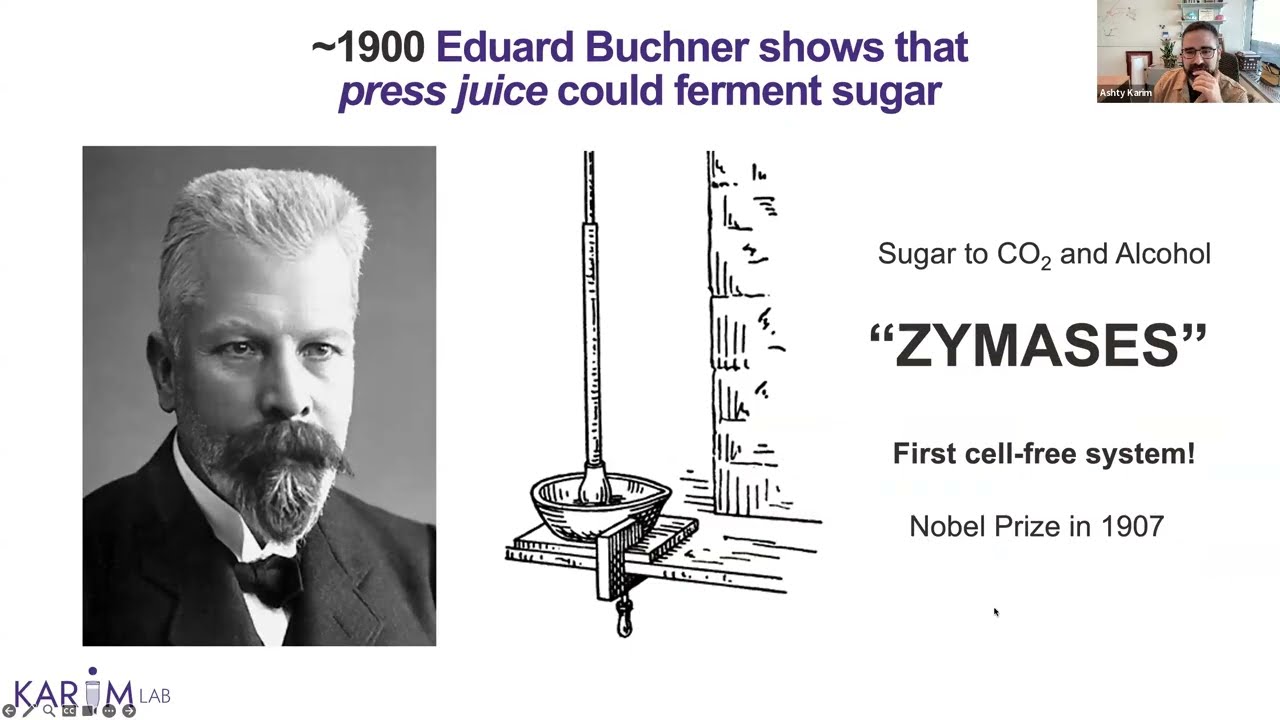
- Historical background: Buchner's discovery and the birth of enzymology.
- Development of cell-free protein synthesis systems.
- Engineering metabolism in cell-free systems: reverse beta-oxidation for butanol production.
- Optimizing enzyme combinations using machine learning.
- Engineering a synthetic pathway for CO2 fixation to malate.
- Reducing cost of cell-free protein synthesis via reagent optimization.
- Future challenges: extending reaction longevity and scaling up.
Cited Sources
- Build-a-Cell contact page — Mentioned for community engagement and questions.
- Build-a-Cell seminar page — Mentioned as the source of the seminar recording.
Concurring Sources
- Cell-free protein synthesis: a promising option for future drug development — Supports the potential of cell-free systems for biomanufacturing.
- Synthetic biology: applications come of age — Provides context on synthetic biology applications.
Dissenting Sources
- Cell-free systems: a new frontier in biotechnology — This source may present a more cautious view on the scalability of cell-free systems, contrasting with the optimistic outlook in the seminar.
Contribution & Novelties
The seminar provides an overview of recent advances in cell-free metabolic engineering, emphasizing data-driven approaches. It highlights the potential of cell-free systems for prototyping and optimizing metabolic pathways, and discusses cost reduction strategies. The speaker’s own research on enzyme engineering and pathway optimization in cell-free systems is a notable contribution.
Pour aller plus loin :
- Cell-free protein synthesis — Overview of the technology and its applications.
- Metabolic engineering — Background on engineering cellular metabolism.
- Machine learning in biotechnology — General concept, relevant to the data-driven approaches discussed.
87 words
Radar Profile
The radar profile shows high scores in all dimensions, indicating a well-rounded and informative seminar. The strong scores in 'quantite_information' and 'qualite_information' reflect the depth and relevance of the content, while 'niveau_technique' and 'fiabilite_globale' are also high, suggesting a technically sound and reliable presentation.