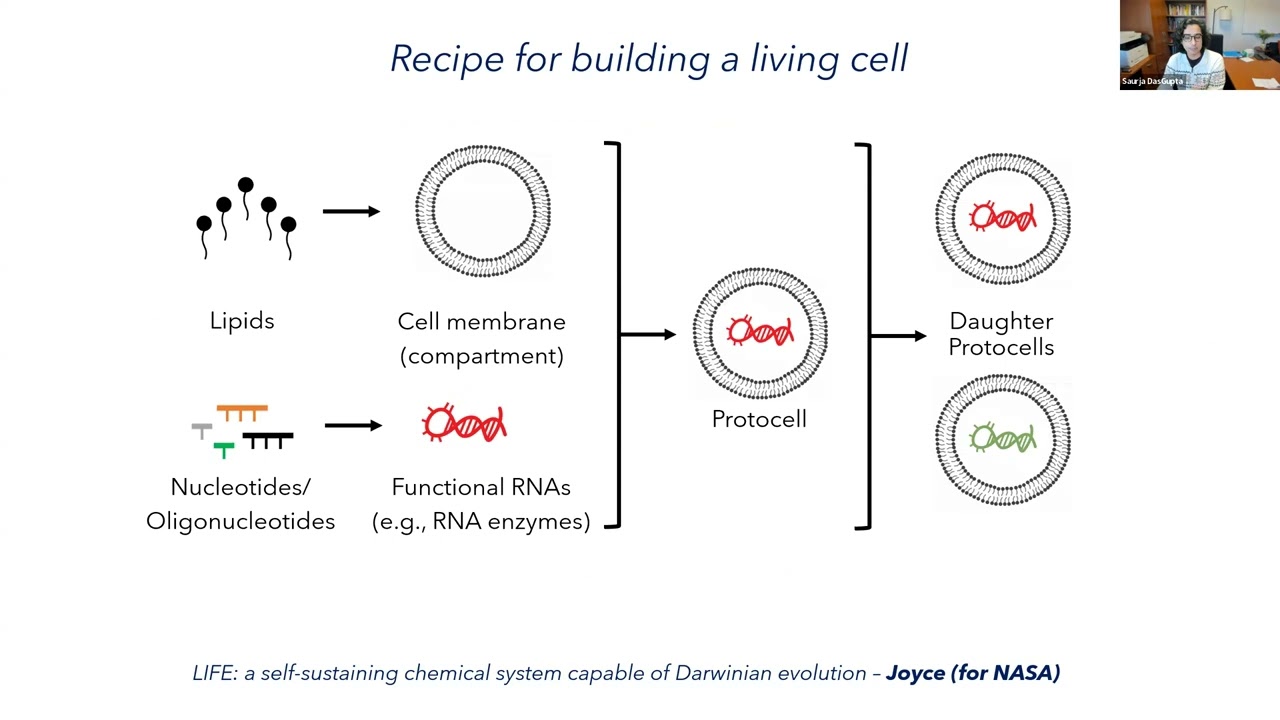
Build-a-Cell seminar Saurja DasGupta: Teaching RNA New Tricks
Keywords
Summary
173 words
Critical Evaluation
Value of the Information & Strength of the Argument
The talk presents original research with clear value: it describes the discovery of a novel ribozyme activity and its potential applications. The argumentation is solid, based on experimental evidence and logical reasoning. The speaker carefully explains the directed evolution process and the characterization of the evolved ribozymes, including control experiments to confirm the reaction mechanism. The potential applications for RNA sequencing and biosensors are promising, though some are still in early stages. The talk is well-structured and provides a compelling case for the importance of RNA engineering.
Scientific Rigor, Source Quality, Title Accuracy
The speaker does not cite specific sources during the talk, but the research is presumably based on published literature. The description provides links to Build-a-Cell resources, but no direct references to the speaker’s papers. The title accurately reflects the content. The talk is a seminar, so it is not peer-reviewed, but the speaker’s affiliation and the detailed experimental data lend credibility. The lack of citations is a minor weakness, but the talk is intended as a research presentation.
180 words
Title / Content Match
The title accurately reflects the content: the speaker discusses engineering RNA to perform new functions, including evolved ribozymes and their applications.
Quality & Reliability
8/10
The seminar presents original research from the speaker's lab, with detailed experimental procedures and results. The speaker is an assistant professor at a reputable institution. The talk is technical and appears scientifically sound, though it is a single presentation without peer review visible.
Key Moments
Markers derived by PSI from the transcript: the creator did not define chapters.
- Introduction and overview of the talk's three research programs.
- Discussion of the RNA world hypothesis and the importance of RNA in origins of life.
- Introduction to the RNA assembly problem and the use of prebiotic substrates.
- Directed evolution of ribozymes for RNA ligation with triphosphate substrates.
- Discovery of the 3'-phosphate requirement and elucidation of the reaction mechanism.
- Application of the evolved ribozymes for capturing and sequencing cleaved RNA.
- Concluding remarks and potential future directions, including biosensors.
Cited Sources
- Build-a-Cell Contact — Mentioned for community contact.
- Build-a-Cell Seminar Series — Mentioned as the seminar series hosting this talk.
Concurring Sources
- Build-a-Cell Seminar Series — The seminar is part of a series focused on synthetic cell research, which aligns with the talk's themes.
Contribution & Novelties
The talk presents a novel ribozyme activity that specifically ligates RNA with a 3’-phosphate, a reactivity not previously observed. This could have implications for understanding primordial RNA repair and for developing new tools for RNA sequencing. The speaker also discusses potential applications in biosensing.
Pour aller plus loin :
- RNA world hypothesis — Provides background on the RNA world hypothesis.
- Directed evolution — Explains the method used to evolve the ribozymes.
- Ribozyme — General information on RNA enzymes.
78 words
Radar Profile
The radar profile shows high scores in technical level and information quality, reflecting the advanced scientific content. The quantity of information is also high, but the global reliability is slightly lower due to the lack of peer-reviewed citations. Overall, the talk is highly informative and technically rigorous.