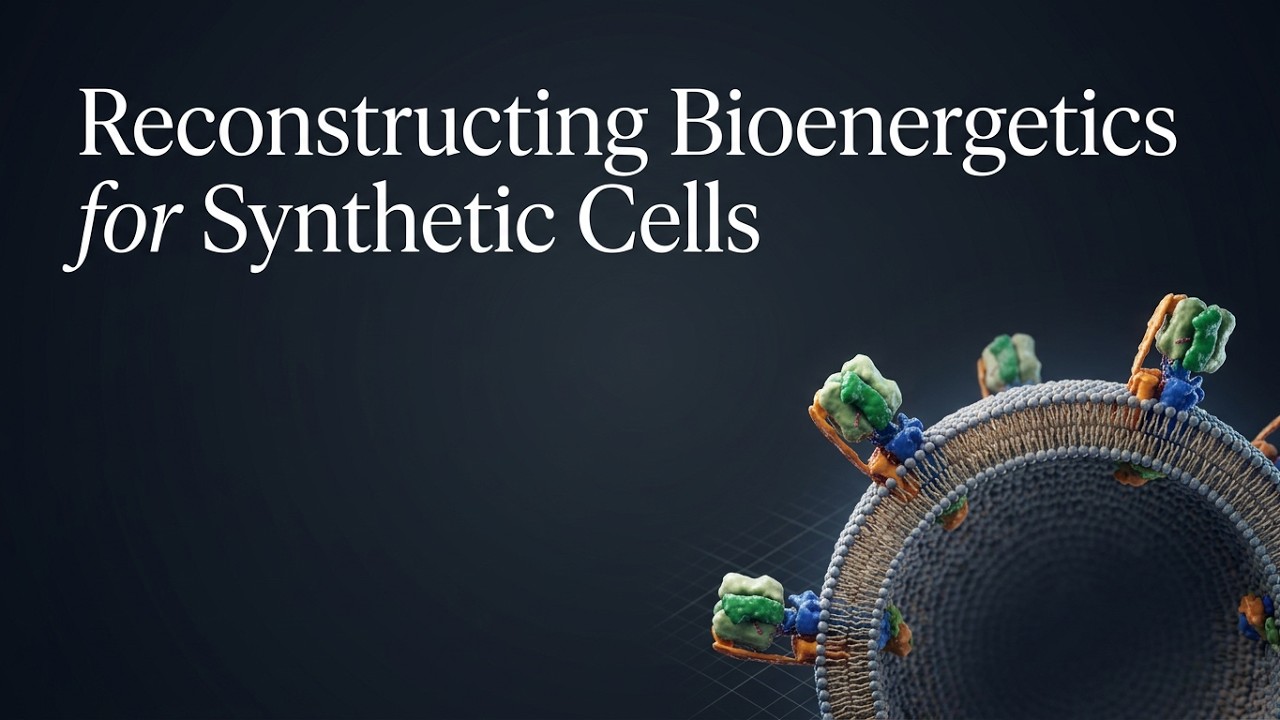
Build-a-Cell seminar Christoph von Ballmoos: Reconstructing Bioenergetics for Synthetic Cells
Keywords
Summary
156 words
Critical Evaluation
Value of the Information & Strength of the Argument
The seminar provides valuable insights into the practical challenges of building bioenergetic modules for synthetic cells. The argumentation is solid, based on experimental data and logical reasoning. The speaker clearly explains the importance of protein orientation and presents innovative solutions to control it. The use of specific examples, such as the ‘ball and chain’ strategy and lipid charge manipulation, strengthens the credibility of the approach. The presentation is well-structured, moving from fundamental concepts to advanced techniques, and effectively communicates the complexity of the field.
Scientific Rigor, Source Quality, Title Accuracy
The scientific rigor is high, with detailed methodology and data presented. The speaker references his own published work and mentions collaborations, but does not provide specific citations during the talk. The title accurately reflects the content, focusing on reconstructing bioenergetics for synthetic cells. The presentation is a seminar, not a peer-reviewed publication, but it offers a credible expert perspective. The description provides links to the Build-a-Cell community, which may offer additional resources, but no direct references to specific papers are given.
180 words
Title / Content Match
The title accurately reflects the content, which focuses on reconstructing bioenergetic systems for synthetic cells.
Quality & Reliability
8/10
The seminar presents original research from a recognized expert in membrane bioenergetics, with detailed methodology and data. The content is technical and appears scientifically sound, though it is a single presentation without peer review or external validation.
Key Moments
Markers derived by PSI from the transcript: the creator did not define chapters.
- Introduction and background of the speaker, focusing on ATP synthase and membrane bioenergetics.
- Explanation of ATP importance and the two main pathways for ATP regeneration: substrate-level phosphorylation and chemiosmotic coupling.
- Discussion of the reconstitution of membrane proteins into liposomes and the challenges of protein orientation.
- Presentation of the 'ball and chain' strategy to control proteorhodopsin orientation using a fusion protein.
- Explanation of how lipid charge influences protein orientation, with experiments using positively charged lipids.
- Description of a method to switch lipid charge during reconstitution to optimize enzyme orientation.
- Brief introduction to using giant unilamellar vesicles as cell models, but the talk is cut short.
Cited Sources
- Build-a-Cell Contact — Provided in the video description for contacting the Build-a-Cell community.
- Build-a-Cell Seminar — Provided in the video description as the seminar series page.
Concurring Sources
- Build-a-Cell — The seminar is part of the Build-a-Cell initiative, which aims to construct synthetic cells.
Contribution & Novelties
The seminar presents original research on controlling membrane protein orientation for ATP synthesis in synthetic cells. The ‘ball and chain’ strategy using a non-covalent linker is a novel approach to orient proteorhodopsin. The use of pH-sensitive lipids to switch surface charge during reconstitution is an innovative method to optimize enzyme orientation. These contributions advance the field of bottom-up synthetic biology by addressing a key technical challenge.
Pour aller plus loin :
- ATP synthase — Overview of the enzyme central to the talk.
- Proteoliposome — Definition and applications of proteoliposomes.
- Chemiosmosis — The principle underlying the discussed energy coupling.
98 words
Radar Profile
The radar profile shows high scores in technical level and information quality, indicating a specialized and detailed presentation. The lower score in quantity of information reflects the relatively short duration and focused scope. Overall, the profile suggests a high-quality seminar for an expert audience.