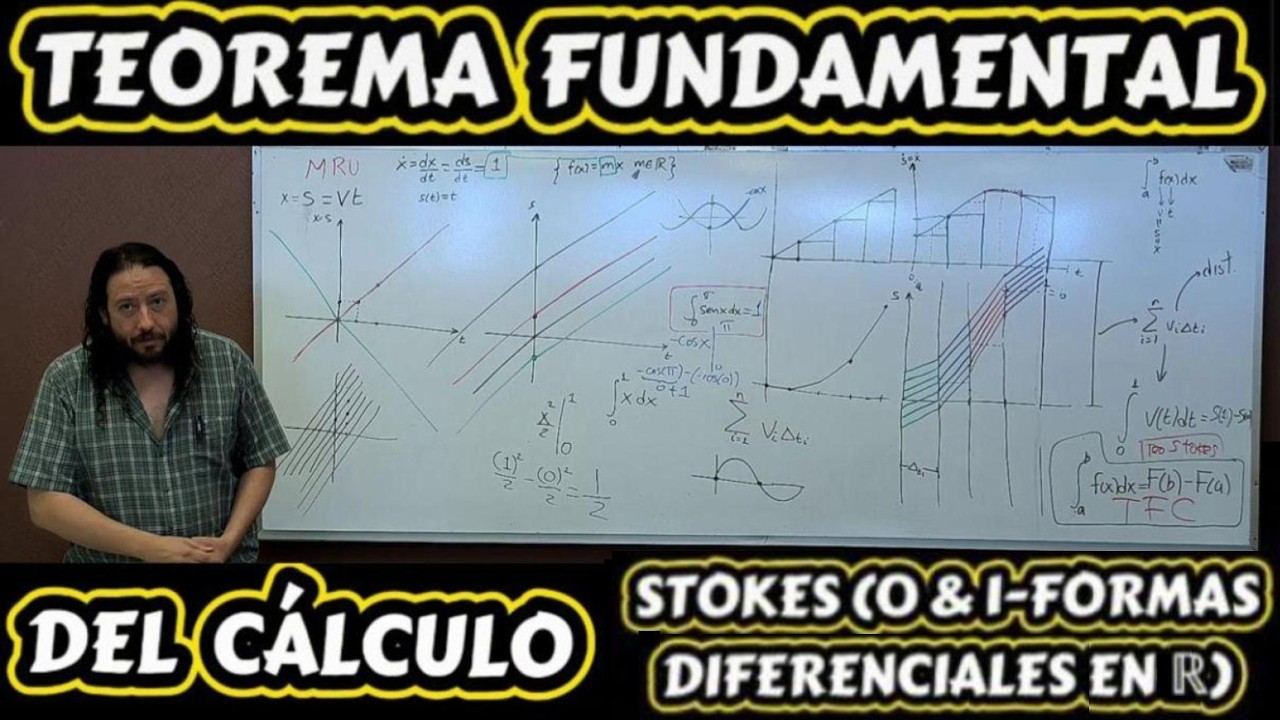
Teorema Fundamental del Cálculo
Keywords
Summary
197 words
Critical Evaluation
Value of the Information & Strength of the Argument
The value of the information is high for a pedagogical context. The instructor provides a clear, intuitive explanation of the fundamental theorem of calculus, using geometric interpretations and analogies (e.g., stretching a rubber band) to make abstract concepts accessible. The argumentation is solid: he builds from simple cases (uniform motion) to more general ones, using the limit process to define the integral. He also connects the material to linear algebra, showing that derivatives are linear transformations, which enriches the understanding. The reasoning is coherent and mathematically correct, with careful attention to potential pitfalls (e.g., the vertical line not being a function).
Scientific Rigor, Source Quality, Title Accuracy
The scientific rigor is appropriate for a lecture: the mathematical content is accurate, and the instructor is careful with definitions and interpretations. However, no external sources are cited, and the presentation relies on the instructor’s expertise. The title accurately reflects the content, as the lecture indeed focuses on the fundamental theorem of calculus. The description mentions ‘Stokes 0 & 1 formas diferenciales en ℝ’, but the video does not explicitly discuss Stokes’ theorem; it may be a teaser for future lectures. No comments were provided for analysis.
203 words
Title / Content Match
The title accurately reflects the content, as the lecture focuses on the fundamental theorem of calculus, building up to it through the interpretation of integrals as areas and derivatives as slopes.
Quality & Reliability
8/10
The video is a pedagogical lecture by a university instructor (UNAM) that carefully develops the fundamental theorem of calculus through geometric intuition and rigorous reasoning. The explanations are mathematically sound, with clear connections to linear algebra and differential equations. The presentation is didactic and accurate, though it does not cite external sources or provide formal proofs.
Key Moments
Markers derived by PSI from the transcript: the creator did not define chapters.
- Introduction: review of distance = velocity × time for uniform motion, and idea of using small intervals to approximate distance.
- Explanation of Riemann sums: approximating distance by summing areas of rectangles under the velocity curve.
- Discussion of linear functions f(x)=mx, their graphs, and interpretation as stretching/contracting the real line.
- Exploration of the identity function and the vertical line as a limiting case with infinite slope.
- Introduction to differential equations: solving dx/dt = 1, showing all solutions are lines with slope 1.
- Connection to the fundamental theorem: linking the integral of velocity to the change in position.
Contribution & Novelties
The lecture’s original contribution lies in its pedagogical approach: it uses the geometric interpretation of linear transformations to build intuition for the fundamental theorem of calculus, connecting it to linear algebra and differential equations. This provides a fresh perspective for learners.
Pour aller plus loin :
- Fundamental theorem of calculus — Provides a formal statement and proof of the theorem.
- Riemann sum — Explains the concept of approximating integrals with sums of rectangles.
- Linear map — Discusses linear transformations, which are central to the lecture’s interpretation of derivatives.
88 words
Radar Profile
The radar profile shows high scores in information quantity and quality, with a slightly lower technical level, indicating a lecture that is rich in content and accurate but accessible to a general audience. The overall reliability is high, reflecting the instructor's expertise.