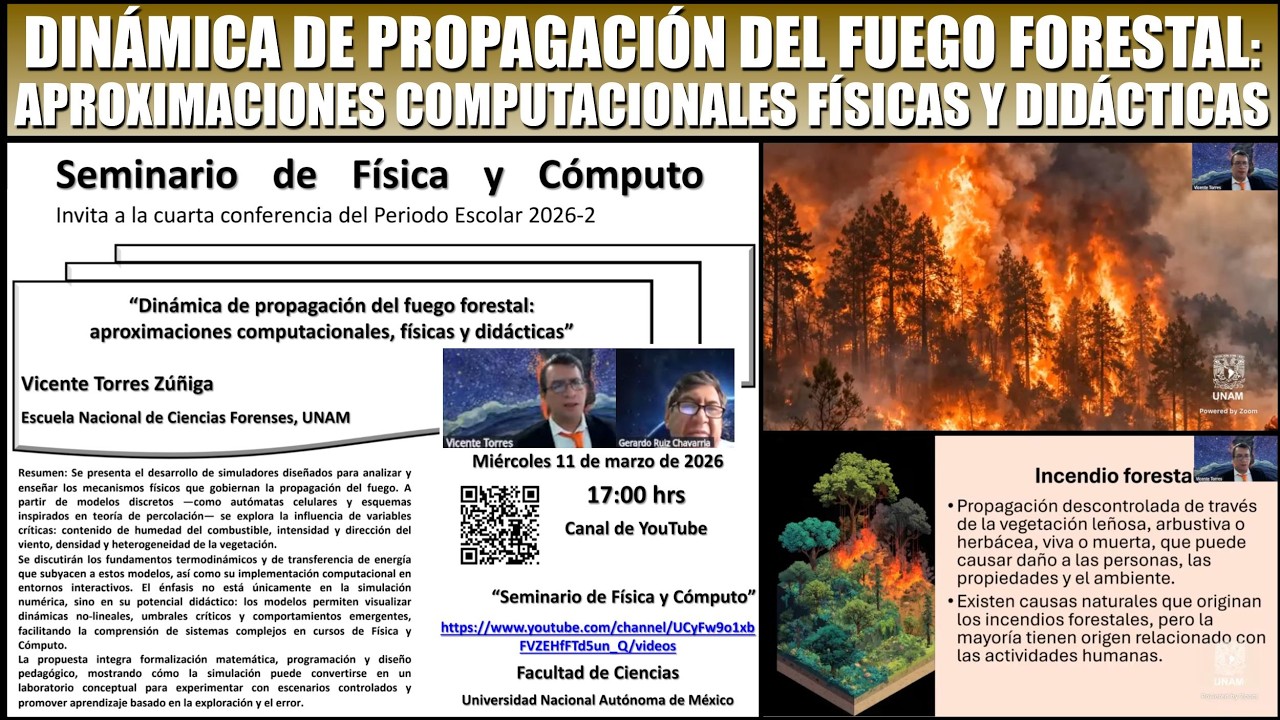
Dinámica de propagación de fuego forestal: aproximación computacional física y didáctica (Vicente T)
Keywords
Summary
166 words
Critical Evaluation
Value of the Information & Strength of the Argument
The presentation provides valuable insights into the practical application of computational models for educational and forensic purposes. The speaker effectively argues for the utility of cellular automata due to their low computational cost and flexibility in incorporating stochastic elements, making them suitable for teaching and exploratory analysis. He supports his points with references to existing models like Rothermel’s and software like Behave, and illustrates the challenges of modeling complex factors such as humidity and wind. The argumentation is coherent and grounded in his experience developing simulators, though it lacks rigorous quantitative validation of the models’ accuracy.
Scientific Rigor, Source Quality, Title Accuracy
The speaker demonstrates scientific rigor by referencing established models and data sources, such as NASA’s FIRMS and CONAFOR reports. However, he does not provide specific citations for the underlying physics or the cellular automata literature, and the talk is more of a demonstration than a peer-reviewed presentation. The title accurately reflects the content, focusing on computational and didactic approaches. The description includes a link to a playlist of related seminar videos, which serves as a source for further exploration.
190 words
Title / Content Match
The title accurately reflects the content, which focuses on computational and didactic approaches to forest fire propagation.
Quality & Reliability
7/10
The speaker is a physicist with 23 years of teaching experience and over 60 academic publications, affiliated with UNAM's National School of Forensic Sciences. The presentation describes the development of educational simulators for forest fire propagation, combining physical principles with computational tools. While the talk is informative and grounded in scientific concepts, it is primarily a demonstration of his own work and lacks peer-reviewed citations or detailed validation of the models.
Key Moments
Markers derived by PSI from the transcript: the creator did not define chapters.
- Introduction and speaker's background
- Importance of models and simulators in science education
- Explanation of the fire triangle and classification of fires
- Impact of climate change on forest fires and data from NASA and CONAFOR
- Introduction to cellular automata for fire modeling
- Comparison of empirical, physics-based, and cellular automata models
- Implementation details of the Edeno simulator using Twine and JavaScript
- Demonstration of the simulator's features and educational activities
Cited Sources
- Seminario de Física y Cómputo playlist — Related seminar videos
Concurring Sources
- Cellular automata for fire spread modeling — The speaker mentions that cellular automata are widely used in literature for fire spread, but no specific source is cited.
Contribution & Novelties
The talk presents an original educational simulator for forest fire propagation, combining cellular automata with an interactive game engine (Twine) and JavaScript, making it accessible on mobile devices. This approach is novel in its focus on forensic science education and its emphasis on didactic interactivity. The speaker highlights the lack of computational simulators for forensic fire investigation courses, positioning his work as a contribution to this niche.
Pour aller plus loin :
- Cellular automaton — Fundamental concept for modeling fire spread.
- Rothermel model — Empirical model for fire spread, referenced in the talk.
- Fire Information for Resource Management System (FIRMS) — NASA’s tool for monitoring fires, mentioned in the talk.
- BehavePlus — Software for fire behavior prediction, referenced in the talk.
121 words
Radar Profile
The radar profile shows balanced scores across all dimensions, with slightly higher scores in information quantity and reliability, reflecting the speaker's expertise and the informative nature of the talk. The technical level is moderate, suitable for a general scientific audience.