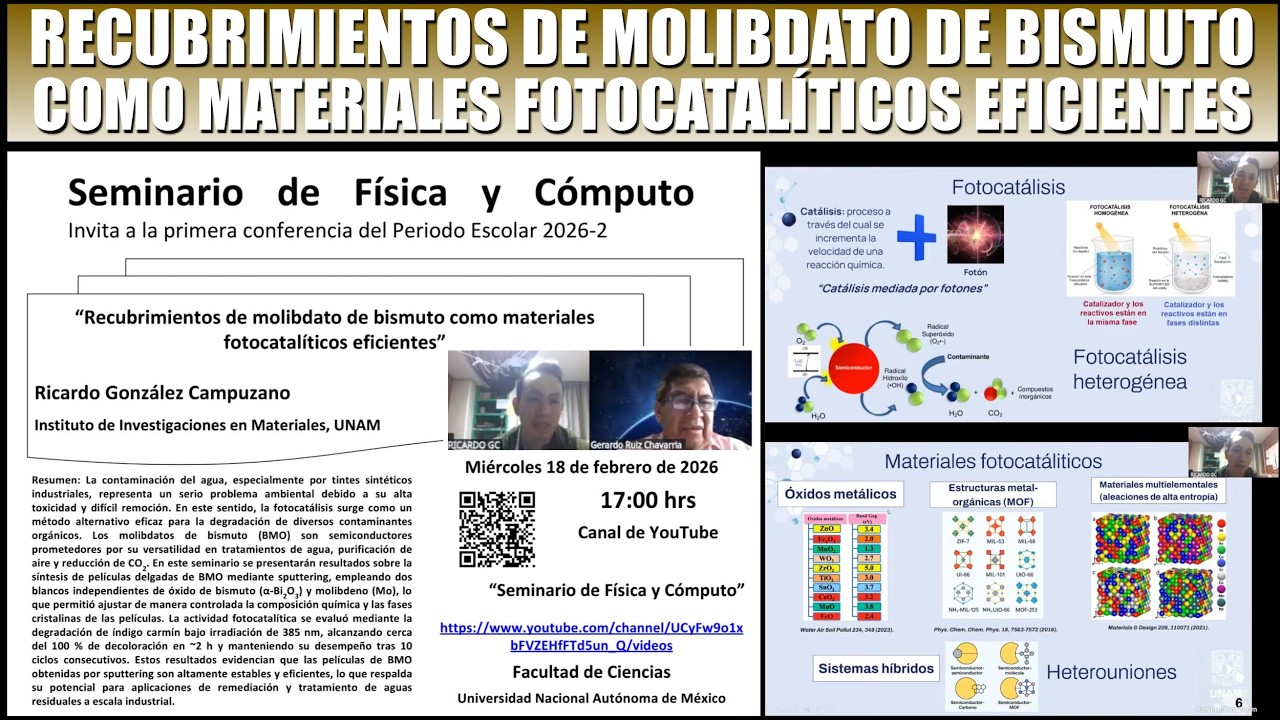
Recubrimientos de molibdato de bismuto como materiales fotocatalíticos eficientes (Ricardo González)
Keywords
Summary
136 words
Critical Evaluation
Value of the Information & Strength of the Argument
The presentation provides valuable insights into the synthesis and characterization of bismuth molybdate thin films for photocatalytic applications. The argumentation is solid, systematically moving from problem definition to material selection, synthesis, characterization, and performance evaluation. The speaker clearly explains the advantages of thin films over powders and justifies the choice of sputtering. The results are presented with quantitative data, including bandgap values, kinetic constants, and degradation percentages, supporting the conclusions. The discussion of phase identification and its correlation with photocatalytic performance adds depth. However, the talk lacks a comparative analysis with existing literature or commercial photocatalysts, which would strengthen the novelty claim. The stability tests are commendable, but the mechanism of degradation is not deeply explored.
Scientific Rigor, Source Quality, Title Accuracy
The scientific rigor is high, with detailed experimental procedures and multiple characterization techniques. The speaker cites two literature works on bismuth molybdate thin films, but no specific references are provided in the description. The title accurately reflects the content. The talk is based on original research, but without published peer-reviewed articles, the sources are limited. The methodology is sound, and the results are reproducible. The adequacy between title and content is excellent. No comments were provided for analysis.
209 words
Title / Content Match
The title accurately reflects the content, focusing on bismuth molybdate coatings as efficient photocatalytic materials.
Quality & Reliability
8/10
The talk presents original research with detailed experimental methods and results, but lacks peer-reviewed publication references and independent verification.
Key Moments
Markers derived by PSI from the transcript: the creator did not define chapters.
- Introduction and speaker presentation
- Motivation: water pollution and photocatalysis basics
- Bismuth molybdate properties and phases
- Thin film advantages and sputtering technique
- Synthesis parameters and thermal treatment
- Characterization: thickness, morphology, composition, structure
- Optical bandgap determination
- Photocatalytic testing with Indigo Carmine
- Kinetic analysis and stability tests
- Conclusions and acknowledgments
Cited Sources
- Seminario de Física y Cómputo playlist — Related seminar videos
Concurring Sources
- Seminario de Física y Cómputo playlist — Related seminar videos
Contribution & Novelties
The talk presents original research on bismuth molybdate thin films synthesized via dual magnetron sputtering, a relatively unexplored configuration. The main novelty is the systematic study of the effect of molybdenum power on phase formation and photocatalytic activity, identifying a mixed-phase film (alpha-Bi2MoO6 and MoO3) with superior performance. The stability over 10 cycles is a practical contribution. The work addresses the challenge of catalyst recovery by using immobilized films.
Pour aller plus loin :
- Photocatalysis - Wikipedia — Overview of photocatalytic principles and applications.
- Bismuth molybdate - Wikipedia — Properties and uses of bismuth molybdates.
- Sputter deposition - Wikipedia — Explanation of the sputtering technique used.
106 words
Radar Profile
The radar profile shows high scores in information quantity and quality, with moderate technical level and reliability. This indicates a well-structured and informative presentation, though the lack of external references slightly reduces reliability.