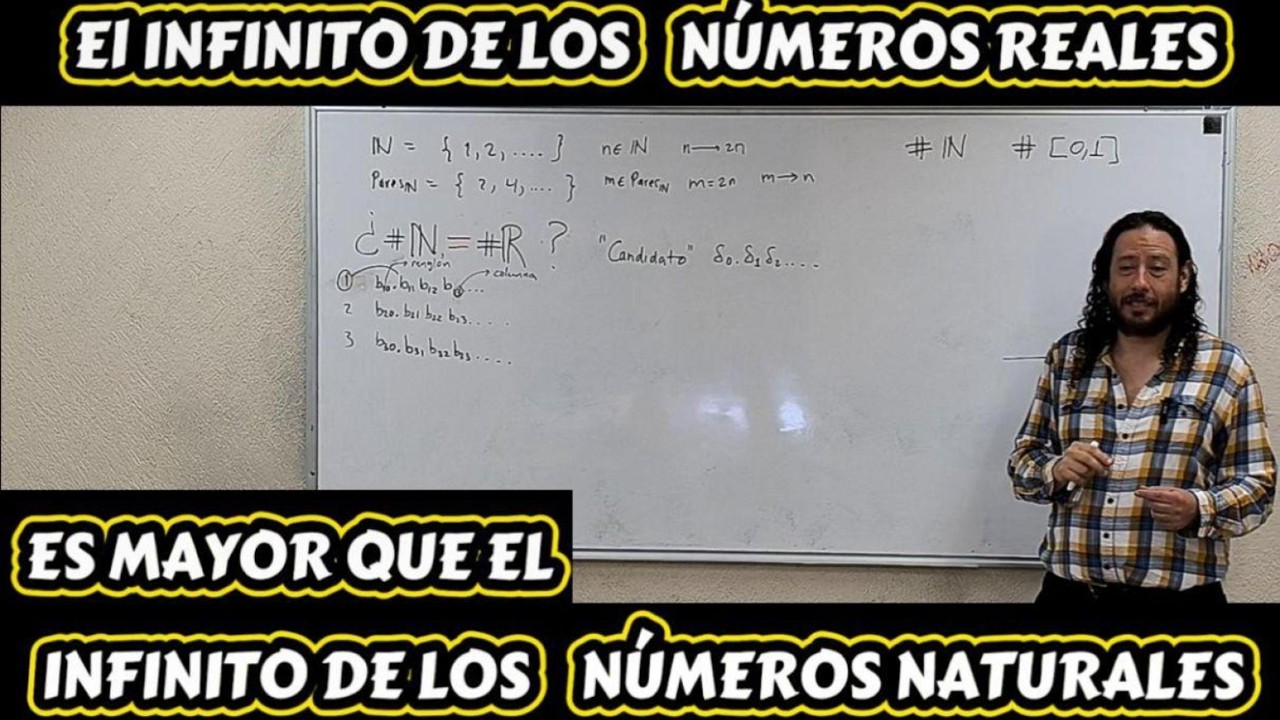
El infinito de los números reales es más grande que el de los números naturales
Keywords
Summary
207 words
Critical Evaluation
Value of the Information & Strength of the Argument
The video provides a clear and rigorous explanation of a fundamental concept in set theory. The argumentation is solid: it builds from the definition of cardinality and bijections, then presents the diagonal argument in a step-by-step manner, ensuring that each step is justified. The interactive approach, with questions to students, helps reinforce understanding. The value lies in its pedagogical effectiveness, making a non-intuitive result accessible through careful reasoning.
Scientific Rigor, Source Quality, Title Accuracy
The mathematical content is rigorous and accurate, following the standard proof of Cantor’s theorem. However, the video does not cite any external sources or references; it relies on the instructor’s explanation. The title accurately reflects the content, as the video indeed demonstrates that the cardinality of the reals is greater than that of the naturals. The video is a lecture, so the lack of citations is not a major flaw, but it limits the ability to verify claims independently.
162 words
Title / Content Match
The title accurately reflects the content: the video demonstrates that the cardinality of the reals is greater than that of the naturals.
Quality & Reliability
8/10
The video presents a rigorous, step-by-step proof of Cantor's diagonal argument, with clear explanations and interactive questioning. The mathematical content is accurate and well-structured, though it lacks formal citations or references to external sources.
Key Moments
Markers derived by PSI from the transcript: the creator did not define chapters.
- Introduction and review of cardinality and bijective correspondences.
- Example of bijection between natural and even numbers.
- Posing the question: can real numbers be listed? Discussion of decimal expansions.
- Introduction of the diagonal argument: constructing a number different from the first in the list.
- Generalizing the diagonal construction to all numbers in the list.
- Conclusion that the constructed number is not in the list, proving the reals are uncountable.
- Discussion of intervals and order on the real line.
Contribution & Novelties
The video offers a pedagogical approach to Cantor’s diagonal argument, emphasizing the construction process and engaging the audience with questions. It provides a clear, step-by-step explanation that is accessible to students. The novelty lies in the interactive teaching style and the emphasis on understanding the proof’s logic rather than just stating it.
Pour aller plus loin :
- Cantor’s diagonal argument — Provides a formal overview of the argument.
- Cardinality — Explains the concept of cardinality for finite and infinite sets.
- Georg Cantor — Background on the mathematician who developed these ideas.
91 words
Radar Profile
The radar profile shows high scores in information quality, technical level, and reliability, with a slightly lower score in information quantity. This indicates a focused, rigorous lecture that prioritizes depth over breadth, suitable for a mathematics course.