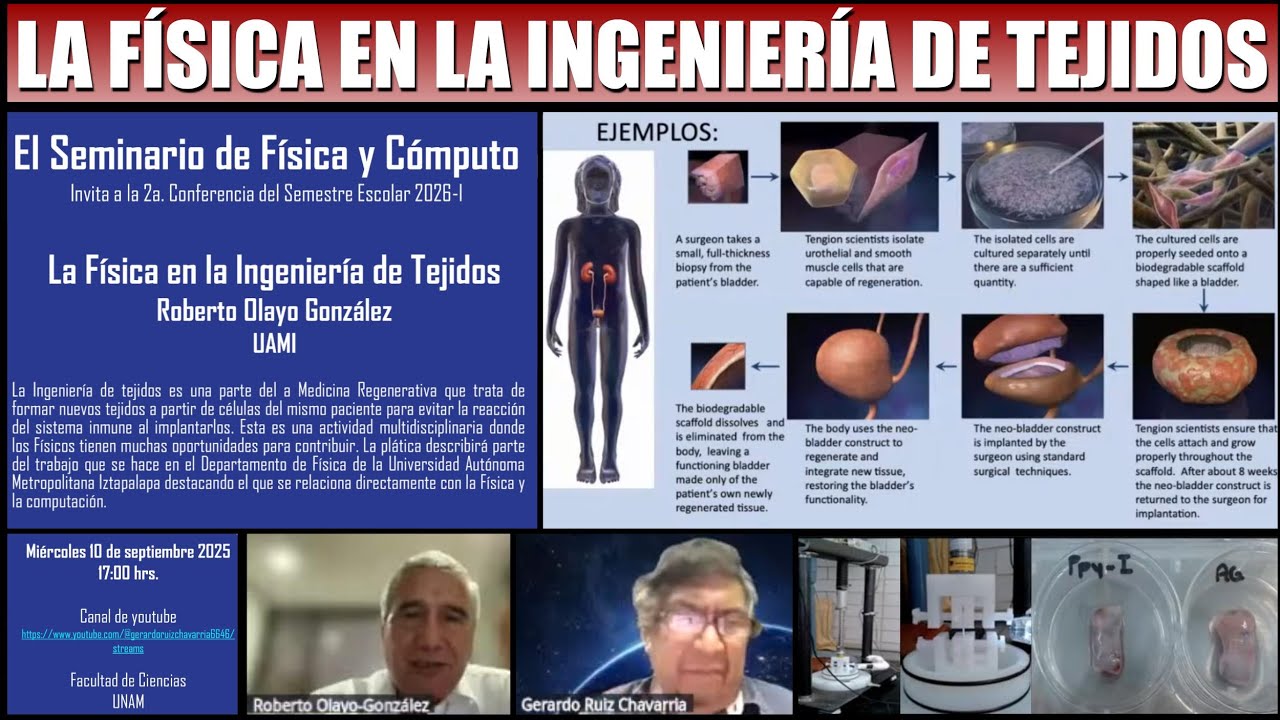
La Física en la Ingeniería de Tejidos
Keywords
Summary
149 words
Critical Evaluation
Value of the Information & Strength of the Argument
The talk provides valuable insights into the application of physics in tissue engineering, particularly through plasma polymerization and scaffold design. The speaker’s argumentation is solid, grounded in his own experimental results and collaborations. He clearly explains the scientific principles behind plasma and polymerization, and supports his claims with specific examples, such as the spinal cord injury study. The presentation is logical, progressing from fundamental concepts to specific research outcomes, and effectively demonstrates the interdisciplinary nature of the field.
Scientific Rigor, Source Quality, Title Accuracy
The scientific rigor is high, as the speaker is an established researcher with a track record of publications. He references his own work and collaborations with institutions like the National Institute of Neurology and the Federico Gómez Children’s Hospital. However, he does not provide explicit citations to specific papers, which limits the verifiability of his claims. The title accurately reflects the content, focusing on the role of physics in tissue engineering. The talk is well-structured and technically detailed, suitable for an audience with some scientific background.
179 words
Title / Content Match
The title accurately reflects the content, which focuses on the role of physics in tissue engineering, particularly in scaffold design and plasma polymerization.
Quality & Reliability
8/10
The speaker is a senior researcher (SNI level 3) with extensive experience in plasma polymerization and tissue engineering, presenting his own research with detailed technical explanations and references to collaborations. The content is grounded in experimental work and published results, though presented as a seminar talk without formal citations.
Key Moments
Markers derived by PSI from the transcript: the creator did not define chapters.
- Introduction to regenerative medicine and tissue engineering
- Explanation of scaffold design parameters
- Introduction to plasma and plasma polymerization
- Characterization of polypyrrole using infrared spectroscopy
- Spinal cord injury experiment and results
- Use of MRI and tractography to monitor nerve regeneration
Cited Sources
- Seminario de Física y Cómputo playlist — Related seminar videos from the same series
Concurring Sources
- Tissue engineering — General concept of tissue engineering as a multidisciplinary field.
- Plasma polymerization — Technique used to synthesize polymers from plasma.
Contribution & Novelties
The talk provides an original perspective on the application of physics in tissue engineering, particularly through the use of plasma polymerization to create conductive polymer scaffolds. The speaker’s work on polypyrrole for spinal cord repair is a novel contribution, demonstrating functional recovery in animal models. The integration of MRI tractography to assess nerve regeneration is also innovative.
Pour aller plus loin :
- Tissue engineering — Overview of the field.
- Plasma polymerization — Technique used to synthesize polymers.
- Polypyrrole — Conductive polymer used in the research.
- Spinal cord injury — Context for the experimental application.
94 words
Radar Profile
The radar profile shows high scores in information quantity, quality, and reliability, with a slightly lower technical level. This indicates a well-balanced presentation that is both informative and credible, though it may require some background knowledge to fully appreciate the technical details.