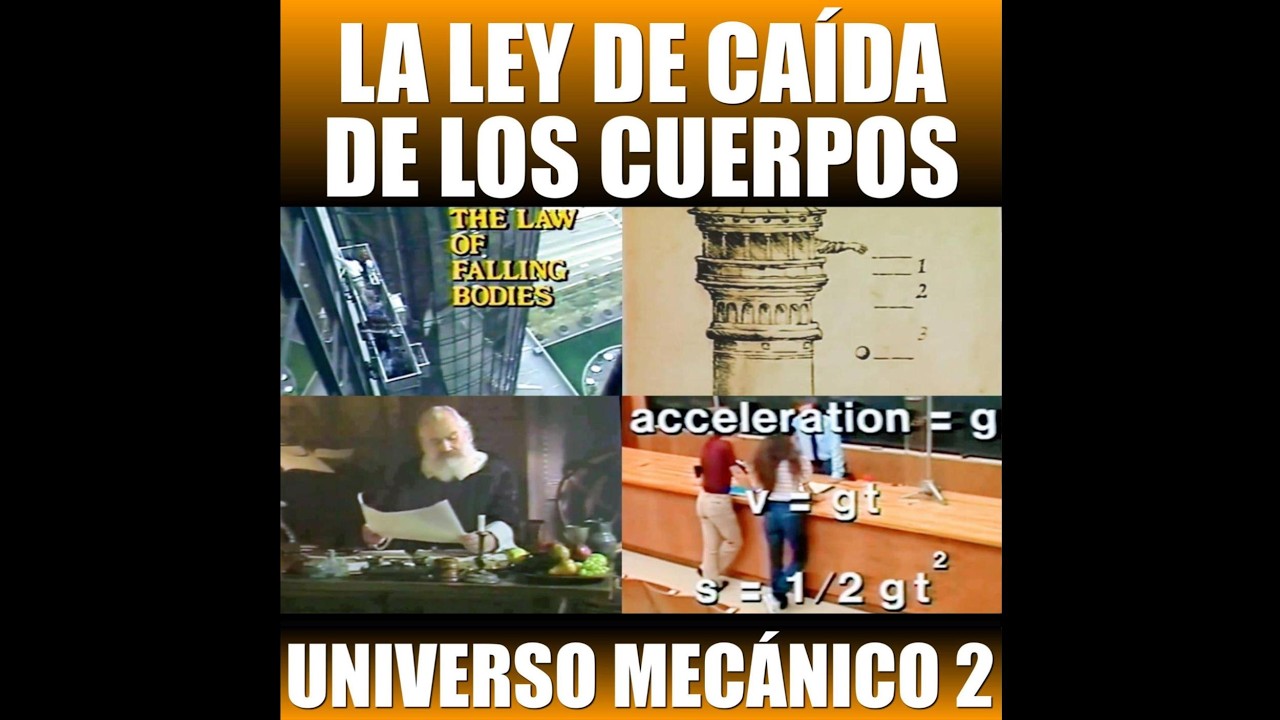
La Ley de la caída de los Cuerpos (Universo Mecánico 2)
Keywords
Summary
157 words
Critical Evaluation
Value of the Information & Strength of the Argument
The video provides a clear and engaging explanation of a fundamental physics concept, using historical context and visual demonstrations. The argumentation is solid, building from empirical observations to mathematical formalization. It effectively shows how Galileo’s law leads to the need for calculus, and the derivation of the derivative is explained step-by-step. The use of the roller coaster example to illustrate the odd-number rule is particularly effective. The video also addresses potential misconceptions, such as the role of air resistance, and presents the logical reasoning behind Galileo’s conclusions.
96 words
Title / Content Match
The title accurately reflects the content, which focuses on the law of falling bodies as discovered by Galileo and developed by Newton and Einstein.
Quality & Reliability
8/10
The video is part of the well-known educational series 'The Mechanical Universe' produced by Caltech, featuring expert narration and historical accuracy. The content is scientifically sound, with clear explanations of Galileo's law and the introduction of calculus. However, it is an educational documentary from 1985, so some modern perspectives are missing.
Key Moments
Markers derived by PSI from the transcript: the creator did not define chapters.
- Demonstration of feather and coin falling in a vacuum tube.
- Apollo 15 astronaut David Scott performs the feather and hammer experiment on the Moon.
- Galileo's thought experiment about heavy and light bodies leading to the conclusion that all fall at the same rate.
- Introduction of Leonardo da Vinci's and Galileo's theories on the distances covered in successive time intervals.
- Explanation of Galileo's odd-number rule and its demonstration on a roller coaster.
- Derivation of the derivative to find instantaneous velocity.
- Derivation of acceleration as a constant, leading to the final equations of motion.
- Discussion of the contributions of Nicole Oresme and the invention of calculus by Newton and Leibniz.
- Conclusion highlighting the significance of the law and its connection to Einstein's general relativity.
Cited Sources
- The Mechanical Universe (English Wikipedia) — Provides background on the series and its production.
- El universo mecánico (Spanish Wikipedia) — Spanish version of the series' Wikipedia page.
- Caltech's Mechanical Universe playlist on YouTube — Original English episodes from Caltech's channel.
- Playlist of the series on Ciencias TV — Spanish playlist of the series.
Concurring Sources
- The Mechanical Universe (Wikipedia) — Confirms the series' educational purpose and content.
Contribution & Novelties
This video offers a clear and engaging introduction to the law of falling bodies, using historical narrative and visual demonstrations. It effectively explains the need for calculus in physics, making the concept of instantaneous velocity accessible. The video’s strength lies in its pedagogical approach, combining experiments, thought experiments, and mathematical derivations.
Pour aller plus loin :
- Galileo’s inclined plane experiment — Provides details on Galileo’s experimental method.
- Derivative (Wikipedia) — Explains the mathematical concept of the derivative.
- Equations of motion — Discusses the kinematic equations for uniformly accelerated motion.
- General relativity — Einstein’s theory that extends the concept of gravity.
100 words
Radar Profile
The radar profile shows high scores in information quality and reliability, with slightly lower scores in technical level and quantity. This indicates a well-balanced educational video that is both accurate and accessible, though it may not delve into advanced mathematical details.
💬 No comments were provided for analysis.