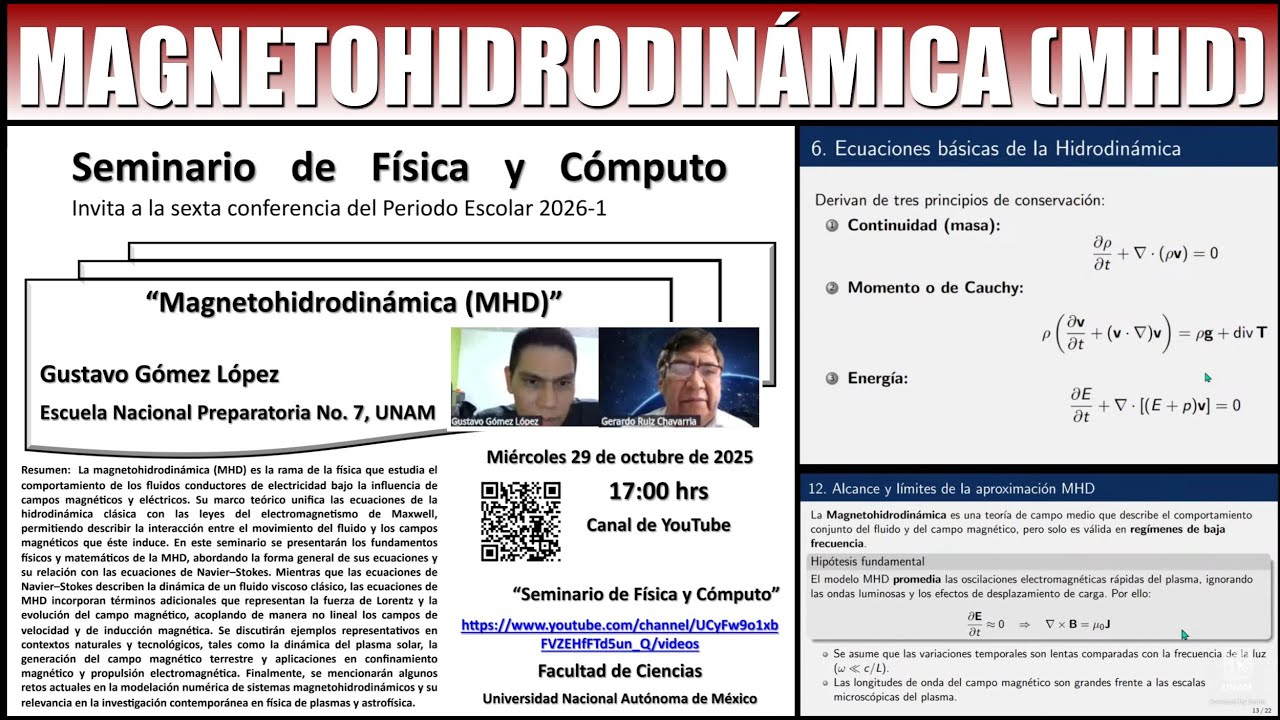
Magnetohidrodinámica (MHD) (Gustavo Gómez)
Keywords
Summary
167 words
Critical Evaluation
Value of the Information & Strength of the Argument
The value of the information lies in its clear pedagogical presentation of the core concepts and equations of MHD, making it accessible to students and newcomers. The argumentation is logically structured, building from fundamental hydrodynamics to the more complex MHD framework. The speaker justifies each simplification (e.g., inviscid flow, infinite conductivity) and explains the physical meaning of each term, which strengthens the educational value. However, the talk is introductory and does not delve into advanced derivations or recent research, limiting its depth for experts.
Scientific Rigor, Source Quality, Title Accuracy
The scientific rigor is adequate for an introductory seminar: the equations are correctly stated, and the physical assumptions are clearly articulated. However, no specific sources or references are cited within the talk, and the only link in the description is to a playlist of related seminars, which does not provide direct references. The title accurately reflects the content, and the presentation is coherent and well-organized. The speaker’s credentials (M.Sc. in fluid mechanics) lend credibility, but the lack of citations reduces the overall rigor.
182 words
Title / Content Match
The title accurately reflects the content, which is an introductory lecture on magnetohydrodynamics.
Quality & Reliability
7/10
The presentation is a clear, well-structured introduction to MHD, grounded in classical fluid dynamics and Maxwell's equations. The speaker demonstrates solid knowledge, but the content is introductory and lacks detailed derivations or citations. The video is a seminar recording, not a peer-reviewed source.
Key Moments
Markers derived by PSI from the transcript: the creator did not define chapters.
- Introduction to the seminar and speaker's background.
- Explanation of the continuum hypothesis and Knudsen number.
- Introduction to hydrodynamics and conservation equations.
- Derivation of Euler equation for inviscid flows.
- Navier-Stokes equations and Reynolds number for flow regimes.
- Introduction to magnetohydrodynamics and its applications.
- MHD momentum equation with Lorentz force.
- Induction equation and frozen-in magnetic field concept.
Cited Sources
- Seminario de Física y Cómputo playlist — The only link in the description, leading to a playlist of related seminars.
Concurring Sources
- Magnetohydrodynamics - Wikipedia — General reference for MHD concepts and equations.
- Navier–Stokes equations - Wikipedia — Reference for the Navier-Stokes equations discussed in the talk.
Contribution & Novelties
The talk provides a clear and concise introduction to MHD, bridging classical fluid dynamics and electromagnetism. It is particularly valuable for students seeking a conceptual understanding of the governing equations and their physical significance. The speaker’s emphasis on the validity conditions of the continuum hypothesis and MHD approximations is a useful pedagogical contribution.
Pour aller plus loin :
- Magnetohydrodynamics - Wikipedia — Comprehensive overview of MHD theory and applications.
- Navier–Stokes equations - Wikipedia — Detailed treatment of the fundamental equations of fluid dynamics.
- Plasma (physics) - Wikipedia — Introduction to plasmas, the primary application of MHD.
96 words
Radar Profile
The radar profile shows balanced scores across all dimensions, with slightly lower technical depth due to the introductory nature. The video is a solid educational resource, though not highly advanced.