Microsismicidad en zonas urbanas: Valle de México y Los Cabos, B.C.S.
Keywords
Summary
177 words
Critical Evaluation
Value of the Information & Strength of the Argument
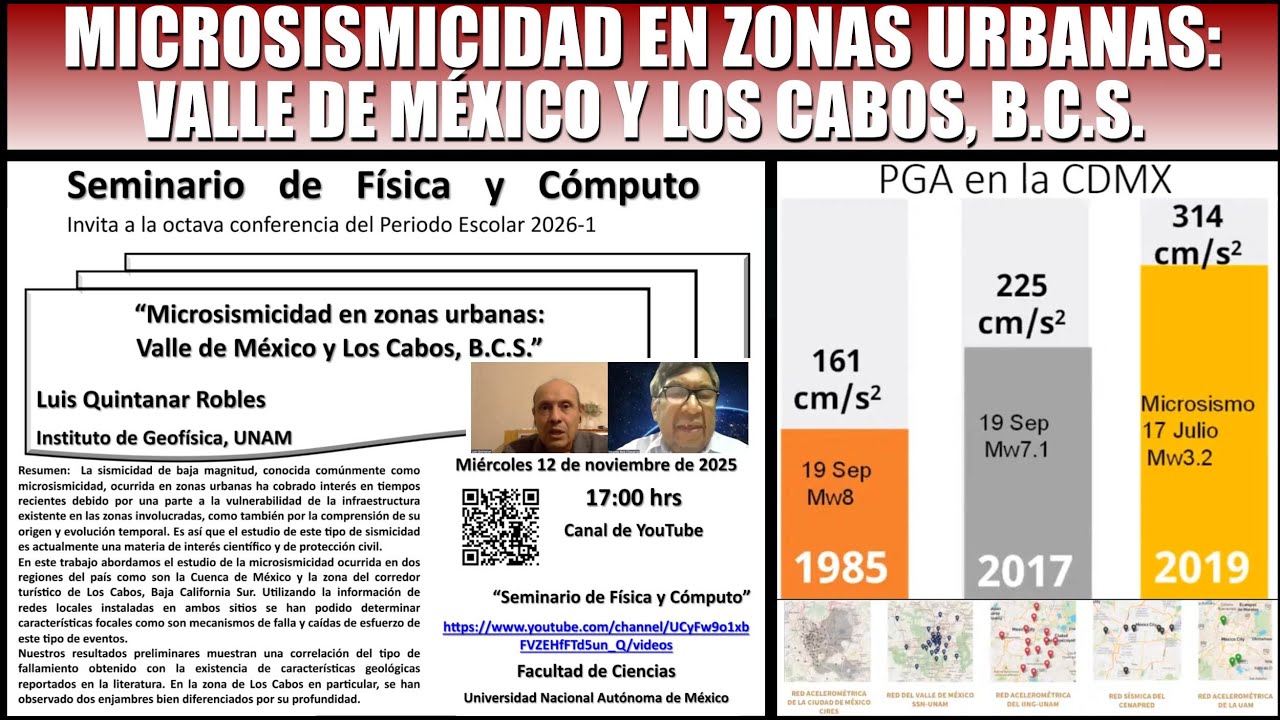
The presentation provides valuable insights into urban microseismicity, highlighting the importance of dense monitoring networks. The argumentation is solid, based on observational data from the seismic network and modeling. The speaker effectively demonstrates how increased station density reveals previously hidden seismicity patterns and how local site effects can amplify ground motion significantly. The comparison of peak ground accelerations from small local events to those from large distant earthquakes is compelling and underscores the need for local hazard assessment. The use of stochastic models to fit observed data is a strength, though the presentation could benefit from more detailed explanation of the modeling assumptions.
Scientific Rigor, Source Quality, Title Accuracy
The scientific rigor is high, as the speaker is a leading expert and the research is based on real seismic data. The sources are primarily the speaker’s own research and the seismic networks, which are credible. The title accurately reflects the content, covering both areas mentioned. The talk is well-structured, but the lack of references to external publications in the description limits the ability to verify claims independently. The adéquation between title and content is good, as the talk delivers on its promise.
201 words
Title / Content Match
The title accurately reflects the content, covering microseismicity in two urban areas as presented.
Quality & Reliability
8/10
The talk is given by a recognized expert from UNAM's Geophysics Institute, presenting original research based on seismic network data. The methodology is sound, and results are contextualized with comparisons to historical events. However, the presentation is a seminar, not a peer-reviewed publication, and some details are simplified for a general audience.
Key Moments
Markers derived by PSI from the transcript: the creator did not define chapters.
- Introduction of the speaker and seminar topic.
- Overview of seismicity in the Valley of Mexico from 2010-2023.
- Comparison of seismic detection before and after the Red Sísmica del Valle de México.
- Discussion of the July 17, 2019 earthquake (M3.2) and its high peak ground acceleration.
- Formation of the Red Sísmica de la Ciudad de México with 120 stations.
- Analysis of the May 11, 2023 earthquake and fault mechanisms.
- Identification of seismic zones in the western part of the city.
- Comparison of observed spectra with theoretical models, highlighting site effects.
- Development of stochastic models for peak ground acceleration.
- Transition to the second part on Los Cabos, B.C.S. (transcript ends).
Cited Sources
- Seminario de Física y Cómputo - Playlist — Description of the video, providing access to other seminar talks.
Concurring Sources
- National Seismological Service (UNAM) — Provides seismic data and monitoring for Mexico, supporting the existence and operation of the networks mentioned.
Contribution & Novelties
The talk provides original insights into urban microseismicity, particularly the discovery of high peak ground accelerations from small local earthquakes in Mexico City, attributed to strong site effects. It also contributes to the development of stochastic models for ground motion prediction specific to the basin. The presentation underscores the value of dense seismic networks for hazard assessment.
Pour aller plus loin :
- Seismic network of Mexico City — Official site of the National Seismological Service, providing data and information on the network.
- Site effects in Mexico City — Wikipedia article on the 1985 earthquake, which discusses site effects and the lakebed amplification.
- Peak ground acceleration — Wikipedia article explaining PGA, a key parameter in seismic hazard assessment.
117 words
Radar Profile
The radar profile shows high scores across all dimensions, indicating a well-rounded and reliable presentation. The quantity and quality of information are strong, with a high technical level appropriate for a specialized seminar. The overall reliability is high, reflecting the expertise of the speaker and the use of real data.