Keywords
Summary
208 words
Critical Evaluation
Value of the Information & Strength of the Argument
The video provides a valuable pedagogical approach to teaching the integral as a natural extension of the concept of work. The argumentation is solid, building from a simple constant-force example to the more complex variable-force case, and clearly demonstrating how the integral arises from the limit of Riemann sums. The instructor effectively uses analogies with previous lessons (velocity and distance) to reinforce the conceptual framework. The explanation of the gravitational field and its geometric representation is clear and helps to motivate the need for integration. The lecture successfully bridges physical intuition and mathematical formalism, making the abstract concept of the integral more tangible.
Scientific Rigor, Source Quality, Title Accuracy
The lecture is mathematically rigorous in its reasoning, but it does not cite any external sources or references. The title is accurate and appropriately reflects the content, which focuses on the integral of force over displacement and its connection to Stokes’ theorem. The presentation is informal and conversational, which may be engaging for students but could be seen as lacking the precision of a formal textbook treatment. The instructor does not provide any citations for the physical laws or mathematical theorems mentioned, relying instead on established knowledge. The video’s content is consistent with standard calculus and physics curricula, and the mathematical derivations are correct.
222 words
Title / Content Match
The title accurately reflects the content: the lecture focuses on the integral of force with respect to displacement, and the connection to Stokes' theorem is mentioned as a broader framework.
Quality & Reliability
7/10
The video is a formal lecture by a university instructor, presenting the concept of work as an integral of force over displacement, using the gravitational field as an example. The mathematical reasoning is sound and pedagogically structured, but it lacks formal citations and references, and the presentation is informal with some digressions.
Key Moments
Markers derived by PSI from the transcript: the creator did not define chapters.
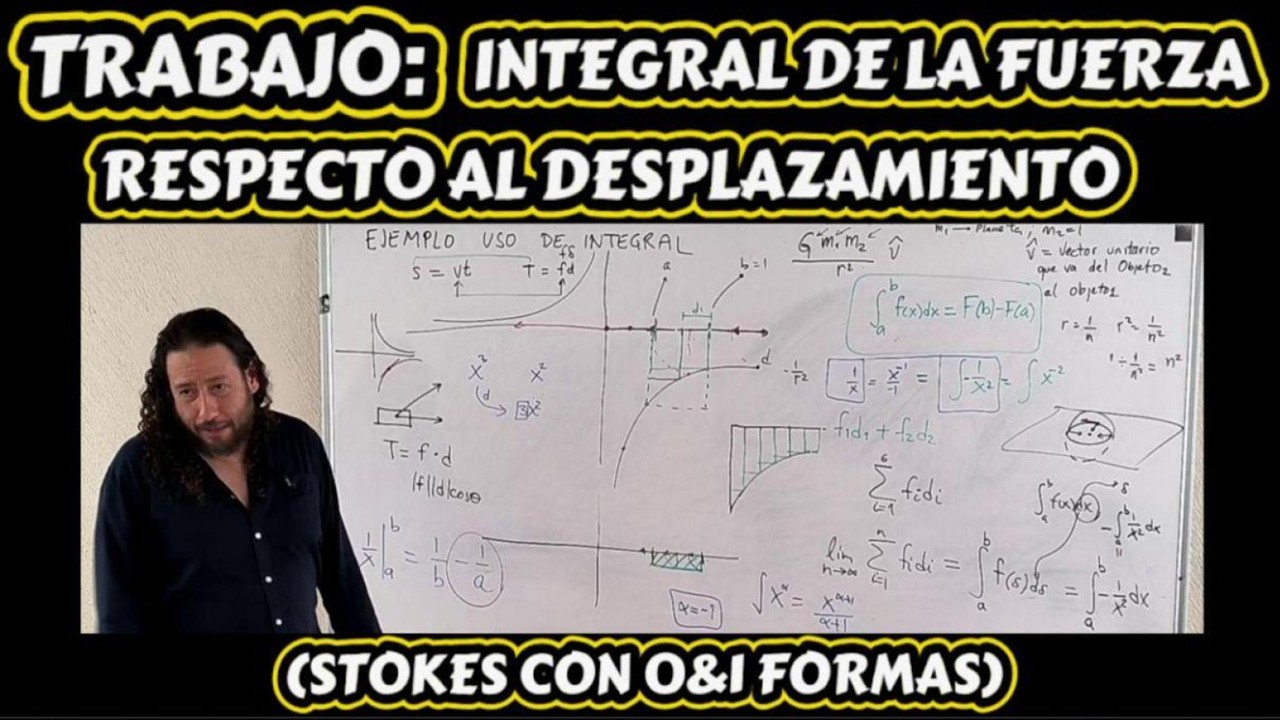
- Introduction: analogy between historical discovery of calculus and recognizing calculus in daily life.
- Definition of work as force times distance, and the plan to simplify to one-dimensional motion.
- Explanation of the gravitational field as an example of a force field, with the inverse square law.
- Geometric visualization of the gravitational field using concentric spheres and vectors.
- Reduction to one dimension: an object falling along a straight line, and the graph of -1/r^2.
- Comparison with the constant-force case, showing how the simple formula underestimates or overestimates the work.
- Introduction of Riemann sums: approximating the work by summing rectangles of force times displacement.
- Conclusion: the integral as the limit of the sum, and the connection to Stokes' theorem and differential forms.
Contribution & Novelties
The video offers a clear and intuitive introduction to the concept of work as an integral, using the gravitational field as a concrete example. It effectively bridges the gap between the simple formula for constant forces and the general case of variable forces, leading to the definition of the line integral. The lecture’s originality lies in its pedagogical approach, emphasizing the geometric interpretation of the integral as the area under a curve and drawing parallels with previous lessons on velocity and distance.
Pour aller plus loin :
- Line integral — Provides a formal definition and examples of line integrals, directly relevant to the concept of work.
- Stokes’ theorem — Generalizes the fundamental theorem of calculus to higher dimensions, connecting the integral of a differential form over a manifold to its boundary.
- Differential form — Explains the mathematical framework of 0-forms and 1-forms, which are mentioned in the title and provide a deeper context for the integral.
156 words
Radar Profile
The radar profile shows a balanced performance across all dimensions, with slightly higher scores in information quantity and quality, reflecting the lecture's comprehensive coverage and clear explanations. The technical level is moderate, suitable for an introductory calculus audience, and the overall reliability is good, though the lack of citations slightly lowers the score.