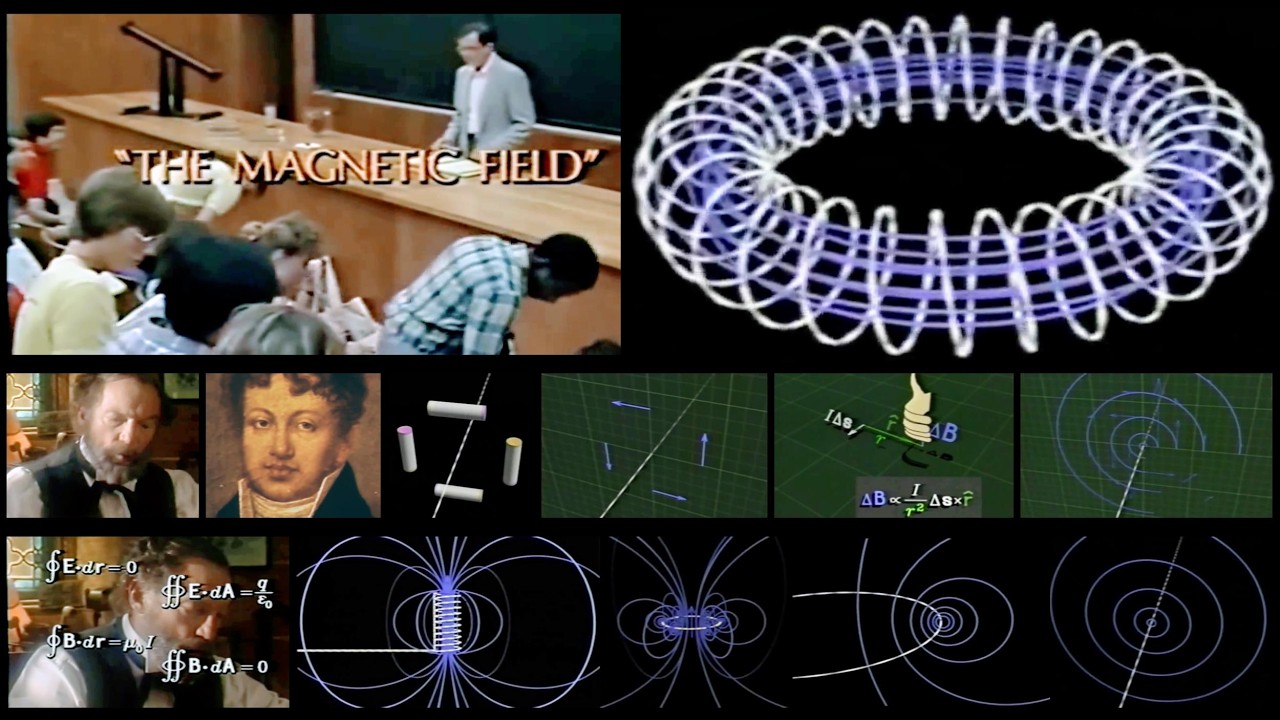
El Campo Magnético (Universo Mecánico 35)
Keywords
Summary
175 words
Critical Evaluation
Value of the Information & Strength of the Argument
The video provides a solid historical and conceptual foundation for understanding magnetic fields. It effectively uses Ampère’s biography to contextualize his scientific achievements, and the step-by-step derivation of Ampère’s law from the magnetic field of a straight wire is clear and logical. The argumentation is sound, presenting both the successes and the later-refuted aspects of Ampère’s theories, such as the ether model, which adds depth. The inclusion of the Marines’ compass navigation serves as a practical illustration of magnetic field applications, though it may seem tangential. Overall, the information is valuable for learners seeking a historical perspective on electromagnetism, but it does not delve into advanced mathematical derivations or modern quantum explanations.
Scientific Rigor, Source Quality, Title Accuracy
The video is part of the well-regarded ‘Mechanical Universe’ series, produced by Caltech and INTELECOM, with lectures by Prof. David Goodstein. The scientific content is accurate and aligns with established physics. The description provides links to Wikipedia articles on the series, which serve as reliable references. The title accurately reflects the content, focusing on magnetic fields and Ampère’s work. No comments were provided for analysis, so no public reception trends can be assessed.
200 words
Title / Content Match
The title accurately reflects the content, which focuses on magnetic fields and Ampère's contributions.
Quality & Reliability
8/10
Produced by Caltech and INTELECOM, featuring lectures by Prof. David Goodstein, with animations by NASA JPL expert James F. Blinn. Content is historically accurate and scientifically sound, though dated (1985).
Key Moments
Markers derived by PSI from the transcript: the creator did not define chapters.
- Introduction to André-Marie Ampère's biography and early life.
- Explanation of Oersted's discovery and its impact on Ampère.
- Magnetic field around a straight wire and the right-hand rule.
- Field of a current loop, solenoid, and toroid.
- Ampère's law derived from line integrals.
- Comparison of electric and magnetic fields, and Maxwell's synthesis.
- Ampère's atomic current hypothesis and Fresnel's critique.
- Discussion of the ether model and its later rejection.
Cited Sources
- The Mechanical Universe (English Wikipedia) — Description provides this link as a reference for the series.
- El universo mecánico (Spanish Wikipedia) — Description provides this link as a reference for the series.
- Caltech's Mechanical Universe playlist on YouTube — Description provides this link to the original English episodes.
- Playlist of Mechanical Universe episodes on this channel — Description provides this link to the playlist of the series.
Concurring Sources
- The Mechanical Universe (English Wikipedia) — Confirms the series' production by Caltech and its educational purpose.
Contribution & Novelties
This episode contributes to physics education by presenting the historical development of magnetic field theory through Ampère’s work, using engaging animations and clear explanations. It bridges experimental discoveries and mathematical formulations, making complex concepts accessible. The video also highlights the iterative nature of scientific progress, including incorrect hypotheses like the ether model.
Pour aller plus loin :
- Ampère’s force law — Directly related to Ampère’s work on forces between current-carrying conductors.
- Biot–Savart law — Provides the mathematical basis for magnetic fields from current elements, complementing Ampère’s law.
- Maxwell’s equations — The complete set of equations that unify electricity and magnetism, building on Ampère’s law.
104 words
Radar Profile
The radar profile shows high scores in information quantity, quality, and reliability, with a slightly lower technical level, indicating a well-balanced educational resource that is both informative and accessible.