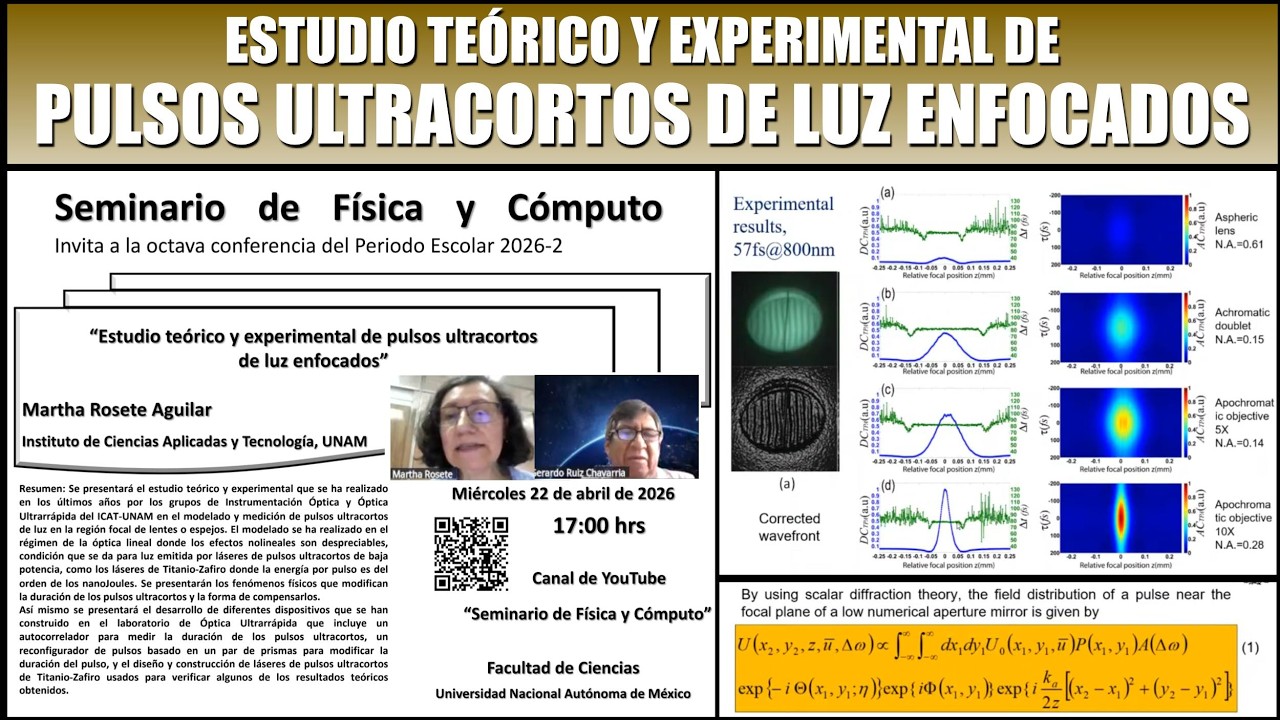
Estudio teórico y experimental de pulsos ultracortos de luz enfocados
Keywords
Summary
201 words
Critical Evaluation
Value of the Information & Strength of the Argument
The value of the information is high for those interested in ultrafast optics, as it provides a clear explanation of key phenomena affecting pulse duration when focusing. The argumentation is solid: the speaker builds from fundamental concepts (mode-locking, group velocity) to more complex effects (GVD, PTD), and supports her claims with both theoretical derivations and experimental results. She also references published work, such as that by Arthur Bon and Rick Trebino, adding credibility. However, the presentation is a seminar, so some details are simplified, and the experimental verification is mentioned but not shown in detail.
Scientific Rigor, Source Quality, Title Accuracy
The scientific rigor is good: the speaker is a researcher in the field, and the content is based on established physics. She cites specific sources, including a paper by Arthur Bon on phase and group lenses, and work by Rick Trebino’s group on aberrations. The title accurately reflects the content, covering both theoretical and experimental aspects. The talk is well-structured, moving from basics to advanced topics. However, the presentation is not a peer-reviewed publication, and some references are mentioned but not fully cited. The description includes a link to a playlist of related seminars, but no direct links to the cited papers.
212 words
Title / Content Match
The title accurately reflects the content, which covers both theoretical modeling and experimental measurements of focused ultrashort pulses.
Quality & Reliability
8/10
The speaker is a researcher at UNAM's Institute of Applied Sciences and Technology, with a solid background in optical design. The presentation is based on published work and includes both theoretical models and experimental verification. However, the talk is a seminar, not a peer-reviewed publication, and some details are simplified for a general audience.
Key Moments
Markers derived by PSI from the transcript: the creator did not define chapters.
- Introduction and importance of ultrashort pulses in applications like nonlinear microscopy and micromachining.
- Explanation of mode-locking and the definition of carrier wave, envelope, phase velocity, and group velocity.
- Discussion of group velocity dispersion (GVD) and its effect on pulse duration using Taylor expansion.
- Introduction of the difference in propagation time (PTD) across a lens and its impact on pulse broadening.
- Theoretical modeling using scalar diffraction theory to show pulse broadening for a simple lens and correction with an achromatic doublet.
- Experimental verification and mention of commercial lasers with specifications matching the calculations.
- Conclusion and emphasis on the need to correct aberrations and dispersion for optimal focusing.
Cited Sources
- Playlist of related seminars — Description of the video, providing access to other seminars from the same series.
Concurring Sources
- Arthur Bon's work on phase and group lenses — Mentioned in the talk as the inspiration for the study, but no direct URL provided.
- Rick Trebino's group on aberrations and pulse duration — Cited in the talk to support the claim that aberrations can increase pulse duration, but no direct URL provided.
Contribution & Novelties
The talk provides a comprehensive overview of the physical phenomena affecting focused ultrashort pulses, combining theoretical modeling with experimental verification. It highlights the importance of correcting group velocity dispersion and chromatic aberration to maintain pulse duration and spatial resolution. The speaker’s own research contributes to the understanding of these effects and offers practical solutions, such as using achromatic doublets.
Pour aller plus loin :
- Group velocity dispersion — A key concept discussed in the talk, explaining how different frequencies travel at different speeds in a medium.
- Chromatic aberration — The phenomenon that causes different wavelengths to focus at different points, relevant to the PTD effect.
- Femtosecond pulse shaping — Techniques used to manipulate ultrashort pulses, related to the talk’s focus on pulse control.
123 words
Radar Profile
The radar profile shows high scores across all dimensions, indicating a well-balanced presentation with strong technical depth, reliable information, and good scientific rigor. The talk is particularly strong in quantitative information and technical level, reflecting its focus on detailed theoretical and experimental analysis.