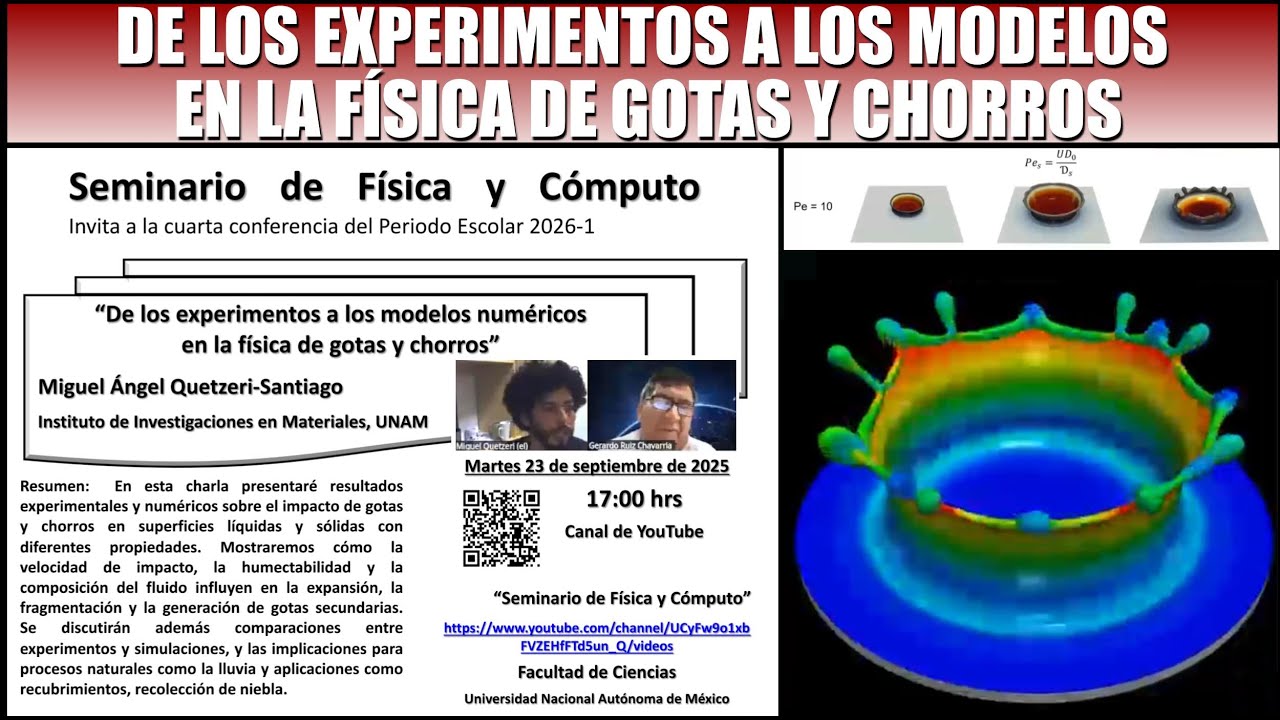
De los experimentos a los modelos en la física de gotas y chorros
Keywords
Summary
155 words
Critical Evaluation
Value of the Information & Strength of the Argument
The talk provides valuable insights into the physics of droplet and jet impacts, supported by a clear experimental methodology and complementary numerical simulations. The speaker systematically varies parameters such as surface wettability, roughness, and surfactant type, and uses dimensionless numbers (Weber, Ohnesorge, Peclet) to characterize the phenomena. The argumentation is solid, as experimental observations are compared with simulation results, and discrepancies are discussed. The introduction of a predictive parameter for splashing (beta) and the explanation of the role of surfactants in crown dynamics are particularly valuable. The presentation is well-structured, moving from simple to complex scenarios, and the speaker effectively communicates the physical mechanisms behind the observed behaviors.
Scientific Rigor, Source Quality, Title Accuracy
The scientific rigor is high: the speaker presents original research with detailed experimental setups and numerical methods. However, no external sources are cited in the talk, and the description only provides a link to the seminar’s playlist. The title accurately reflects the content, which transitions from experiments to models. The talk is a seminar presentation, not a peer-reviewed publication, so the absence of citations is expected. The methodology is clearly described, and the results are reproducible in principle. The adequacy between title and content is excellent, as the talk indeed covers both experimental and numerical aspects.
219 words
Title / Content Match
The title accurately reflects the content, which transitions from experimental observations to numerical models for drops and jets.
Quality & Reliability
8/10
The talk presents original research with clear experimental setup, high-speed imaging, and numerical simulations. The speaker is a researcher at UNAM's Materials Research Institute. The methodology is well-described, and results are compared with simulations. However, no external sources are cited, and the talk is a seminar rather than a peer-reviewed publication.
Key Moments
Markers derived by PSI from the transcript: the creator did not define chapters.
- Introduction to the importance of droplet physics in nature and industry.
- Experimental setup for droplet impact on solid surfaces using high-speed camera.
- Impact of droplets on hydrophilic and hydrophobic surfaces, showing spreading and bouncing.
- Effect of surface roughness and wettability on splashing, introduction of beta parameter.
- Study of emulsion droplets and their impact on hydrophobic surfaces.
- Phase diagram for droplet rebound vs. sticking, explanation of suction force.
- Numerical simulations using Basilisk, comparison with experiments.
- Impact of droplets on liquid pools with surfactants, crown formation.
- Simulations of surfactant distribution and Marangoni flow.
- Jet impact into deep pools, ongoing research.
Cited Sources
- Seminario de Física y Cómputo - Playlist — Playlist of related seminar talks from the same channel.
Concurring Sources
- Seminario de Física y Cómputo - Playlist — Related seminar talks that may cover similar topics.
Contribution & Novelties
The talk presents original research on droplet and jet impacts, combining experimental observations with numerical simulations. The speaker introduces a parameter beta to predict splashing based on air forces, and studies the effect of surfactants on crown dynamics. The numerical simulations using Basilisk and a front-tracking/level-set method provide insights into the underlying physics. The talk also explores the use of patterned surfaces to control droplet spreading, which has potential applications in printing and coating.
Pour aller plus loin :
- Droplet impact dynamics — Overview of the field.
- Weber number — Dimensionless number used to characterize droplet impact.
- Marangoni effect — Relevant to surfactant-driven flows.
- Basilisk (software) — Open-source CFD software used for simulations.
113 words
Radar Profile
The radar profile shows high scores in quantity and quality of information, and moderate technical level. The talk is rich in content and well-structured, but the technical depth is accessible to a general scientific audience. The reliability is high due to the original research nature.
💬 Sur les 0 commentaires analysés, aucune tendance n'est disponible.