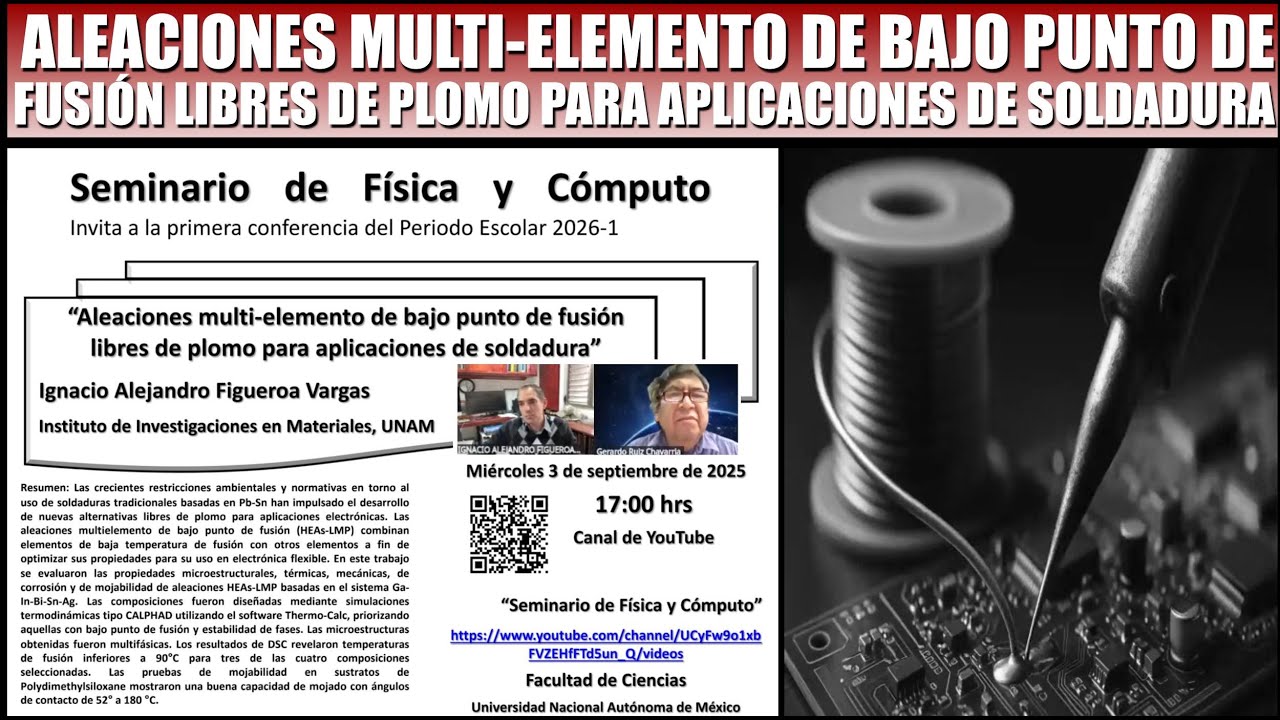
Aleación multi-elemento d bajo punto d fusión libres d plomo p aplicaciones d soldadura (Ignacio F)
Keywords
Summary
167 words
Critical Evaluation
Value of the Information & Strength of the Argument
The value of the information is high, as it presents a systematic approach to alloy design, combining computational thermodynamics with experimental validation. The argumentation is solid, with a clear logical flow from problem definition to solution. The speaker effectively demonstrates how Thermo-Calc simulations can efficiently screen a large compositional space, reducing experimental effort. The experimental results corroborate the simulations, and the mechanical and corrosion testing provide a comprehensive evaluation of the alloy’s performance. The presentation is well-structured, and the speaker’s expertise is evident.
Scientific Rigor, Source Quality, Title Accuracy
The scientific rigor is commendable: the research follows a standard materials science methodology, with careful attention to experimental details (e.g., controlled atmosphere, quartz sealing). The use of Thermo-Calc with a dedicated database for low-melting-point alloys is appropriate. The sources cited are primarily the speaker’s own work and the Thermo-Calc software, with no external references provided in the description. The title accurately reflects the content, and the presentation is consistent with the abstract. The video is a seminar recording, so the quality is typical of academic presentations.
184 words
Title / Content Match
The title accurately reflects the content: the talk focuses on lead-free, low-melting-point multi-principal element alloys for soldering applications.
Quality & Reliability
8/10
The presentation is based on original research, with a clear methodology combining thermodynamic simulations (Thermo-Calc) and experimental validation (XRD, DSC, mechanical testing, corrosion tests). The speaker demonstrates expertise and provides detailed data. However, the video is a seminar recording with limited peer-review context, and some results are presented qualitatively.
Key Moments
Markers derived by PSI from the transcript: the creator did not define chapters.
- Introduction to the seminar and the topic of lead-free low-melting-point alloys for soldering.
- Explanation of the four fundamental requirements for solder: wetting, mechanical properties, melting temperature, and corrosion resistance.
- Definition of high-entropy alloys and multi-principal element alloys, and the history of the field.
- Description of the methodology: using Thermo-Calc to simulate over 200 compositions and select promising candidates.
- Experimental synthesis: arc melting of high-melting-point elements, then sealing in quartz with argon and melting at 600°C.
- Presentation of Thermo-Calc simulation results for the selected alloys, showing the evolution of phases and the reduction of residual liquid.
- Microstructural analysis via XRD and metallography, correlating experimental phases with simulations.
- Mechanical testing: compression tests showing the best alloy's ductility, and wetting tests demonstrating good wetting on copper.
- Corrosion testing: comparison with conventional lead-free solder, showing superior corrosion resistance.
Cited Sources
- Seminario de Física y Cómputo playlist — Link to other videos from the seminar series, provided in the video description.
Concurring Sources
- High-entropy alloys: A critical review — A comprehensive review of high-entropy alloys, supporting the background and definitions.
Contribution & Novelties
The presentation contributes to the field by demonstrating a systematic approach to designing low-melting-point, lead-free solders using high-entropy/multi-principal element alloys. The use of Thermo-Calc to screen a large number of compositions and the subsequent experimental validation is a valuable methodology. The identification of a specific alloy with a melting point of 84°C, excellent ductility, and good corrosion resistance is a practical contribution. The work addresses the need for solders compatible with flexible polymer substrates.
Pour aller plus loin :
- High-entropy alloys — Overview of the field and key concepts.
- Thermo-Calc — Software used for thermodynamic calculations.
- Lead-free soldering — Context on the need for lead-free alternatives.
106 words
Radar Profile
The radar profile shows high scores in information quantity, quality, and reliability, with a slightly lower technical level, indicating a well-balanced presentation that is accessible yet detailed. The strengths are in the depth of content and the credibility of the research, while the technical level might be moderate for specialists.
💬 No comments were provided for analysis.