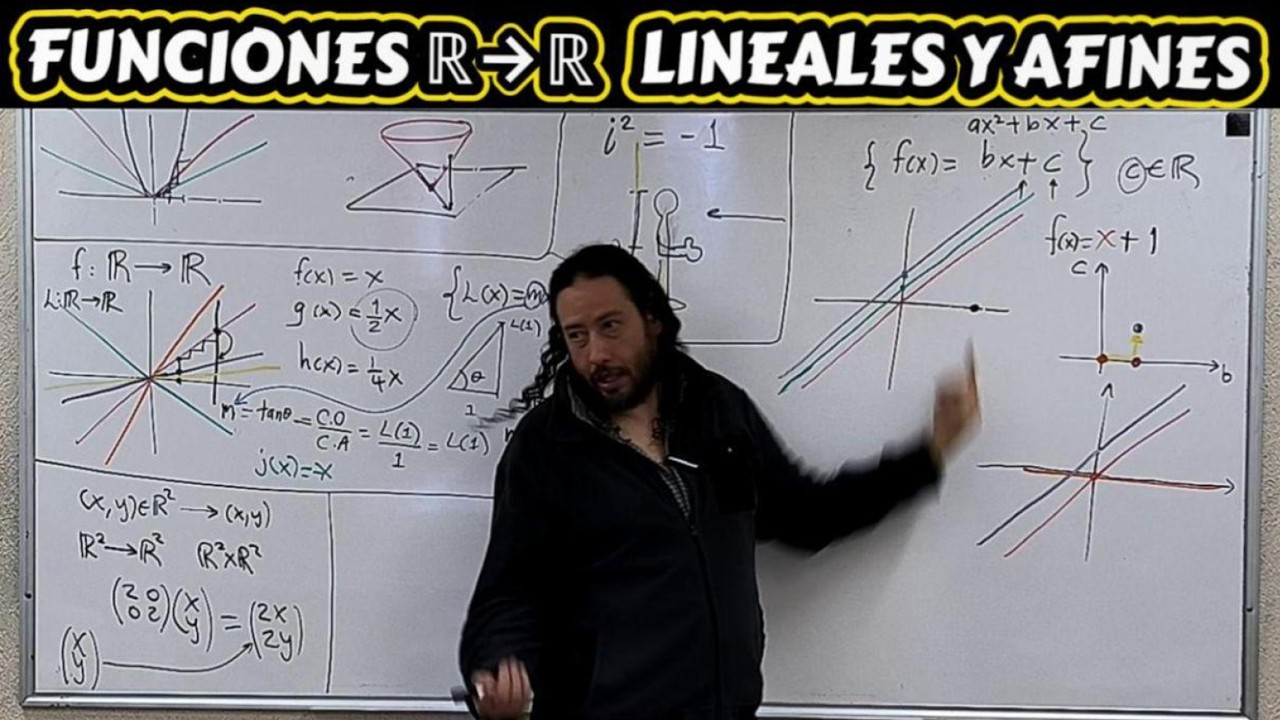
Funciones ℝ→ℝ lineales y afines
Keywords
Summary
144 words
Critical Evaluation
Value of the Information & Strength of the Argument
The lecture provides substantial value by building a solid conceptual foundation for linear functions. The instructor’s argumentation is clear and logically structured, starting from basic definitions and progressively adding layers of complexity. He uses multiple representations—algebraic, geometric, and intuitive—to reinforce understanding. The connection between linear functions and matrices is particularly insightful, offering a glimpse into more advanced topics. The use of examples, such as the staircase analogy for uniform growth, effectively illustrates abstract concepts. The instructor also addresses potential misconceptions, such as confusing distance with squared distance, which strengthens the pedagogical value.
Scientific Rigor, Source Quality, Title Accuracy
The lecture demonstrates scientific rigor in its mathematical reasoning, building concepts from axioms and prior knowledge. The instructor is careful to distinguish between distance and squared distance, and he explains the geometric meaning of slope using right triangles. However, the lecture is a classroom session and does not cite external sources; it relies on the instructor’s expertise and the course’s internal logic. The title accurately reflects the content, focusing on linear and affine functions. The lecture’s rigor is high for an introductory course, though it may not meet the standards of a formal academic publication.
202 words
Title / Content Match
The title accurately reflects the content: the lecture focuses on linear and affine functions from ℝ to ℝ, with geometric interpretations and connections to linear algebra.
Quality & Reliability
8/10
The lecture is mathematically rigorous, building concepts from axioms and geometric intuition. The instructor demonstrates deep understanding and connects ideas (e.g., distance, linear functions, matrices) coherently. However, as a classroom recording, it lacks formal citations and peer review, and the conversational style may introduce minor imprecisions.
Key Moments
Markers derived by PSI from the transcript: the creator did not define chapters.
- Introduction and review of previous topics: real numbers, Cartesian product, distance.
- Discussion on the distance function and its geometric interpretation as a cone.
- Review of coordinate systems and the role of coordinate functions.
- Introduction to linear functions from ℝ to ℝ, emphasizing uniform growth.
- Explanation of scaling functions by constants and its effect on the graph.
- Connection between linear functions and matrices, introducing the idea of matrices as 'credentials'.
- Preview of linear functions in higher dimensions and the concept of planes in ℝ⁴.
Contribution & Novelties
The lecture offers a pedagogical approach that connects linear functions to broader mathematical concepts, such as distance, matrices, and linear algebra. It emphasizes geometric intuition and the idea of functions as transformations. The instructor’s method of linking the slope to the tangent of an angle and introducing matrices as representations of linear functions provides a fresh perspective for beginners.
Pour aller plus loin :
- Linear function — Provides a formal definition and examples.
- Affine transformation — Explains the concept of affine functions and their properties.
- Matrix (mathematics) — Introduces matrices and their role in representing linear transformations.
- Distance — Discusses the concept of distance in mathematics and its properties.
109 words
Radar Profile
The radar profile shows high scores in information quantity, quality, and reliability, with a slightly lower technical level. This indicates a lecture that is rich in content and well-structured, but accessible to an introductory audience. The balance suggests a solid educational resource.