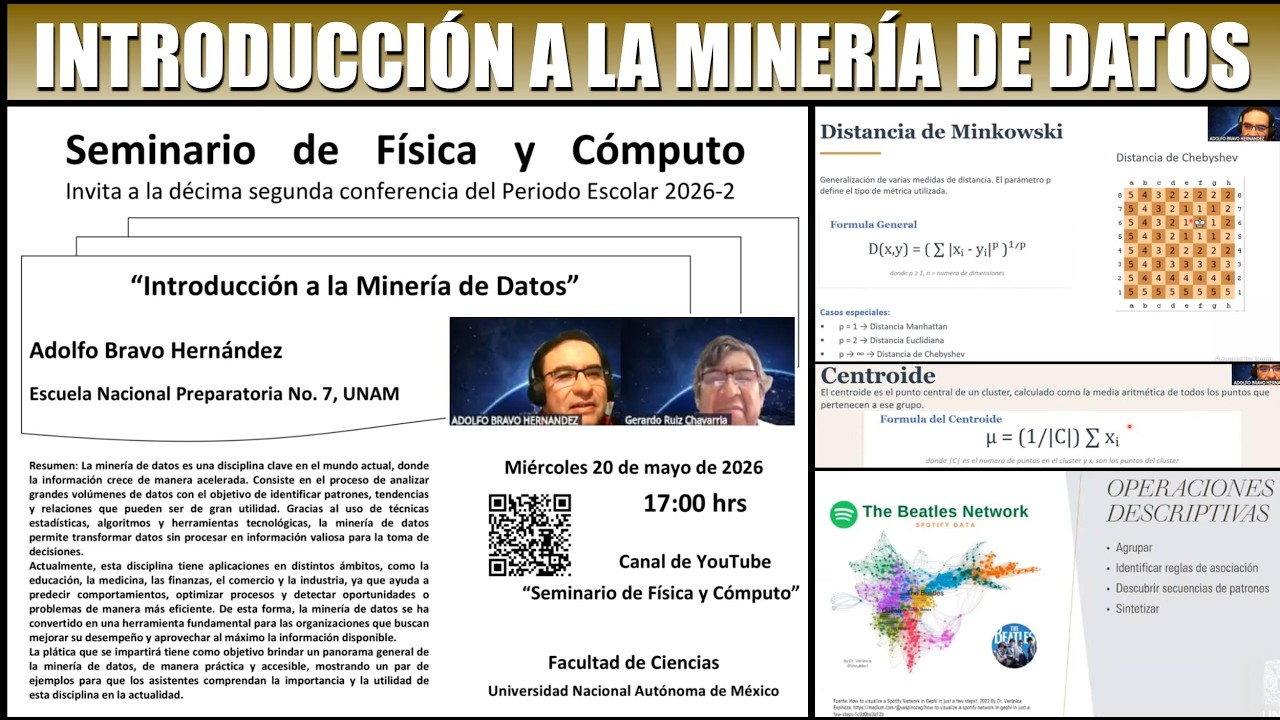
Introducción a la Minería de Datos
Keywords
Summary
186 words
Critical Evaluation
Value of the Information & Strength of the Argument
The lecture provides a solid foundational overview of data mining, effectively explaining key concepts and distinctions. The speaker’s argumentation is coherent, building from definitions to algorithm types and distance metrics. He uses relatable examples, such as the correlation vs. causation distinction and the chess king analogy for Chebyshev distance, which enhance understanding. However, the presentation lacks depth in formal mathematical treatment and does not provide concrete case studies or empirical evidence to support claims. The value lies in its clarity and practical orientation, making it a good starting point for beginners, but it does not offer novel insights or advanced techniques.
Scientific Rigor, Source Quality, Title Accuracy
The scientific rigor is moderate; the speaker accurately presents standard concepts but does not cite specific academic sources or provide references. The quality of sources is not explicitly addressed, as no external references are mentioned. The title accurately reflects the content, which is a general introduction. The presentation is well-structured and logically organized, but the lack of citations and detailed technical depth limits its scientific rigor. The speaker’s experience adds credibility, but the absence of verifiable sources is a notable weakness.
197 words
Title / Content Match
The title accurately reflects the content, which is a broad introduction to data mining concepts and techniques.
Quality & Reliability
7/10
The presentation is a well-structured introductory lecture by a practitioner with academic and industry experience. It covers core concepts accurately, but lacks depth in formal definitions and does not cite specific sources. The content is reliable for an overview, though not exhaustive.
Key Moments
Markers derived by PSI from the transcript: the creator did not define chapters.
- Definition of data mining and the data-information-knowledge hierarchy.
- Introduction to supervised vs. unsupervised learning.
- Explanation of distance metrics: Euclidean, Manhattan, Chebyshev, and Minkowski.
- Detailed discussion on clustering and the K-means algorithm.
- Mention of CRISP-DM methodology and model evaluation.
Cited Sources
- Seminario de Física y Cómputo - Playlist — Referenced in the video description as a source for related seminars.
Concurring Sources
- Data Mining: Concepts and Techniques — A standard textbook that aligns with the concepts presented.
Contribution & Novelties
The lecture offers a clear and accessible introduction to data mining, particularly valuable for beginners. It effectively explains the distinction between supervised and unsupervised learning and provides intuitive examples of distance metrics. The speaker’s practical experience in the financial sector adds a real-world perspective. However, the content is not novel for those familiar with the field.
Pour aller plus loin :
- Data mining - Wikipedia — Provides a comprehensive overview and historical context.
- K-means clustering - Wikipedia — Detailed explanation of the algorithm and its variants.
- CRISP-DM - Wikipedia — Describes the methodology mentioned in the lecture.
97 words
Radar Profile
The radar profile shows balanced scores across information quantity, quality, technical level, and reliability, indicating a well-rounded introductory presentation. The slightly lower technical level reflects the accessible nature of the talk, while the reliability score is moderate due to the lack of explicit citations.