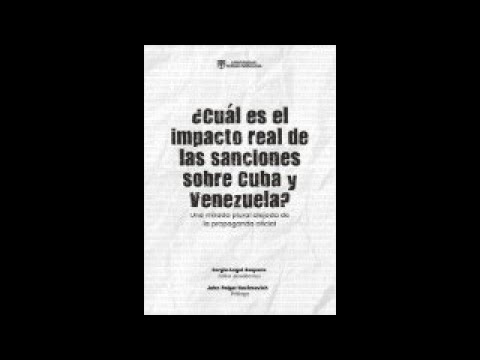
The Real Impact of Sanctions Against Cuba and Venezuela
Keywords
Summary
188 words
Critical Evaluation
Value of the Information & Strength of the Argument
The value of the information is high, as it provides a nuanced, multi-perspective analysis of sanctions’ impact, challenging both pro- and anti-sanction narratives. The argumentation is solid, with presenters citing specific data, such as the $165 billion estimate and compensatory factors, and referencing legal frameworks like the Trade Sanctions Reform and Export Enhancement Act of 2000. The panelists effectively argue that internal policies are primary drivers of crises, while sanctions act as aggravating factors. However, the discussion is inherently partisan, with some presenters holding strong anti-regime views, which may bias the interpretation. The use of network analysis and literature review in the first chapter adds methodological rigor.
Scientific Rigor, Source Quality, Title Accuracy
The scientific rigor is moderate to high. The book is edited by academics and includes chapters from various experts, suggesting peer review. However, the video does not provide direct citations or references to specific studies, making it difficult to verify claims. The title accurately reflects the content, focusing on the real impact of sanctions. The discussion is well-structured, but the lack of detailed sourcing in the video limits its standalone credibility. The panelists do not explicitly mention external sources, but they reference their own book and its chapters. The adequacy between title and content is strong, as the discussion directly addresses the impact of sanctions on Cuba and Venezuela.
231 words
Title / Content Match
The title accurately reflects the content, which focuses on the real impact of sanctions on Cuba and Venezuela, moving beyond propaganda.
Quality & Reliability
7/10
The discussion is led by academics and researchers with relevant expertise, presenting a book with multiple chapters and diverse perspectives. The arguments are supported by data and references, though the event is a book presentation with inherent advocacy elements. The lack of detailed citations in the video limits verification.
Key Moments
Markers derived by PSI from the transcript: the creator did not define chapters.
- Introduction by Sebastián Arco, setting the stage for the book presentation.
- Sergio Ángel Paquero explains the book's origin from a UN Human Rights Council session.
- Discussion of the network analysis of 250 texts on sanctions, embargo, and blockade.
- Presentation of Carmelo's chapter on the $165 billion estimate and $238.5 billion compensatory factors.
- Discussion of the impact on families and private sector, and the paradox of sanctions.
- Analysis of food and medicine exports, and the role of internal policies.
- Acosta González discusses the connection between sanctions and human development, highlighting multicausality.
- Comparison with Venezuela and the role of sanctions in regime change.
- Q&A session begins, with audience questions on the book's arguments.
- Concluding remarks and summary of the book's contributions.
Cited Sources
- The Real Impact of Sanctions Against Cuba and Venezuela (book) — The book being presented, edited by Sergio Ángel Paquero, with chapters from various authors.
Concurring Sources
- UN Human Rights Council report on unilateral coercive measures — The book's origin is tied to a UN session discussing the human rights impact of sanctions.
Dissenting Sources
- Cuban government's official position on the embargo — The Cuban government attributes the crisis primarily to the US embargo, which the panelists argue is overstated.
Contribution & Novelties
The video provides a novel synthesis of academic perspectives on sanctions, challenging dominant narratives from both the US and Cuban/Venezuelan governments. It introduces a comparative framework and highlights the role of internal policies in crises. The book’s use of network analysis to map the literature on sanctions is an innovative methodological approach.
Pour aller plus loin :
- Unilateral coercive measures and human rights — Relevant to the discussion on the UN’s stance on sanctions.
- Trade Sanctions Reform and Export Enhancement Act of 2000 — Key legal context for food and medicine exports to Cuba.
- Human Development Index — Relevant to the discussion on Cuba’s human development decline.
- Cuban economic reforms — Context for internal policy challenges.
116 words
Radar Profile
The radar profile shows high scores in quantity and quality of information, with moderate technical level and reliability. This indicates a well-informed discussion with substantive content, but with some limitations in technical depth and verifiability.