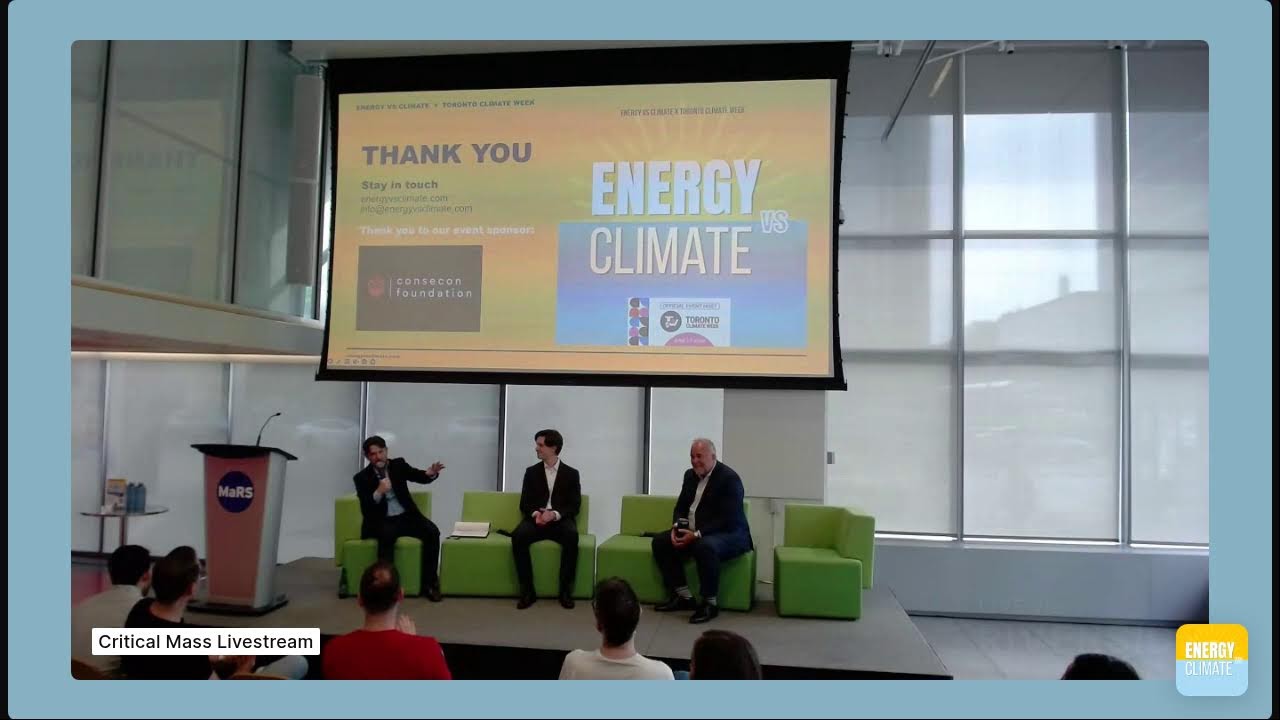
Energy vs Climate - Nuclear Townhall livestream
Keywords
Summary
180 words
Critical Evaluation
Value of the Information & Strength of the Argument
The value of the information is high, as it provides direct insights from a former energy minister and a policy expert, with concrete data on costs, public opinion, and project outcomes. The argumentation is generally solid, with panelists supporting their claims with specific examples (Darlington, Vogtle) and referencing studies (Oxford report). However, there is a clear pro-nuclear bias, and counterarguments are not deeply explored. The discussion is more of a debate than a rigorous scientific analysis, but it offers valuable perspectives on the practical and political challenges of nuclear deployment.
Scientific Rigor, Source Quality, Title Accuracy
The scientific rigor is moderate: the panelists cite specific sources (e.g., Oxford University report, Leger polling) and provide concrete figures, but these are not systematically verified. The quality of sources is mixed, with a reliance on industry experience and think tank research. The title accurately reflects the content, and the discussion stays on topic. The event is a town hall, so it is more about exchanging views than presenting peer-reviewed evidence, but the participants are credible experts.
182 words
Title / Content Match
The title accurately reflects the content: a town hall discussion on the role of nuclear energy in Canada's energy future, framed around the energy-climate nexus.
Quality & Reliability
7/10
The discussion features expert panelists with direct policy and industry experience, and references specific data (polling, cost figures) and reports. However, it is a town hall debate with advocacy elements, and some claims (e.g., cost projections) are contested. The sources cited are not systematically verified.
Key Moments
Markers derived by PSI from the transcript: the creator did not define chapters.
- Introduction: Ed explains why he, a climate activist, is now exploring nuclear energy, citing three changes: rising electricity demand, federal support, and successful refurbishments.
- First theme: cost paradox. Clip from David Keith on nuclear costs being 'a joke' in the Western world.
- Todd Smith discusses the Darlington refurbishment as a success story, highlighting the fleet approach and repeatability.
- Brendan Frank presents Leger polling: 50% of Canadians see nuclear as a solution, but support drops to 5% when cost increases are mentioned.
- Discussion of Vogtle project as a cautionary tale, with cost overruns and governance failures.
- Debate on SMRs and learning curves: Sarah's clip argues that nuclear won't follow solar-like cost declines; Brendan suggests possible 30-50% reductions.
- Audience poll on whether the BWRX-300 will be on time and on budget; mixed show of hands.
Cited Sources
- The Unicorn of a Nuclear Project (Oxford University report) — Referenced by Todd Smith as a study on the Darlington refurbishment project.
- Leger polling on Canadian attitudes towards nuclear — Commissioned by Clean Prosperity, cited by Brendan Frank.
Concurring Sources
- Oxford University report on Darlington — Supports the success of the Darlington refurbishment.
- Leger polling — Provides data on Canadian public opinion.
Dissenting Sources
- David Keith's critique of nuclear costs — Argues that Western nuclear costs are exorbitant and not improving, contrasting with the panelists' optimism.
Contribution & Novelties
The video provides a balanced, expert-led discussion on nuclear energy in Canada, offering unique insights from a former energy minister and a policy expert. It highlights the political and economic realities of nuclear deployment, including public opinion and cost challenges. The format of a town hall with expert clips adds depth.
Pour aller plus loin :
- Small modular reactor - Wikipedia — Overview of SMR technology and its potential.
- Darlington Nuclear Generating Station - Wikipedia — Details on the refurbishment project.
- Vogtle Electric Generating Plant - Wikipedia — Context on the Vogtle project and its cost overruns.
97 words
Radar Profile
The radar profile shows high scores in quantity of information and technical level, reflecting the expert panel and detailed discussion. Quality and reliability are moderate, as the content is debate-oriented with some advocacy. The overall balance suggests a informative but not deeply rigorous source.
💬 No comments were provided for analysis.