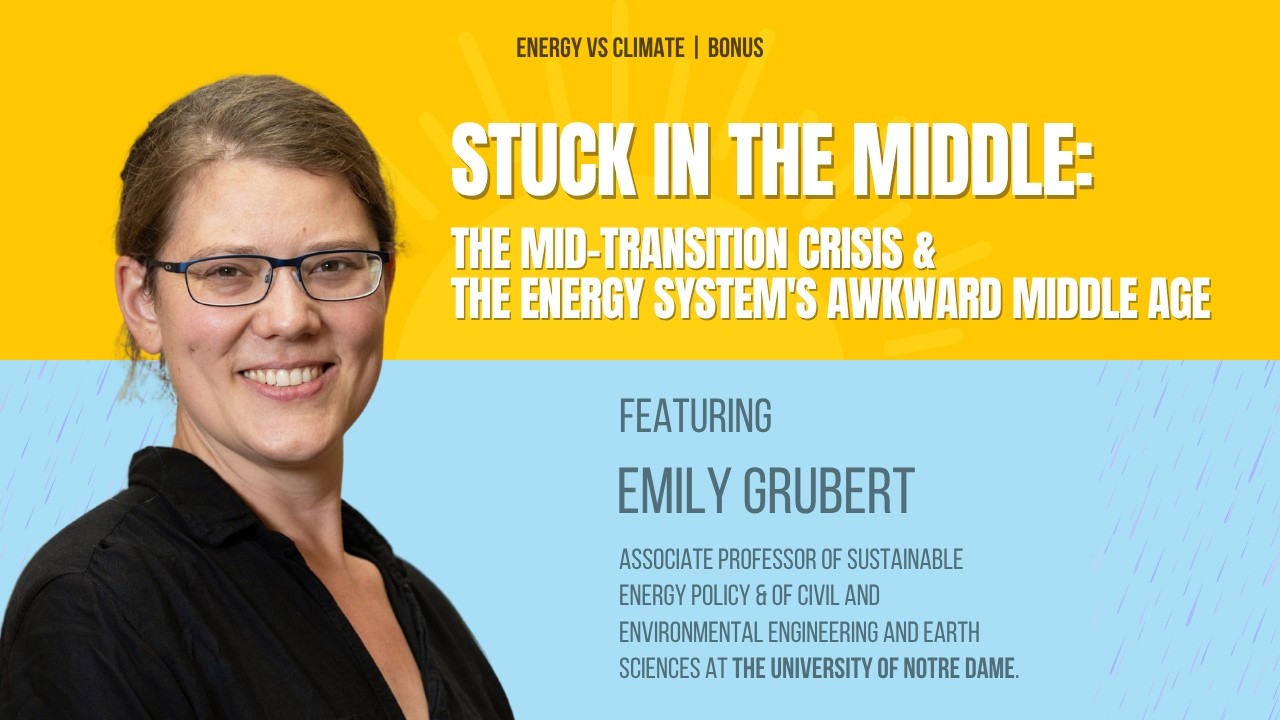
Stuck in the Middle: The Energy System's Mid-Transition Crisis | With Emily Grubert
Keywords
Summary
153 words
Critical Evaluation
Value of the Information & Strength of the Argument
The value of the information is high, as it provides a nuanced framework for understanding the energy transition beyond simple addition of renewables. The argumentation is solid, grounded in the speakers’ expertise and the referenced paper. They effectively illustrate concepts with concrete examples, such as refinery turndown limits and the Alberta coal phase-out, and acknowledge complexities and trade-offs. The discussion is balanced, considering both technical and social aspects.
Scientific Rigor, Source Quality, Title Accuracy
The scientific rigor is good, with references to a peer-reviewed paper and expert insights. However, specific data points are not cited in detail, and the conversational format limits the depth of source verification. The title accurately reflects the content, and the discussion stays on topic. No comments were provided for analysis.
134 words
Title / Content Match
The title accurately reflects the content, focusing on the mid-transition crisis in energy systems and featuring Emily Grubert.
Quality & Reliability
8/10
The discussion features an expert in energy policy (Emily Grubert) and is grounded in a peer-reviewed paper co-authored by the guest. The arguments are nuanced and acknowledge complexities, but the format is conversational and lacks detailed citations or data verification.
Chapters
- Cold Open
- What Is the Mid-Transition?
- The 80/20 Rule: Are We Already In It?
- Decarbonization Means Subtraction Too
- What Each System Forces on the Other
- Refineries and the Limits of Ramping Down
- Alberta's Coal Phase-Out, Explained
- Managing Coal Decline in the US
- Fast Payouts for Companies, Slow Support for Communities
- Can the Oil Sands Shrink Smoothly?
- Long Mid-Transition or Short? The Band-Aid Question
Cited Sources
- Energy vs Climate website — Main website for the podcast, mentioned in the description.
- Energy vs Climate on LinkedIn — LinkedIn page for the podcast, listed in the description.
- Energy vs Climate on Bluesky — Bluesky profile for the podcast, listed in the description.
- Bespoke Podcasts — Production company for the podcast, mentioned in the description.
Concurring Sources
- Designing the Mid-Transition — The paper co-authored by Emily Grubert and Sara Hastings-Simon, which is the basis for the discussion.
External References
Contribution & Novelties
The video provides a clear and accessible explanation of the mid-transition concept, emphasizing the need to consider both the growth of clean energy and the decline of fossil fuels. It offers practical examples and discusses governance challenges, adding value to the public discourse on energy transition.
Pour aller plus loin :
- Designing the Mid-Transition — The paper by Grubert and Hastings-Simon that forms the basis of the discussion.
- Just Transition — Concept of ensuring fairness in the transition, relevant to the discussion on community support.
- Path Dependence — Concept explaining how past decisions constrain future options, relevant to the challenges of transitioning away from fossil fuels.
106 words
Radar Profile
The radar profile shows high scores in information quantity and quality, reflecting the expert discussion and concrete examples. The technical level is moderate, making it accessible to a broad audience. The overall reliability is high due to the expert guest and referenced paper.