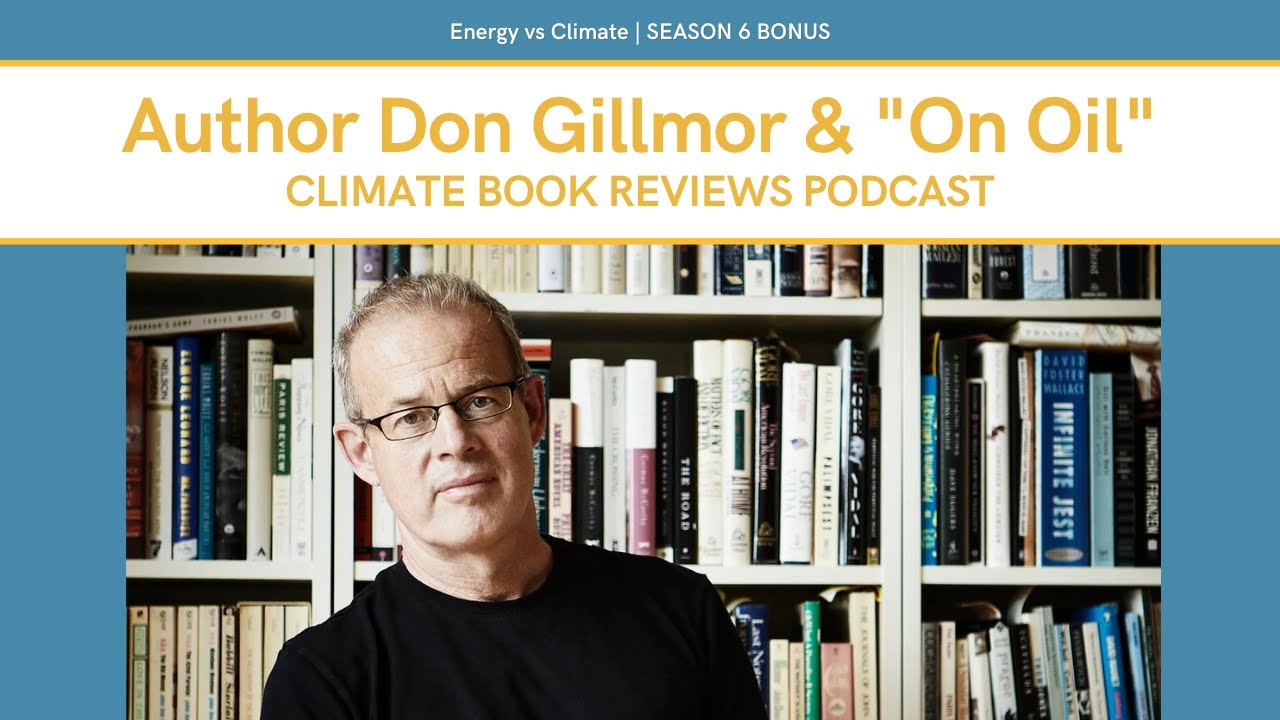
BONUS: Author Don Gillmor on his latest book "On Oil" | Climate Book Reviews #books #writing
Keywords
Summary
168 words
Critical Evaluation
Value of the Information & Strength of the Argument
The value of the information lies in the firsthand experiences and expert insights shared by the speakers. Don Gillmor’s personal history in the oil fields and his journalistic background lend authenticity to his observations. The argumentation is coherent, with a clear narrative that connects historical events, personal anecdotes, and broader economic and political themes. The hosts contribute their own expertise, particularly Ed Whittingham’s policy knowledge, which enriches the discussion. However, the arguments are largely qualitative and opinion-based, with limited quantitative data or formal citations, which may reduce the overall rigor.
Scientific Rigor, Source Quality, Title Accuracy
The scientific rigor is moderate; the discussion is informed but not heavily sourced. The speakers reference specific books and reports (e.g., Peter Maas’s ‘Crude World’, OPEC and IEA forecasts) but do not provide detailed citations. The title accurately reflects the content, as it is a book review episode. The sources mentioned are credible, but the lack of systematic referencing limits the overall reliability. The conversation is engaging and well-structured, but it is more of an expert opinion piece than a rigorous scientific analysis.
188 words
Title / Content Match
The title accurately reflects the content: a bonus episode of Climate Book Reviews featuring author Don Gillmor discussing his book 'On Oil'.
Quality & Reliability
7/10
The discussion features an award-winning author and a clean energy policy expert, providing credible perspectives. However, it is primarily an opinion-based conversation with limited verifiable data and no formal citations.
Key Moments
Markers derived by PSI from the transcript: the creator did not define chapters.
- Introduction to the episode and guest Don Gillmor.
- Don shares his early experiences working on Alberta oil rigs.
- Discussion on the 'moral imperative' for oil extraction and its religious roots.
- Exploration of the 'resource curse' in Nigeria and Alberta.
- Analysis of the oil sands' current state and shift to income trust model.
- Discussion on conflicting oil demand forecasts from OPEC and IEA.
- Reflections on the changing narrative around oil and climate change.
- Wrap-up and final thoughts on the book's contribution.
Cited Sources
- Energy vs Climate website — Mentioned as the main website for the podcast and additional resources.
- Bespoke Podcasts — Production company for the podcast.
- Energy vs Climate on Bluesky — Social media channel for the podcast.
- Energy vs Climate on LinkedIn — Professional network page for the podcast.
- Amit Tandon's LinkedIn — Producer of the podcast.
Concurring Sources
- International Energy Agency (IEA) — The IEA's forecasts on oil demand are mentioned as a contrasting view to OPEC's.
- OPEC — OPEC's projections on oil demand growth are referenced in the discussion.
Dissenting Sources
- OPEC vs IEA oil demand forecasts — The episode highlights the conflicting projections between OPEC (expecting growth) and the IEA (expecting peak), illustrating the uncertainty in oil market predictions.
Contribution & Novelties
The episode provides a unique blend of personal memoir and expert analysis, offering a human perspective on the oil industry’s complexities. It highlights the cultural and religious dimensions of oil extraction, which are often overlooked in technical discussions. The conversation also brings attention to the current transition of oil sands companies to income trust models, a topic not widely covered.
Pour aller plus loin :
- Resource curse - Wikipedia — Provides background on the economic phenomenon discussed.
- Oil sands - Wikipedia — Offers technical and historical context on Alberta’s oil sands.
- International Energy Agency (IEA) - Oil Market Report — Source for oil demand forecasts referenced in the discussion.
109 words
Radar Profile
The radar profile shows moderate scores across all dimensions, with slightly higher values for information quantity and quality, reflecting the rich anecdotal and expert content. The lower technical score indicates the discussion is accessible to a general audience. Overall, the episode is well-rounded but not highly technical.
💬 No comments were provided for analysis.