2026 03 19 Ketamine
Keywords
Summary
248 words
Critical Evaluation
Value of the Information & Strength of the Argument
The lecture provides valuable clinical insights into ketamine use in palliative care, with practical dosing recommendations and a balanced discussion of evidence. Dr. Andres effectively argues for the utility of ketamine in pain and depression, citing specific studies and acknowledging limitations. She highlights the heterogeneity of dosing and the low quality of many studies, which strengthens the credibility of her argument. The case presentations illustrate real-world application, though they are anecdotal. The argumentation is solid, but the reliance on expert opinion and small studies limits the strength of conclusions.
Scientific Rigor, Source Quality, Title Accuracy
The lecture demonstrates scientific rigor by referencing key studies, including a 2017 Cochrane review, a meta-analysis on chronic pain, and RCTs on depression. However, some references are not fully cited (e.g., the article on ketamine’s mechanism), and the speaker does not provide specific citations for all claims. The title is minimal and does not reflect the comprehensive content, but it is not misleading. The speaker is transparent about the limitations of the evidence, which enhances trustworthiness. Overall, the sources are appropriate but could be more systematically referenced.
191 words
Title / Content Match
The title '2026 03 19 Ketamine' is minimal and does not convey the content's depth, but it is accurate as the lecture is indeed about ketamine.
Quality & Reliability
7/10
The lecture is delivered by a palliative care physician with clinical experience, referencing several studies and reviews (e.g., Cochrane review, meta-analyses) and providing balanced discussion of evidence limitations. However, it is primarily an expert opinion with some anecdotal case presentations, and the speaker acknowledges the heterogeneity and low quality of much of the literature.
Key Moments
Markers derived by PSI from the transcript: the creator did not define chapters.
- Introduction and objectives of the lecture.
- Case presentation of a patient with head and neck cancer and severe pain.
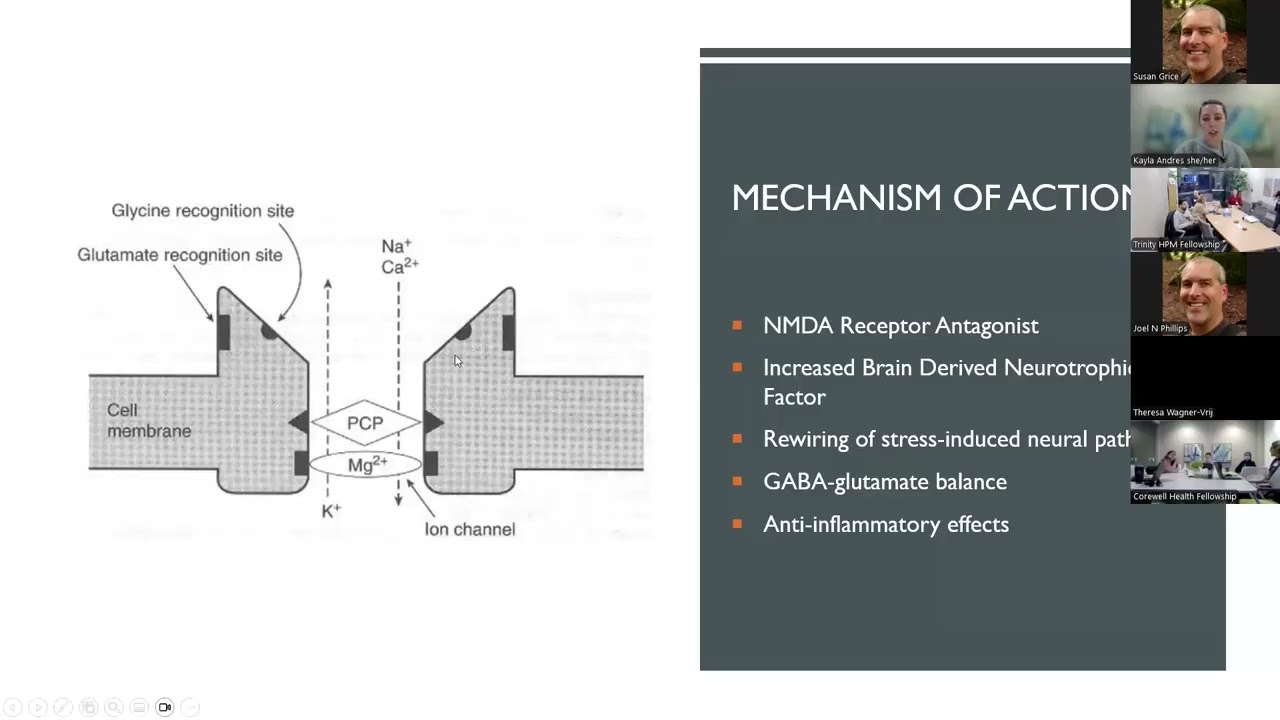
- Mechanism of action of ketamine: NMDA receptor antagonism and its role in pain and depression.
- Pharmacokinetics: bioavailability, metabolism, and drug interactions.
- Dosing strategies for pain and depression, including IV, oral, and intranasal routes.
- Adverse effects and safety considerations, including intracranial pressure concerns.
- Evidence review for pain: chronic pain, cancer pain, and postoperative pain.
- Evidence for depression and suicidal ideation, and concluding case.
Cited Sources
- Cochrane Review on Ketamine for Cancer Pain (2017) — Cited as a 2017 Cochrane review stating insufficient evidence for ketamine in cancer pain.
- Meta-analysis on Ketamine for Chronic Non-Cancer Pain — Referenced as a meta-analysis and trial sequential analysis concluding ketamine ineffective for chronic non-cancer pain, but with moderate evidence for pain reduction at 4 weeks when excluding high-risk bias studies.
- Study on Ketamine for Cancer Pain in Journal of Pain and Symptom Management — Highlighted as a recent review with 35 studies and 2,279 patients, concluding ketamine may be effective for cancer pain, though the speaker challenges this claim.
- Randomized Controlled Trial on Ketamine for Depression and Suicidal Ideation — Referenced as a small RCT of 42 patients with cancer and depression, showing improvement in suicidal ideation at day 1 and 3 after a single dose.
Concurring Sources
- Ketamine for chronic pain: risks and benefits — A review discussing the evidence for ketamine in chronic pain, aligning with the lecture's mixed findings.
- Efficacy and Safety of Ketamine for Depression: A Systematic Review — A systematic review supporting ketamine's antidepressant effects, consistent with the lecture's discussion.
Dissenting Sources
Contribution & Novelties
The lecture provides a comprehensive clinical overview of ketamine in palliative care, integrating pain and depression management. It offers practical dosing guidance and highlights the importance of considering ketamine even if not directly prescribed. The discussion of evidence limitations is valuable for clinicians.
Pour aller plus loin :
- Ketamine - Wikipedia — General overview of ketamine, including pharmacology and clinical uses.
- NMDA receptor - Wikipedia — Detailed explanation of the NMDA receptor and its role in pain and depression.
- Esketamine - Wikipedia — Information on the S-enantiomer of ketamine, used for treatment-resistant depression.
- Cochrane Library — Source for systematic reviews, including the 2017 review on ketamine for cancer pain.
109 words
Radar Profile
The radar profile shows high scores in quantity of information and technical level, reflecting the lecture's comprehensive coverage and clinical detail. Quality of information and global reliability are slightly lower due to the reliance on expert opinion and heterogeneous evidence. The profile suggests a well-informed but not fully evidence-based presentation.
💬 Sur les 0 commentaires analysés, aucune tendance n'est disponible.