2025 11 06 Decision Making in Pediatric Palliative Care
Keywords
Summary
188 words
Critical Evaluation
Value of the Information & Strength of the Argument
The lecture provides valuable insights into the practical and ethical complexities of pediatric palliative care, drawing on real cases and legal precedents. The argumentation is persuasive, emphasizing the need for nuanced, family-centered approaches. However, it relies heavily on anecdotal evidence and personal opinion, lacking systematic review or data. The speaker’s advocacy for parental autonomy is clear, but the presentation could benefit from more balanced consideration of opposing viewpoints.
Scientific Rigor, Source Quality, Title Accuracy
The lecture demonstrates practical knowledge but lacks formal citations. It references legal cases and concepts like Abraham’s Law and Prince v. Massachusetts, but without specific sources. The title accurately reflects the content. The speaker’s experience adds credibility, but the absence of references to medical literature or guidelines reduces scientific rigor. The presentation is more of an expert opinion than a systematic review.
145 words
Title / Content Match
The title accurately reflects the content, which focuses on decision-making processes in pediatric palliative care.
Quality & Reliability
7/10
The lecture is delivered by experienced practitioners in pediatric palliative care, providing practical insights and case examples. However, it lacks formal citations and relies heavily on anecdotal evidence and personal experience, limiting its scientific rigor.
Key Moments
Markers derived by PSI from the transcript: the creator did not define chapters.
- Introduction and disclosures by Scott Hawkins
- Presentation of the case of a 16-year-old with neurodegenerative decline
- Review of ethical principles in pediatrics
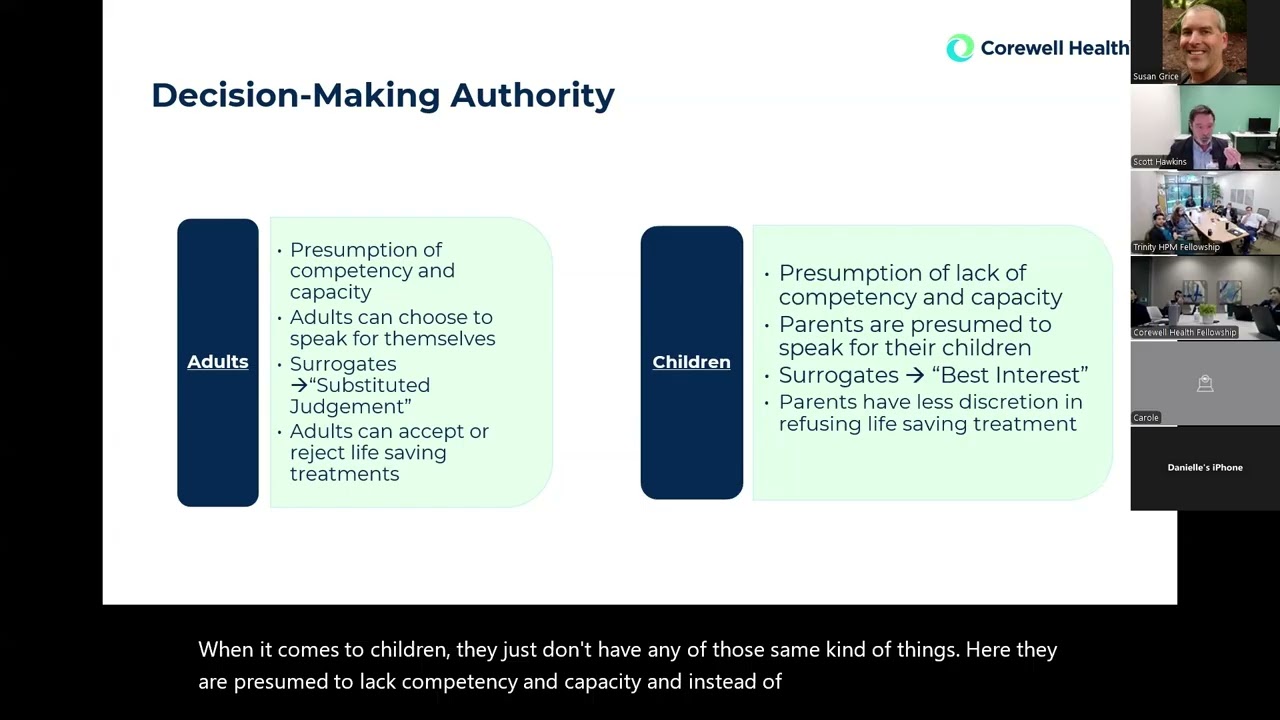
- Discussion of decision-making authority and capacity in children
- Limits to parental autonomy and legal cases of treatment refusal
- Case examples: Abraham's Law, Dennis Lindberg, and others
- Discussion on life-sustaining treatments and family goals
- Critique of NICU response to a mother's request to stop support
- Advanced care planning in pediatrics and guardianship at age 18
- Hospice enrollment and DNR considerations for minors
Cited Sources
- Abraham's Law — Mentioned as a Virginia law allowing families to refuse treatment in certain situations.
- Prince v. Massachusetts (1944) — Cited as a legal precedent regarding parental authority and child welfare.
Concurring Sources
- Pediatric Palliative Care: A Review — Supports the importance of family-centered care and ethical decision-making.
Dissenting Sources
- Parental Refusal of Medical Treatment: A Harm-Based Analysis — Presents a contrasting view on when parental refusal should be overridden, emphasizing harm to the child.
Contribution & Novelties
The lecture offers a practical, case-based perspective on pediatric palliative care decision-making, emphasizing the ethical and legal complexities. It highlights the inconsistencies in court rulings and the need for individualized, family-centered approaches. The speaker’s advocacy for open communication and re-evaluation of interventions is a valuable contribution.
Pour aller plus loin :
- Pediatric Palliative Care — Overview of the field and its principles.
- Best Interest Standard — Ethical concept central to pediatric decision-making.
- Mature Minor Doctrine — Legal concept relevant to adolescent decision-making capacity.
83 words
Radar Profile
The radar profile shows high scores in quantity and quality of information, reflecting the speaker's experience and the breadth of topics covered. The technical level is moderate, suitable for a professional audience. The overall reliability is good but limited by the lack of formal citations.
💬 No comments were provided for analysis.