2025 08 14 Nausea and Vomiting
Keywords
Summary
182 words
Critical Evaluation
Value of the Information & Strength of the Argument
The lecture offers high practical value for clinicians, providing a structured approach to nausea and vomiting management. Dr. Wyn’s argumentation is solid, grounded in clinical experience and established pharmacological principles. He effectively explains the rationale behind medication choices by linking them to specific pathophysiological mechanisms. The use of a case study makes the content relatable and applicable. He also addresses common pitfalls, such as over-reliance on ondansetron, and emphasizes the importance of non-pharmacological measures. The discussion is nuanced, acknowledging the multifactorial nature of nausea and the need for individualized treatment. The inclusion of audience questions adds depth and clarifies potential misconceptions.
Scientific Rigor, Source Quality, Title Accuracy
The lecture demonstrates scientific rigor through its systematic approach and alignment with current medical knowledge. However, it lacks formal citations or references to specific studies, relying instead on the speaker’s expertise and clinical experience. The title accurately reflects the content, which is a comprehensive lecture on nausea and vomiting. The content is consistent with established guidelines for palliative care symptom management. The speaker’s credentials and the context of a fellowship lecture series lend credibility. The audience interaction shows a commitment to accuracy, as seen in the correction regarding aprepitant’s mechanism. Overall, the scientific quality is high, but the absence of explicit sources limits its verifiability.
221 words
Title / Content Match
The title accurately reflects the content, which is a comprehensive lecture on nausea and vomiting in palliative care.
Quality & Reliability
8/10
Lecture by an experienced hospice and palliative medicine physician, based on clinical expertise and established medical knowledge. Content is consistent with current guidelines, though it is an opinion-based educational talk without formal citations.
Key Moments
Markers derived by PSI from the transcript: the creator did not define chapters.
- Introduction and objectives
- Quotes and historical context
- Case study presentation
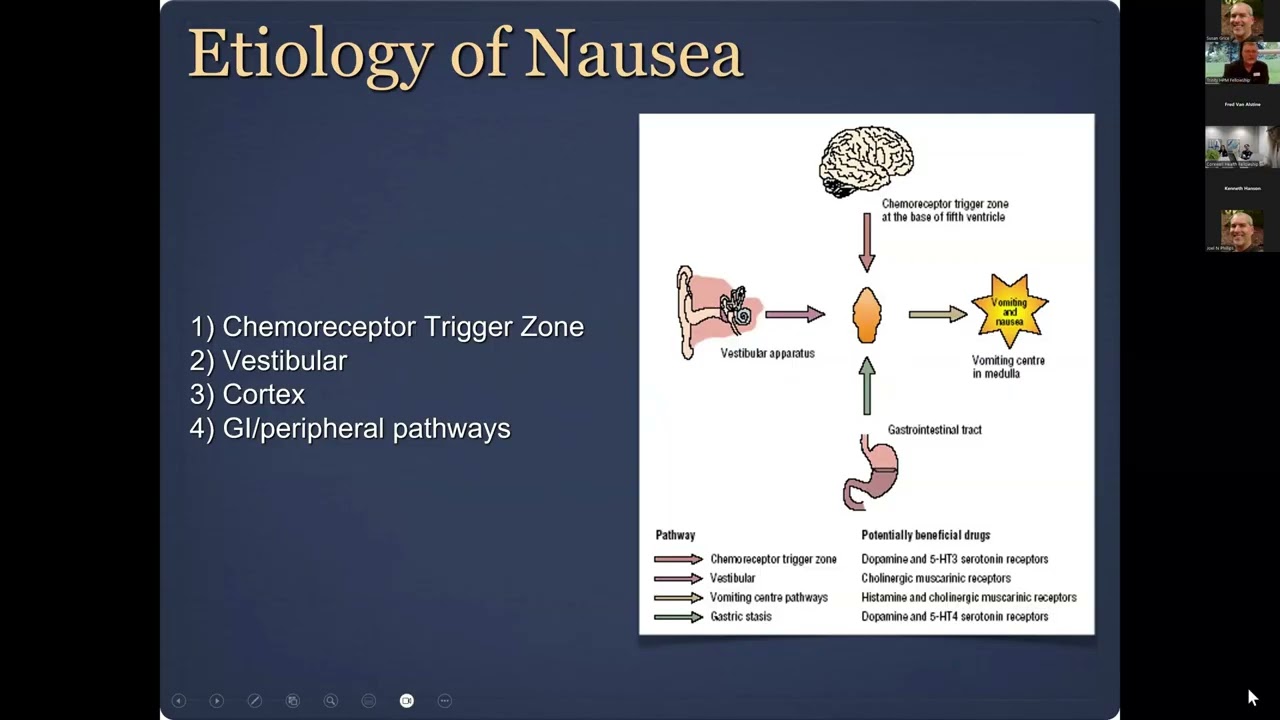
- Pathophysiology of nausea
- Assessment and reversible causes
- Non-pharmacological treatments
- Matching medications to mechanisms
- Opioid-induced nausea
- Chemotherapy-induced nausea and bowel obstruction
- Motion-induced nausea and increased ICP
Contribution & Novelties
The lecture provides a practical, mechanism-based approach to managing nausea and vomiting in palliative care, emphasizing the importance of individualized treatment. It offers a clear framework for clinicians to select antiemetics based on underlying pathways, which is a valuable educational contribution. The inclusion of non-pharmacological strategies and the emphasis on multifactorial causes are particularly useful.
Pour aller plus loin :
- Nausea and vomiting in palliative care — Overview of management options.
- Antiemetic guidelines — NCCN guidelines for antiemesis.
- Octreotide in malignant bowel obstruction — Study on octreotide use.
88 words
Radar Profile
The radar profile shows high scores in quantity and quality of information, with a strong technical level and reliability. This indicates a comprehensive and trustworthy educational resource, though it may be more suited for a professional audience.
💬 No comments were provided for analysis.