2025 11 13 Ethics in the Dying Patient
Keywords
Summary
149 words
Critical Evaluation
Value of the Information & Strength of the Argument
The lecture offers valuable practical insights for clinicians, grounded in real-world cases and established ethical frameworks. The argumentation is coherent, with clear explanations of principles and their application. The use of case studies effectively illustrates common ethical dilemmas and provides actionable strategies. However, the content is largely based on expert opinion and anecdotal experience, lacking systematic evidence or citations to support some claims. The discussion of the double effect principle and opioid use is well-reasoned, but could benefit from referencing specific studies or guidelines.
Scientific Rigor, Source Quality, Title Accuracy
The lecture demonstrates a solid understanding of medical ethics, with accurate references to legal and ethical concepts such as capacity, informed consent, and surrogate decision-making. The title accurately reflects the content. However, the presentation does not cite specific sources or references, relying instead on the speaker’s expertise. The description provides no additional links or references. The content is consistent with standard medical ethics teachings, but the lack of explicit citations limits the ability to verify specific claims. The lecture is suitable for a professional audience, but the absence of references may reduce its scientific rigor.
194 words
Title / Content Match
The title accurately reflects the content, which focuses on ethical considerations in end-of-life care.
Quality & Reliability
8/10
The lecture is presented by a physician with clinical expertise in palliative care and ethics, providing a structured overview of ethical principles and practical strategies. The content aligns with established medical ethics frameworks, though it is primarily based on expert opinion and clinical experience rather than systematic review or original research.
Key Moments
Markers derived by PSI from the transcript: the creator did not define chapters.
- Introduction to ethics consultations and the four C's: conflict, concern, confusion, crossroads.
- Review of core ethical principles: autonomy, beneficence, non-maleficence, justice.
- Discussion on decisional capacity and its requirements.
- Explanation of informed consent and its application in emergency situations.
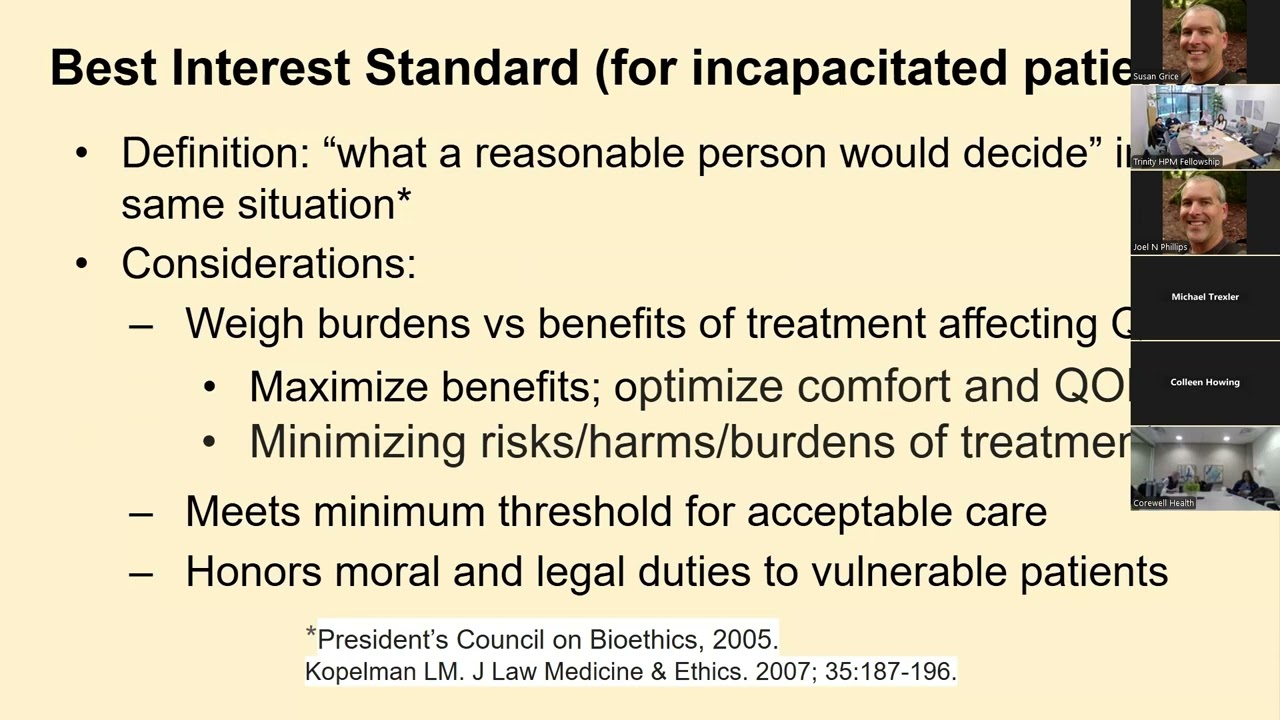
- Introduction to substituted judgment and best interest standard.
- Case study of a 64-year-old man with pancreatitis and conflict with family.
- Discussion on types of ethical conflicts and strategies for resolution.
- Introduction to the GOAR score for CPR outcome prediction.
- Case study of a 90-year-old with advanced dementia and code status discussion.
- Conclusion and summary of key points.
Contribution & Novelties
The lecture provides a comprehensive overview of ethical considerations in end-of-life care, with practical case-based examples. It emphasizes the importance of communication and shared decision-making, and introduces tools like the GOAR score to facilitate discussions about prognosis. The discussion on the double effect principle offers clarity on opioid use in dying patients.
Pour aller plus loin :
- The Four Principles of Biomedical Ethics — Foundational framework for medical ethics.
- Informed Consent — Detailed analysis of informed consent in medical practice.
- Medical Futility — Ethical considerations regarding non-beneficial treatment.
- GOAR Score — Tool for predicting CPR outcomes.
96 words
Radar Profile
The radar profile shows high scores in information quantity and quality, indicating a content-rich lecture. The technical level is moderately high, suitable for medical professionals. The overall reliability is strong, though the lack of explicit citations slightly reduces the score.