Considerations in Pain Management Part 1
Keywords
Summary
219 words
Critical Evaluation
Value of the Information & Strength of the Argument
The lecture provides a solid, evidence-based overview of pain management, integrating physiological mechanisms with practical clinical approaches. It emphasizes the importance of a comprehensive assessment and multimodal treatment, aligning with current palliative care guidelines. The argumentation is coherent, moving from basic science to clinical application, and stresses the need to address the psychological and spiritual aspects of pain, as exemplified by the concept of total pain. The speaker’s experience and practical tips, such as the use of compounded ketamine cream and scrambler therapy, add value. However, the lecture is introductory and does not delve into specific dosing or complex cases, which are presumably covered in subsequent parts.
Scientific Rigor, Source Quality, Title Accuracy
The lecture demonstrates scientific rigor by grounding pain management in established physiological principles and referencing historical figures like Cicely Saunders. The speaker adapts material from a colleague, indicating a tradition of shared knowledge within the fellowship. The title accurately reflects the content, which is a foundational discussion of pain considerations. The lecture does not cite specific studies or sources, but it aligns with standard medical education. The adequacy between title and content is high, as it covers the basic theory and approaches as promised.
206 words
Title / Content Match
The title accurately reflects the content, which focuses on foundational considerations in pain management, including physiology, types of pain, and initial approaches.
Quality & Reliability
8/10
Lecture by a palliative care physician, based on established medical knowledge and adapted from a colleague's material. The content is consistent with current understanding of pain physiology and management, though it is an educational lecture rather than a peer-reviewed source.
Key Moments
Markers derived by PSI from the transcript: the creator did not define chapters.
- Introduction to the lecture series and the importance of pain management in palliative care.
- Definition of pain and the subjective nature of the pain experience.
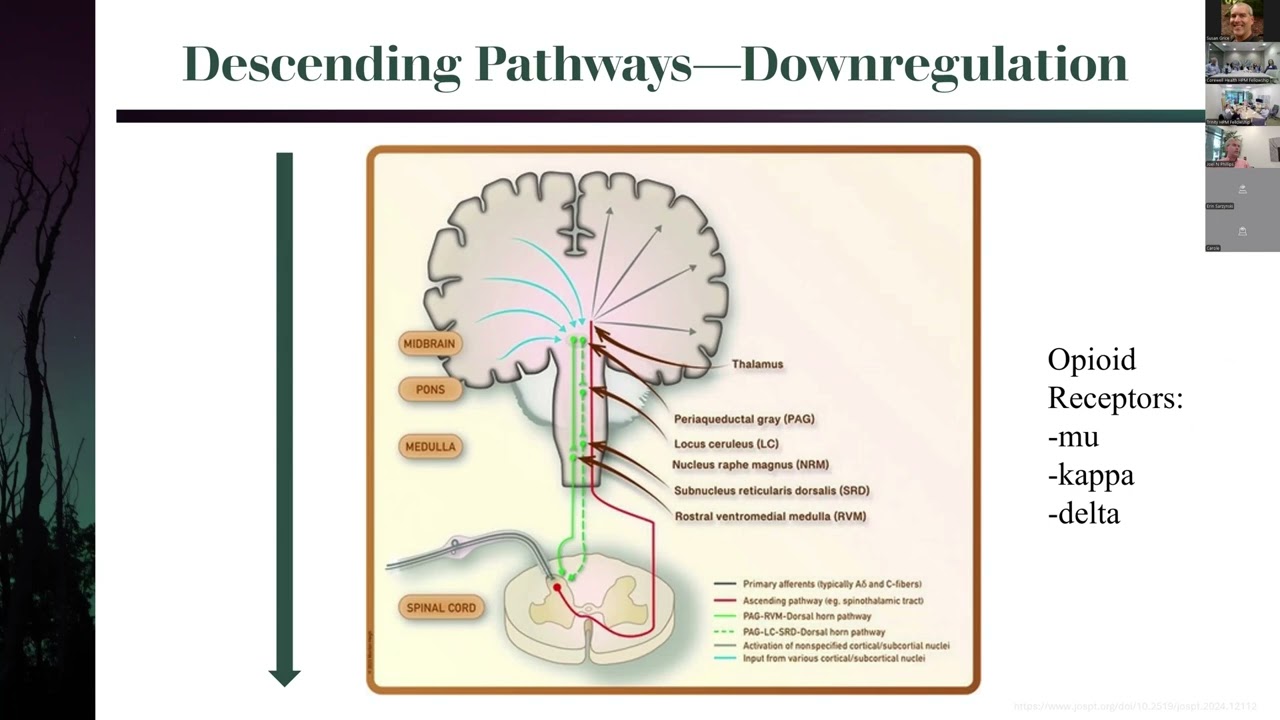
- Review of pain neuroanatomy: ascending and descending pathways.
- Overview of pain goals: decrease pain, improve function and mood.
- Introduction to types of pain: nociceptive, neuropathic, central, and total pain.
- Taking a pain history: OQRST and other key questions.
- Management of nociceptive pain: treat underlying cause, non-pharmacologic, NSAIDs, opioids.
- Neuropathic pain: mechanisms, examples, and treatment options.
- Central pain: causes and management.
- Interventional approaches: nerve blocks, scrambler therapy, and ablations.
Cited Sources
- Cicely Saunders and the concept of total pain — Mentioned as the founder of the hospice movement and the originator of the term 'total pain'.
Concurring Sources
- International Association for the Study of Pain (IASP) definition of pain — Provides the standard definition of pain, aligning with the lecture's emphasis on subjective experience.
Contribution & Novelties
The lecture provides a comprehensive and practical introduction to pain management for palliative care fellows, emphasizing a holistic approach. It integrates physiological mechanisms with clinical strategies and highlights the importance of addressing psychological and spiritual aspects. The discussion of newer interventions like scrambler therapy offers contemporary insights.
Pour aller plus loin :
- Total pain concept — Historical and conceptual background.
- Neuropathic pain management — Evidence-based guidelines.
- Central sensitization — Mechanism underlying chronic pain.
73 words
Radar Profile
The radar profile shows high scores across all dimensions, indicating a well-rounded and reliable educational resource. The lecture is information-dense, technically sound, and credible, with a strong balance between theoretical and practical content.
💬 No comments were provided for analysis.