2025 10 02 Who Decides When the Patient Can't
Keywords
Summary
173 words
Critical Evaluation
Value of the Information & Strength of the Argument
The lecture provides valuable practical insights for clinicians, emphasizing the ethical imperative of patient self-determination and the nuances of capacity assessment. The speaker’s argumentation is grounded in clinical experience and legal principles, though it relies heavily on anecdotal evidence and personal opinion rather than systematic research. The discussion of myths and the four-part capacity assessment is particularly useful, offering clear guidance for practice. The speaker’s emphasis on listening and avoiding assumptions about incapacity based on disagreement is well-argued and clinically relevant. However, the lack of formal citations and the reliance on state-specific legal information may limit generalizability.
Scientific Rigor, Source Quality, Title Accuracy
The lecture demonstrates a reasonable level of scientific rigor, with the speaker referencing legal statutes and common law, but it lacks formal citations to peer-reviewed literature. The speaker acknowledges her non-lawyer status and the difficulty of accessing legal information, which adds transparency but also highlights potential limitations. The title accurately reflects the content, which is focused on surrogate decision-making. The speaker’s use of personal anecdotes and clinical examples enhances engagement but may introduce bias. Overall, the information is consistent with established medical ethics and legal principles, but the absence of formal sources and the state-specific focus reduce its generalizability.
211 words
Title / Content Match
The title accurately reflects the content, which focuses on surrogate decision-making when patients lack capacity.
Quality & Reliability
7/10
The lecture is based on the speaker's extensive clinical experience and references legal statutes and common law, but lacks formal citations and peer-reviewed sources. The information is generally accurate and aligns with standard medical ethics and legal principles, but the speaker acknowledges not being a lawyer and the legal landscape varies by state.
Key Moments
Markers derived by PSI from the transcript: the creator did not define chapters.
- Introduction and objectives
- Elevator speech and importance of self-determination
- Patient Self-Determination Act and its implications
- Capacity vs. competence: myths and misconceptions
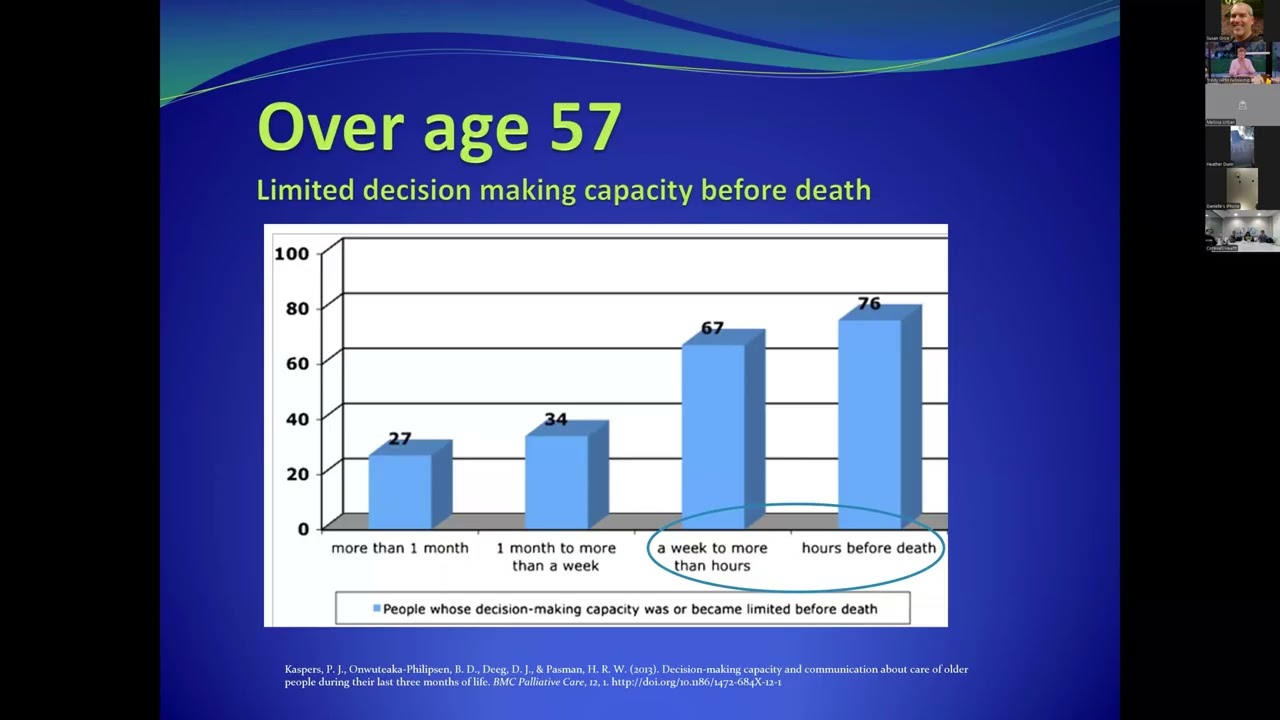
- Prevalence of incapacity and its clinical relevance
- When to assess capacity: high vs. low stakes
- Four elements of capacity assessment
- Clinical assessment questions and red flags
- Competence and guardianship: legal aspects
- Identifying surrogates: advance directives and Michigan law
Cited Sources
- Patient Self-Determination Act — Mentioned as the 1990 federal law that incentivized healthcare institutions to provide information about advance directives.
- Michigan Healthcare Surrogate Act (proposed) — Referenced as pending legislation in Michigan to establish surrogate succession.
Concurring Sources
- Assessment of decision-making capacity in older adults — Supports the four-element model of capacity assessment.
Contribution & Novelties
The lecture offers a practical, experience-based overview of capacity and surrogate decision-making, emphasizing the importance of patient self-determination and the distinction between capacity and competence. It provides a clear framework for capacity assessment and highlights common pitfalls. The discussion of Michigan-specific legal nuances, such as the lack of statutory succession, adds value for practitioners in that state.
Pour aller plus loin :
- Capacity assessment in clinical practice — A review of capacity assessment tools and approaches.
- Advance directives and patient self-determination — AMA guidance on advance care planning.
- Surrogate decision-making: ethical and legal considerations — Ethical analysis of surrogate decisions.
100 words
Radar Profile
The radar profile shows high scores in quantity and quality of information, reflecting the lecture's comprehensive coverage and practical relevance. The technical level is moderate, suitable for a professional audience. The overall reliability is good, though the lack of formal citations slightly reduces the score.
💬 No comments were provided for analysis.