2026 02 05 Words Matter Language in Palliative Medicine That Can Hurt or Help Our Patients
Keywords
Summary
176 words
Critical Evaluation
Value of the Information & Strength of the Argument
The lecture offers valuable insights into the impact of language on patient care, particularly in palliative settings. Dr. Beckrow argues convincingly that certain common phrases, such as ’there’s nothing more we can do,’ can lead to feelings of abandonment and hopelessness. He supports his arguments with personal anecdotes and clinical experience, illustrating how alternative phrasing can foster trust and provide comfort. The emphasis on building trust through allyship, rapport, and giving patients control is well-articulated and practical. The discussion on prognostication is particularly useful, advocating for honest and hedged communication that prepares patients and families for possible outcomes. The argumentation is coherent and grounded in the realities of clinical practice, though it relies primarily on anecdotal evidence rather than empirical research.
Scientific Rigor, Source Quality, Title Accuracy
The lecture demonstrates a high level of scientific rigor in its practical approach, but it lacks formal citations or references to specific studies. The speaker draws on his extensive clinical experience and mentions concepts like the ‘myth of sticks and stones’ and the importance of recognizing suffering, but does not provide external sources. The title accurately reflects the content, which focuses on the impact of language in palliative care. The lecture is well-structured and aligns with the stated objectives. The speaker acknowledges that the topic is dynamic and encourages ongoing learning, which adds to its credibility. However, the absence of references to empirical literature limits its scientific rigor.
244 words
Title / Content Match
The title accurately reflects the content, which focuses on the impact of language in palliative care and offers guidance on using words that help rather than hurt patients.
Quality & Reliability
8/10
The lecture is delivered by a palliative care physician with practical experience, providing concrete examples and actionable advice. It is based on clinical expertise and established communication principles, though it lacks formal citations or references to empirical studies.
Key Moments
Markers derived by PSI from the transcript: the creator did not define chapters.
- Introduction and objectives: identifying language that impacts patients, negativistic terms, and militaristic metaphors.
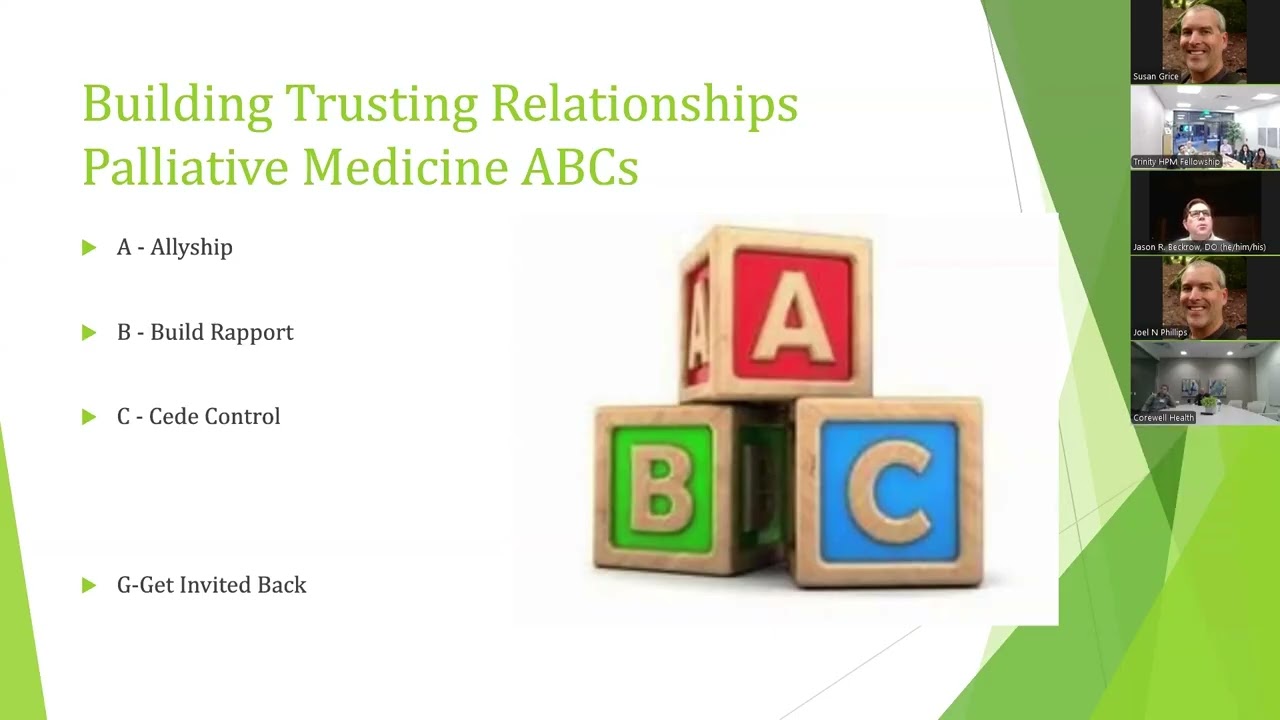
- Discussion on building trust through allyship, rapport, and giving patients control.
- Exploration of the phrase 'there's nothing more we can do' and its negative impact, with alternatives.
- Advice on prognostication: using hedged language and being honest about uncertainty.
- Discussion on clear vs. ambiguous language in describing patient conditions.
- Emphasis on recognizing suffering and the importance of validation and empathy.
Contribution & Novelties
This lecture provides a practical framework for improving communication in palliative care, emphasizing the power of language to either alleviate or exacerbate suffering. It offers concrete examples of harmful phrases and suggests alternatives, such as focusing on what can be done rather than what cannot. The emphasis on building trust through allyship and giving patients control is a valuable contribution. The lecture also highlights the importance of honest prognostication and the use of hedged language to prepare patients and families.
Pour aller plus loin :
- Breaking Bad News: A Guide for Health Care Professionals — This resource provides evidence-based strategies for delivering bad news, which is relevant to the lecture’s focus on language.
- The SPIKES Protocol — A widely used framework for breaking bad news, directly applicable to the communication techniques discussed.
- Palliative Care Communication: A Systematic Review — This review synthesizes research on communication in palliative care, supporting the lecture’s recommendations.
152 words
Radar Profile
The radar profile shows high scores in quality and reliability, reflecting the speaker's expertise and practical advice. The lower score in quantity of information is due to the lecture's focus on qualitative communication rather than extensive data. The technical level is moderate, suitable for a professional audience.