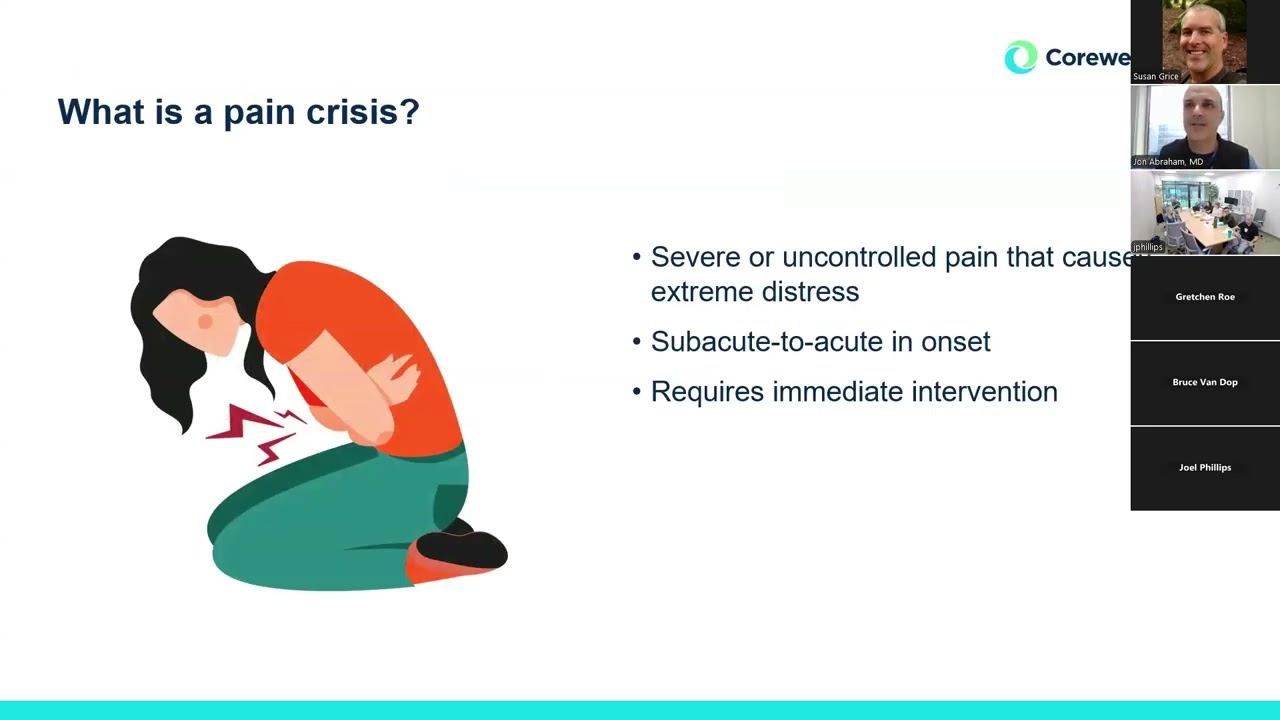
Severe Pain and Management of Pain Crisis
Keywords
Summary
235 words
Critical Evaluation
Value of the Information & Strength of the Argument
The lecture provides valuable, practical guidance for clinicians managing pain crises, drawing on the speaker’s extensive experience in palliative and emergency medicine. The argumentation is clear and logical, with a strong emphasis on safety and individualized care. The use of a clinical case to illustrate opioid conversion calculations is effective. The speaker acknowledges potential pitfalls, such as inaccurate history and staff apprehension, and offers strategies to address them. The discussion of PCA is particularly valuable, highlighting its benefits and practical considerations. The introduction of ketamine as an adjuvant is timely and relevant, with a concise overview of its pharmacology and clinical use. The argumentation is solid, though it relies primarily on anecdotal experience rather than citing specific evidence or guidelines.
Scientific Rigor, Source Quality, Title Accuracy
The lecture demonstrates scientific rigor in its clinical reasoning and adherence to standard practices in pain management. However, it does not cite specific sources or references, which limits its scholarly depth. The title accurately reflects the content, which is focused on severe pain and its management. The speaker’s credentials and experience lend credibility to the information presented. The lecture is well-structured, with clear objectives and a logical flow. The use of Frida Kahlo’s story as an introduction is engaging and relevant, but it is not a scientific source. Overall, the content is reliable and evidence-informed, but the lack of explicit citations is a minor weakness.
240 words
Title / Content Match
The title accurately reflects the content, which focuses on severe pain and its management in a palliative care context.
Quality & Reliability
8/10
Lecture by a palliative care physician with clinical expertise, providing practical guidance on pain crisis management. Content aligns with established medical practices, but lacks citations to specific studies or guidelines.
Key Moments
Markers derived by PSI from the transcript: the creator did not define chapters.
- Introduction and overview of the lecture series
- Story of Frida Kahlo and her experience with chronic pain
- Definition of pain crisis and the concept of 'pain resuscitation'
- Initial assessment and medication planning for pain crisis
- Opioid selection for opioid-naive patients: starting low and going slow
- Opioid selection for opioid-tolerant patients: calculating OME and cross-tolerance
- Clinical case: converting oral morphine to IV and determining PRN dose
- Introduction to patient-controlled analgesia (PCA) and its benefits
- PCA patient selection, contraindications, and pump data interpretation
- Ketamine as an adjuvant: pharmacology, advantages, and side effects
Contribution & Novelties
The lecture offers a practical, experience-based approach to managing pain crises, with a strong emphasis on rapid, coordinated intervention. It provides clear dosing strategies for opioid-naive and opioid-tolerant patients, and highlights the utility of PCA and ketamine. The integration of a patient narrative (Frida Kahlo) adds a humanistic perspective. The lecture is particularly useful for trainees in palliative care.
Pour aller plus loin :
- WHO Guidelines for the pharmacological and radiotherapeutic management of cancer pain in adults and adolescents — Relevant for evidence-based pain management.
- Patient-Controlled Analgesia (PCA) - StatPearls — Comprehensive overview of PCA.
- Ketamine for pain management - PubMed article — Discusses ketamine’s role in pain management.
109 words
Radar Profile
The radar profile shows high scores in quantity and quality of information, with a slightly lower but still solid technical level. This indicates a lecture that is rich in practical content and clinically relevant, though not extremely technical. The overall reliability is high, reflecting the speaker's expertise and the evidence-informed nature of the content.