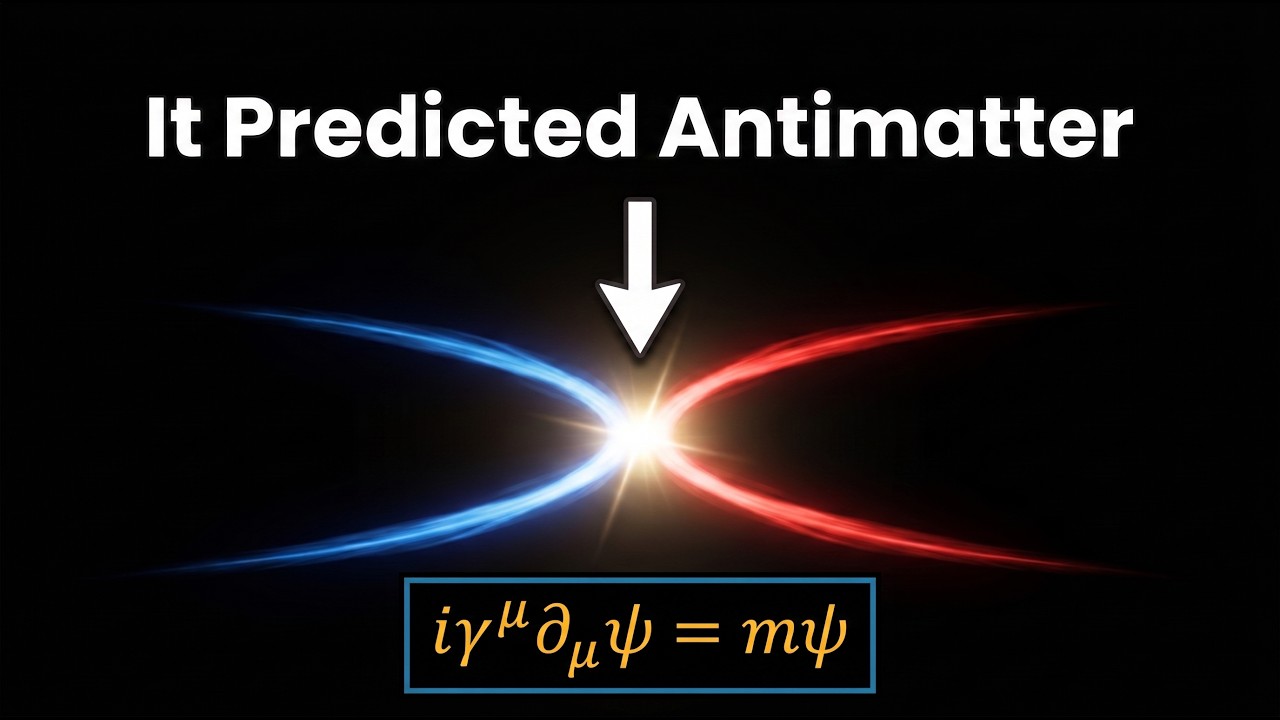
Nobody Explained the Dirac Equation Like THIS!
Keywords
Summary
182 words
Critical Evaluation
Value of the Information & Strength of the Argument
The video’s primary value lies in its clear, step-by-step derivation that avoids hand-waving. It meticulously explains why each mathematical step is necessary, from the requirement of first-order equations to the impossibility of using ordinary numbers or 2x2 matrices. The argumentation is solid and logically structured, building each concept on the previous one. It also provides valuable historical context, correcting the common misconception that Dirac immediately predicted antimatter, and instead showing the three-year struggle to correctly interpret his own equation. This nuanced historical account adds depth and credibility.
Scientific Rigor, Source Quality, Title Accuracy
The video demonstrates high scientific rigor by referencing primary sources, including Dirac’s original papers, Anderson’s discovery paper, and Nobel Prize pages. It also correctly notes the Klein-Gordon equation’s validity for other particles and the later reinterpretation by Pauli and Weisskopf. The title, while slightly sensational, is justified by the video’s unique and effective explanatory approach. The content is well-researched and accurately presented, with the creator explicitly inviting corrections, which further enhances trustworthiness.
174 words
Title / Content Match
The title is somewhat hyperbolic but accurately reflects the video's unique pedagogical approach of deriving the equation from first principles and highlighting the surprising consequences.
Quality & Reliability
9/10
The video provides a rigorous, step-by-step derivation of the Dirac equation, accurately presenting the historical context and correcting common misconceptions (e.g., the Klein-Gordon equation's validity, the timing of the positron prediction). It cites primary sources and Nobel Prize pages, and the creator explicitly invites corrections, indicating a commitment to accuracy.
Key Moments
Markers derived by PSI from the transcript: the creator did not define chapters.
- Introduction: The central problem of reconciling quantum mechanics and relativity, and the two unasked-for answers (spin and antimatter).
- Explanation of first-order vs. second-order equations in time and why quantum mechanics requires first-order for probability conservation.
- Introduction of the Klein-Gordon equation and its failure for a single electron due to negative probabilities.
- The core problem: taking the square root of the relativistic energy-momentum relation, leading to the need for anti-commuting coefficients.
- Explanation of why 2x2 matrices are insufficient (only 3 anti-commuting ones exist) and the necessity of 4x4 matrices.
- Derivation of electron spin and the g-factor of 2 from the four-component wavefunction.
- Introduction of negative energy states and the 'Dirac sea' concept, followed by Dirac's initial mistake of identifying holes as protons.
- Correction of the proton mistake, the 1931 prediction of a new particle, and Carl Anderson's discovery of the positron in 1932.
- Summary of the entire derivation and the philosophical implication that the equation knew more than its creator.
Cited Sources
- Dirac, P. A. M. (1928). The Quantum Theory of the Electron. Proceedings of the Royal Society A 117. — Original paper introducing the Dirac equation.
- Dirac, P. A. M. (1931). Quantised Singularities in the Electromagnetic Field. Proceedings of the Royal Society A 133. — Paper where Dirac abandons the proton identification and predicts a new particle.
- Anderson, C. D. (1933). The Positive Electron. Physical Review 43. — Paper reporting the discovery of the positron.
- Uhlenbeck, G. E., and Goudsmit, S. (1925). The proposal of electron spin. Goudsmit's own account of the discovery is free at the Lorentz Institute. — Historical account of the electron spin proposal.
- Pauli, W., and Weisskopf, V. (1934). On the quantization of the scalar relativistic wave equation — Paper that reinterpreted the Klein-Gordon equation.
- Nobel Prize in Physics 1933, Schrodinger and Dirac — Nobel Prize page for the discovery of new productive forms of atomic theory.
- Nobel Prize in Physics 1936, Anderson, for the discovery of the positron — Nobel Prize page for the discovery of the positron.
- Farmelo, G. The Strangest Man: The Hidden Life of Paul Dirac. — Biography of Paul Dirac.
Concurring Sources
- Dirac equation - Wikipedia — Confirms the derivation steps and the physical consequences (spin, antimatter).
- Positron - Wikipedia — Confirms the historical timeline of the positron prediction and discovery.
Dissenting Sources
- Some popular accounts may claim Dirac immediately predicted antimatter in 1928. — The video correctly points out that Dirac's prediction was not immediate and involved a period of misinterpretation.
External References
Contribution & Novelties
The video’s original contribution lies in its pedagogical approach: it derives the Dirac equation from a single, clearly stated demand (first-order in time) and follows the mathematical consequences without skipping steps. It demystifies the ‘square root’ of the energy-momentum relation and explains why matrices are necessary, making the derivation accessible to a wider audience. It also provides a historically accurate account of the positron prediction, correcting the common oversimplification.
Pour aller plus loin :
- Dirac equation - Wikipedia — For a comprehensive overview of the equation, its derivation, and its implications.
- Spinor - Wikipedia — To understand the mathematical objects that describe spin and how they relate to the four-component wavefunction.
- Quantum field theory - Wikipedia — To explore the modern framework that replaces the Dirac sea and naturally incorporates antiparticles.
131 words
Radar Profile
The radar profile shows very high scores in information quantity, quality, and reliability, with a slightly lower but still strong score in technical level. This indicates a video that is both highly informative and trustworthy, while still being accessible to a motivated audience.
💬 No comments were provided for analysis.