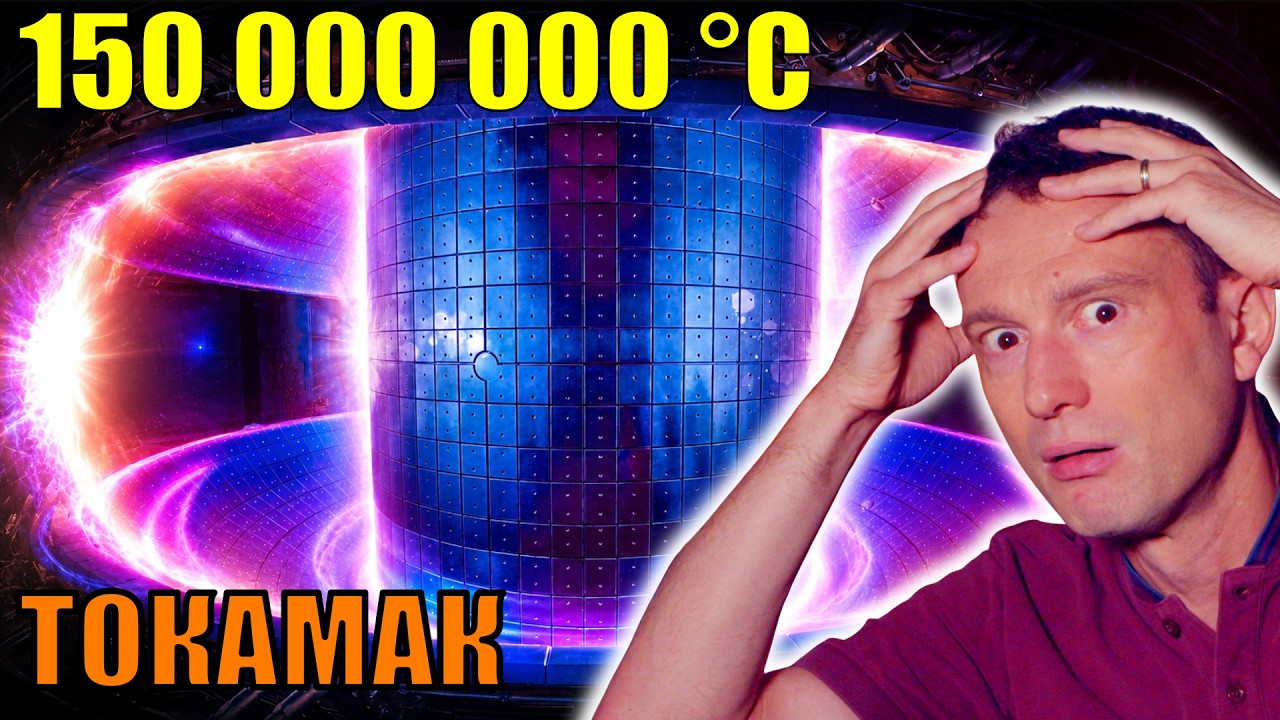
Fusion nucléaire : Comment piéger un plasma sans le toucher ?
Keywords
Summary
164 words
Critical Evaluation
The video is an excellent example of high-quality science communication. It presents complex physics concepts with remarkable clarity, using intuitive simulations and clear explanations. The scientific content is accurate and well-structured, building from fundamental principles (Lorentz force) to the practical challenges of tokamak design. The argumentation is solid, with each step logically leading to the next. The use of simulations greatly aids understanding, and the video does not oversimplify the material, maintaining a good level of technical depth. The sources are not explicitly cited within the video, but the companion blog post likely provides references. The title accurately reflects the content, and the video fulfills its promise. The only minor critique is that the video could have mentioned the role of instabilities in more detail, but it does cover them briefly. Overall, this is a top-tier educational video that successfully conveys the intricacies of magnetic confinement fusion.
147 words
Title / Content Match
The title accurately reflects the content: the video explains how magnetic confinement works to trap a plasma without physical contact, focusing on tokamaks.
Quality & Reliability
9/10
The video is produced by a physicist (David Louapre) with a strong track record of accurate science communication. It explains fundamental physics (Lorentz force, magnetic confinement) with clear simulations and references to real experimental devices (tokamaks, stellarators). The content aligns with established scientific knowledge and includes a companion blog post for further details.
Chapters
Cited Sources
- Blog post accompanying the video — Provides additional details and references on magnetic confinement and tokamak control.
- Science étonnante books page — Lists books by the author, including 'Le Labo du jeu vidéo' mentioned in the video.
- Science étonnante YouTube channel — The channel where the video is published, offering more science content.
Concurring Sources
- Tokamak - Wikipedia — Confirms the basic principles of tokamak operation and magnetic confinement.
- ITER official website — Provides current status and details on the largest tokamak project, aligning with the video's content.
Contribution & Novelties
The video provides a clear and accessible explanation of magnetic confinement in tokamaks, using custom simulations to visualize particle trajectories. It effectively bridges the gap between basic electromagnetism and the engineering challenges of fusion devices. The novelty lies in the pedagogical approach, making complex concepts intuitive.
Pour aller plus loin :
- Tokamak - Wikipedia — Overview of tokamak design and history.
- Stellarator - Wikipedia — Alternative magnetic confinement device.
- Lorentz force - Wikipedia — Fundamental physics behind particle motion in magnetic fields.
- ITER — International fusion research project, relevant to current tokamak development.
93 words
Radar Profile
The radar profile shows high scores across all dimensions, indicating a well-balanced and comprehensive video. The strong performance in information quantity and quality, combined with a high technical level and reliability, suggests a top-tier educational resource.
💬 Très positif. Sur les 30 commentaires analysés, le public exprime une admiration unanime pour la clarté de l'explication et la qualité des simulations, saluant la chaîne comme une référence en vulgarisation scientifique.