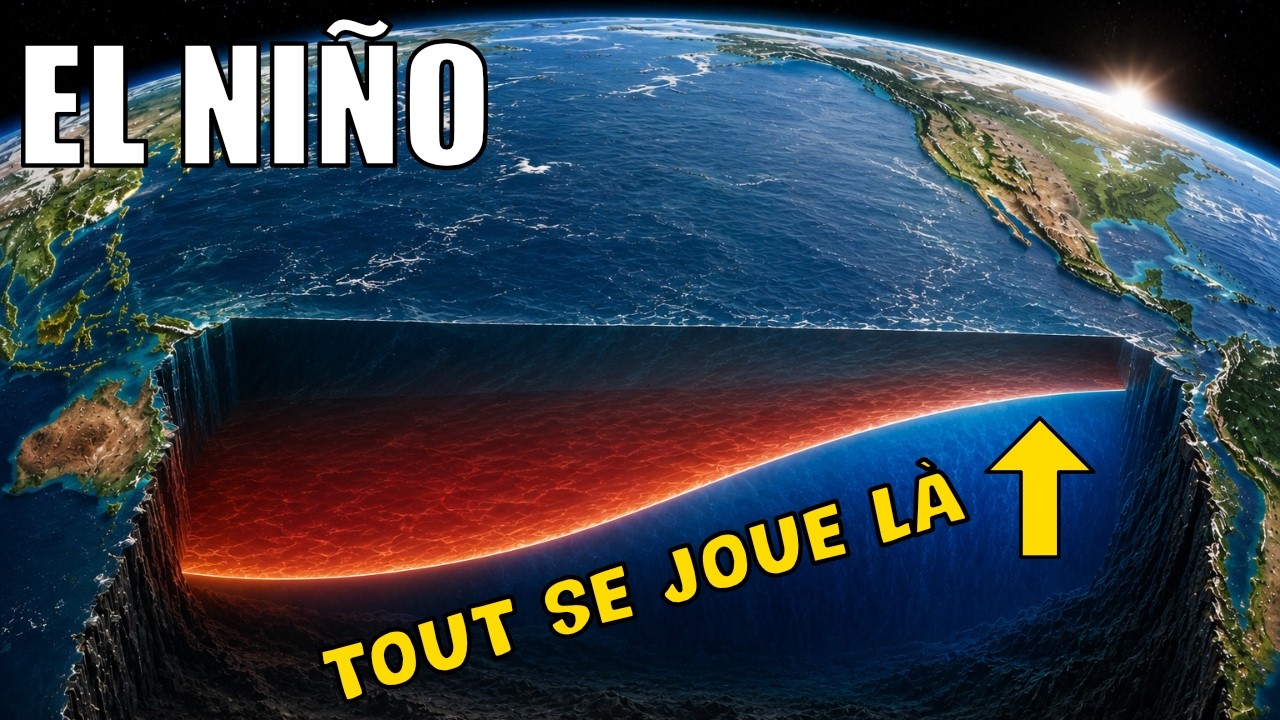
EL NIÑO : Pourquoi l'Océan Pacifique bascule-t-il ?
EL NIÑO: Why Does the Pacific Ocean Tilt?
Keywords
Summary
149 words
Critical Evaluation
Value of the Information & Strength of the Argument
The video provides a high-value explanation of a complex climate phenomenon, breaking it down into understandable components. The argumentation is solid, building from basic oceanography to the coupled ocean-atmosphere dynamics. The use of simple models (e.g., the two-layer ocean, the recharge oscillator) effectively illustrates the key mechanisms without oversimplifying. The creator clearly explains the positive and negative feedbacks that govern the ENSO cycle, and the inclusion of a simulation helps visualize the wave dynamics. The video is well-structured and logically progresses from description to explanation.
Scientific Rigor, Source Quality, Title Accuracy
The scientific content is rigorous and aligns with established climate science. The creator, David Louapre, is a physicist known for accurate science communication. The video does not cite specific papers, but the mechanisms described (Bjerknes feedback, recharge oscillator) are well-documented in the literature. The title accurately reflects the content. The video includes a brief mention of the creator’s book, but no sponsored segment. No comments were provided for analysis.
169 words
Title / Content Match
The title accurately reflects the content, which focuses on the geophysical mechanisms behind El Niño in the Pacific Ocean.
Quality & Reliability
9/10
The video provides a rigorous, well-structured explanation of El Niño, grounded in established geophysical mechanisms (Bjerknes feedback, recharge oscillator model). The creator, David Louapre, is a physicist with a strong track record of accurate science communication. The content is consistent with current scientific consensus and avoids sensationalism.
Chapters
Cited Sources
- ScienceEtonnante - Books — Mentioned in the video description as a resource for the creator's books.
- ScienceEtonnante YouTube Channel — Channel link provided in the video description.
Concurring Sources
- NOAA - El Niño — NOAA's educational resource on El Niño, consistent with the video's explanation.
Contribution & Novelties
The video’s original contribution lies in its clear, accessible synthesis of the complex mechanisms behind El Niño, particularly the recharge-discharge oscillator model, which is often not well explained in popular media. It bridges the gap between descriptive accounts and the underlying physics.
Pour aller plus loin :
- El Niño–Southern Oscillation — Wikipedia article providing a comprehensive overview of ENSO.
- Bjerknes feedback — Wikipedia article on the positive feedback mechanism central to El Niño development.
- Recharge oscillator — Wikipedia article on the conceptual model explaining ENSO cycles.
- Walker circulation — Wikipedia article on the atmospheric circulation pattern influenced by ENSO.
99 words
Radar Profile
The radar profile shows high scores across all dimensions, indicating a well-balanced and reliable video. The slightly lower score in 'niveau_technique' reflects the accessible presentation, while 'fiabilite_globale' is high due to the accurate scientific content.