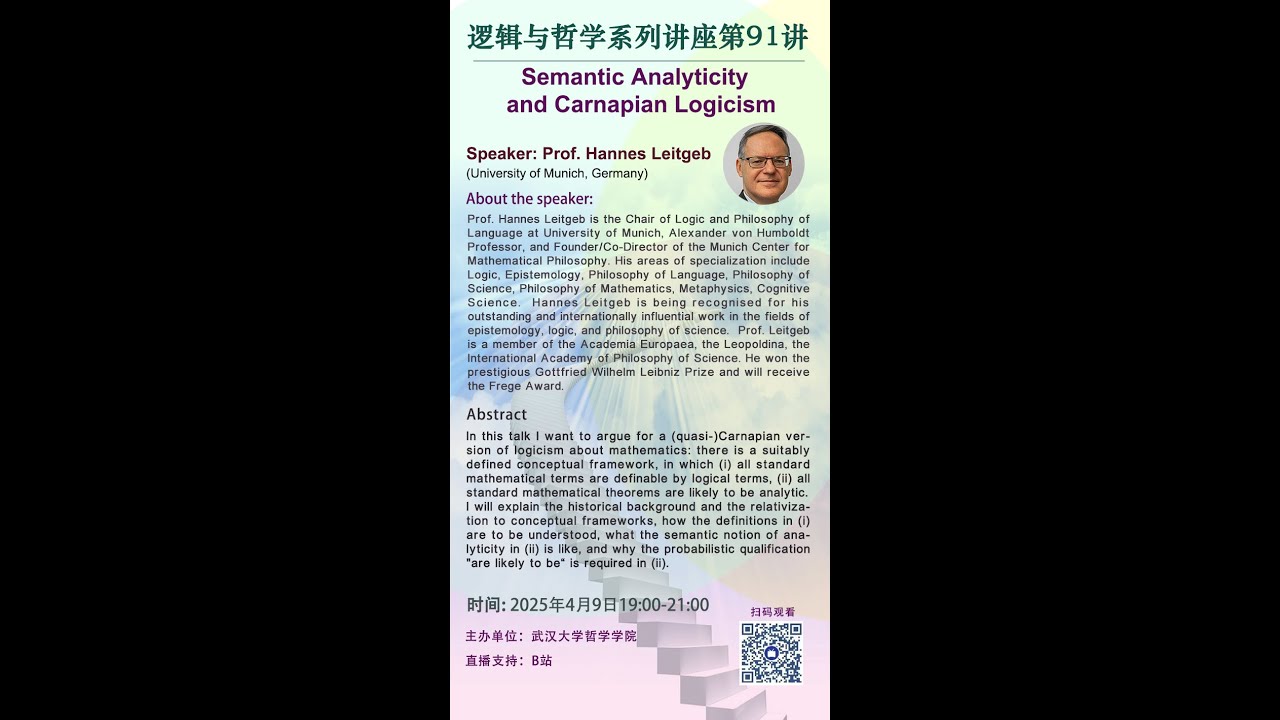
Semantic Analyticity and Carnapian Logicism
Keywords
Summary
157 words
Critical Evaluation
Value of the Information & Strength of the Argument
The lecture provides a valuable contribution to the philosophy of mathematics by offering a fresh perspective on logicism, integrating semantic analyticity and second-order logic. The argumentation is rigorous and well-structured, building from historical context to a clear thesis. Leitgeb carefully distinguishes his view from Carnap’s actual position, avoiding anachronism. He also addresses potential objections, such as the reliance on second-order logic, and justifies his choices. The probabilistic element is intriguing but could be more developed. Overall, the argument is compelling and thought-provoking.
Scientific Rigor, Source Quality, Title Accuracy
The lecture demonstrates high scientific rigor, with careful use of historical sources and clear definitions. Leitgeb references key works by Frege, Carnap, and others, and mentions a recent paper by himself and colleagues. The title accurately reflects the content, focusing on semantic analyticity and Carnapian logicism. The talk is well-organized and the speaker is transparent about the scope and limitations of his argument. No comments were provided, so no analysis of public reception is possible.
172 words
Title / Content Match
The title accurately reflects the content, focusing on semantic analyticity and its role in a Carnapian version of logicism.
Quality & Reliability
8/10
The lecture is given by a recognized expert in philosophy of mathematics, with clear argumentation and references to established literature. However, it is a philosophical talk without formal peer review, and some claims rely on the speaker's interpretation.
Key Moments
Markers derived by PSI from the transcript: the creator did not define chapters.
- Introduction: speaker clarifies what he will not discuss, referencing a recent paper.
- Definition of logicism as conjunction of two theses: definability of mathematical terms and derivability of theorems.
- Historical background: Kant's synthetic a priori, Frege's analyticity, and Carnap's adoption of logicism.
- Introduction of semantic analyticity based on Tarski's semantics, contrasting with proof-theoretic analyticity.
- Thesis: all standard mathematical terms definable from logical terms, and theorems likely analytic in a Carnapian framework.
- Focus on second-order set theory as a convenient foundation, with a note on pluralism.
- Discussion of the role of definitions and the importance of second-order resources.
- Distinction from Carnap's own position: quasi-Carnapian logicism, referencing Benjamin Marshall's paper.
- Potential applications of the strategy to other mathematical theories, such as arithmetic and analysis.
- Conclusion and outlook, emphasizing the probabilistic component and future directions.
Cited Sources
- The Logicist Foundations of Mathematics — Carnap's 1931 paper where he defines logicism as the conjunction of two theses.
- Stanford Encyclopedia of Philosophy entry on Rudolf Carnap — Co-authored by Leitgeb and Carus, providing background on Carnap's philosophy.
- Carnap on Logicism — Paper by Bonut (1975) summarizing Carnap's logicism.
- A Defense of Logicism — Recent paper by Leitgeb, Nelman, and Salta, mentioned as different from the talk's approach.
- Benjamin Marshall's paper on Carnap — Historical reasons why Carnap might not have endorsed the speaker's approach.
Concurring Sources
- The Logicist Foundations of Mathematics — Carnap's original formulation of logicism, which the talk builds upon.
- Stanford Encyclopedia of Philosophy entry on Rudolf Carnap — Provides context on Carnap's semantic turn and his views on analyticity.
Dissenting Sources
- Benjamin Marshall's paper on Carnap — Suggests that Carnap would not have endorsed the speaker's approach, as he had a different view of set-theoretic membership.
Contribution & Novelties
The lecture offers a novel synthesis of Carnapian semantics and logicism, proposing a semantic notion of analyticity that avoids proof-theoretic issues. It extends logicism to second-order set theory, providing a unified framework for standard mathematics. The probabilistic component is a distinctive addition, suggesting a pragmatic twist. The talk also emphasizes pluralism in foundations, which is a contemporary concern.
Pour aller plus loin :
- Logicism (Wikipedia) — Overview of logicism and its history.
- Semantic theory of truth (Wikipedia) — Background on Tarski’s semantics.
- Second-order logic (Wikipedia) — Explanation of second-order logic and its uses.
- Rudolf Carnap (Stanford Encyclopedia of Philosophy) — Detailed entry on Carnap’s philosophy.
105 words
Radar Profile
The radar profile shows high scores in quantity and quality of information, with a strong technical level and high reliability. This indicates a dense, well-argued lecture suitable for an audience with background in logic and philosophy.