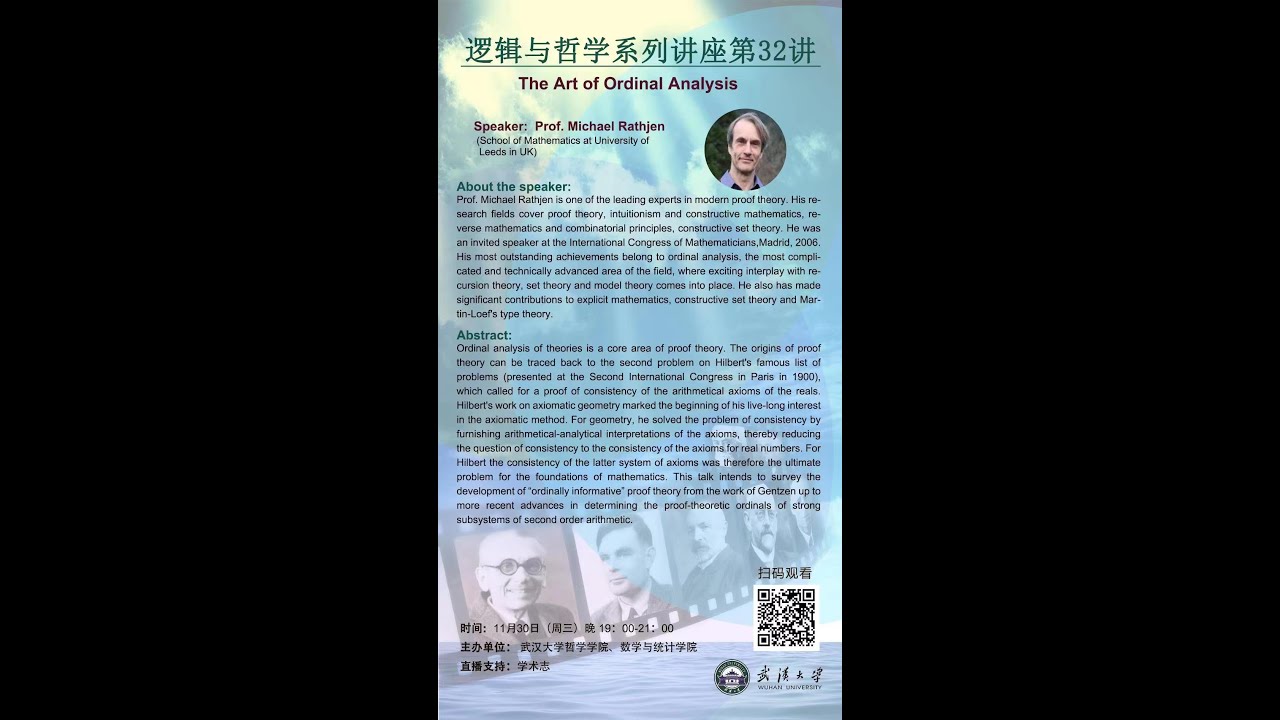
The Art of Ordinal Analysis
Keywords
Summary
124 words
Critical Evaluation
Value of the Information & Strength of the Argument
The lecture provides valuable insights into the motivations and techniques of ordinal analysis. Rathjen argues that ordinal analysis is not just about consistency proofs but also yields deep mathematical results. He supports his points with historical examples and technical explanations, demonstrating the power of the method. The argumentation is solid, as he connects the technical machinery to broader philosophical questions about the foundations of mathematics.
Scientific Rigor, Source Quality, Title Accuracy
The lecture is scientifically rigorous, given the speaker’s expertise. Rathjen references key works by Gentzen, Hilbert, and others, and discusses the historical development accurately. The title is appropriate, as the lecture indeed covers the ‘art’ of ordinal analysis, balancing technical detail with conceptual overview. The sources cited are primarily historical and foundational, and the presentation is consistent with established knowledge in proof theory.
143 words
Title / Content Match
The title accurately reflects the content, which focuses on the methods and history of ordinal analysis.
Quality & Reliability
9/10
Lecture by a leading expert in proof theory, with historical context and technical details. The content is rigorous and well-structured, though the transcription is imperfect.
Key Moments
Markers derived by PSI from the transcript: the creator did not define chapters.
- Introduction of speaker and topic
- Historical background: Hilbert's program and consistency problem
- Gentzen's consistency proof for PA using epsilon-zero
- Explanation of ordinal representation systems
- Sequent calculus and cut elimination
- Infinite proofs and their role in ordinal analysis
- Applications: independence results and Goodstein's theorem
- Discussion of the art of choosing ordinal notations
- Conclusion and outlook
Cited Sources
- Gentzen's consistency proof — Mentioned as foundational work
- Hilbert's program — Historical context
- Goodstein's theorem — Independence result
Concurring Sources
- Ordinal analysis - Wikipedia — General overview consistent with lecture
Contribution & Novelties
The lecture offers a comprehensive overview of ordinal analysis, highlighting its historical development and technical core. It emphasizes the ‘art’ of selecting ordinal notations, which is often underappreciated. The talk bridges historical context with modern applications, making it valuable for both newcomers and experts.
Pour aller plus loin :
- Ordinal analysis - Wikipedia — Overview and references.
- Proof theory - Stanford Encyclopedia of Philosophy — Philosophical and technical background.
- Gentzen’s consistency proof - Wikipedia — Details on the proof.
79 words
Radar Profile
The radar profile shows high scores across all dimensions, indicating a well-rounded and reliable lecture. The technical depth is balanced with historical context, making it accessible yet rigorous.