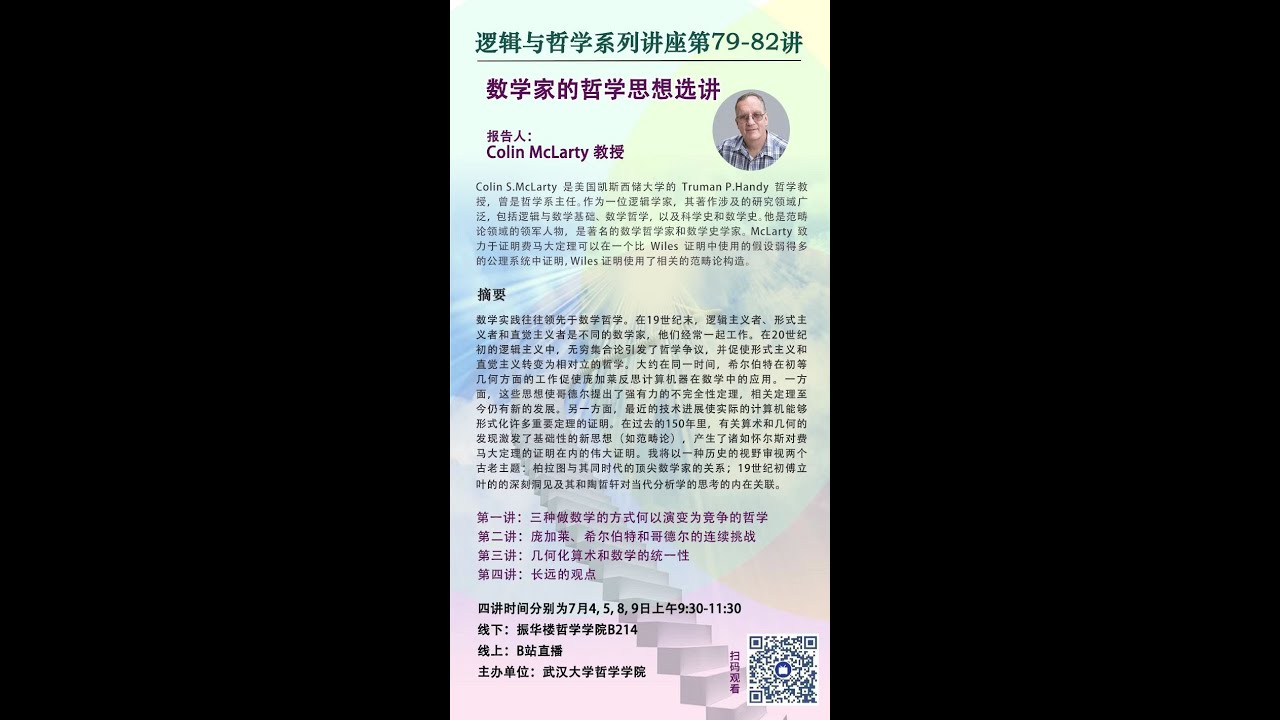
The continuing challenge of Poincare, Hilbert, and Gödel
Keywords
Summary
168 words
Critical Evaluation
Value of the Information & Strength of the Argument
The lecture provides valuable insights into the historical development of foundational ideas, correcting common misconceptions about Poincaré’s and Hilbert’s positions. McLarty argues convincingly that Poincaré was not simply an opponent of Hilbert but appreciated the value of formalization for specific purposes. The argumentation is solid, grounded in primary sources and historical context, and effectively demonstrates how Gödel’s theorems undermined Hilbert’s program. The speaker’s expertise is evident, and the narrative is coherent and persuasive.
Scientific Rigor, Source Quality, Title Accuracy
The lecture demonstrates high scientific rigor, with careful attention to historical accuracy and philosophical nuance. McLarty references primary sources such as Poincaré’s reviews and Hilbert’s works, and he correctly interprets Gödel’s theorems. The title accurately reflects the content, which addresses the ongoing challenges posed by these three figures. The speaker’s authority as a professor of philosophy and mathematics adds to the credibility. No comments were provided for analysis.
156 words
Title / Content Match
The title accurately reflects the content, which focuses on the historical and philosophical challenges posed by Poincaré, Hilbert, and Gödel.
Quality & Reliability
8/10
Lecture by a recognized expert in the philosophy of mathematics, based on historical documents and scholarly analysis. The content is well-structured and demonstrates deep knowledge, though it is an oral presentation without formal citations.
Key Moments
Markers derived by PSI from the transcript: the creator did not define chapters.
- Introduction to the lecture and overview of Poincaré's relationship with Hilbert.
- Discussion of Poincaré's review of Hilbert's Foundations of Geometry, praising precision but criticizing formalization.
- Explanation of Hilbert's goal to reduce geometry to mechanical rules and Poincaré's concerns about teaching and research.
- Historical context of mechanical reasoning: Babbage's analytical engine and Jevons's logic piano.
- Hilbert's program to prove consistency of arithmetic and set theory by finite means.
- Gödel's incompleteness theorems and their impact on Hilbert's program.
- Reflections on the boldness of assuming consistency and the philosophical implications.
Cited Sources
- Foundations of Geometry — Hilbert's foundational work discussed in the lecture.
- On the Foundations of Geometry — Poincaré's review of Hilbert's work, as mentioned in the lecture.
- Über formal unentscheidbare Sätze der Principia Mathematica und verwandter Systeme I — Gödel's original paper on incompleteness, referenced in the lecture.
Concurring Sources
- Hilbert's Program — Supports the lecture's explanation of Hilbert's program and its goals.
- Gödel's Incompleteness Theorems — Confirms the lecture's account of Gödel's theorems and their implications.
Contribution & Novelties
This lecture offers a nuanced historical perspective on the interactions between Poincaré, Hilbert, and Gödel, correcting oversimplified narratives. It highlights Poincaré’s constructive criticism of Hilbert’s formalism and the influence of early computing machines on Hilbert’s program. The lecture also clarifies the scope and limitations of Hilbert’s program, making it accessible to a broader audience.
Pour aller plus loin :
- Hilbert’s program — Stanford Encyclopedia of Philosophy entry on Hilbert’s program.
- Gödel’s incompleteness theorems — Stanford Encyclopedia of Philosophy entry on Gödel’s theorems.
- Poincaré’s philosophy of mathematics — Stanford Encyclopedia of Philosophy entry on Poincaré.
94 words
Radar Profile
The radar profile shows high scores in information quantity, quality, and reliability, with a slightly lower technical level, reflecting the lecture's balance between depth and accessibility. The overall high scores indicate a valuable and trustworthy resource.