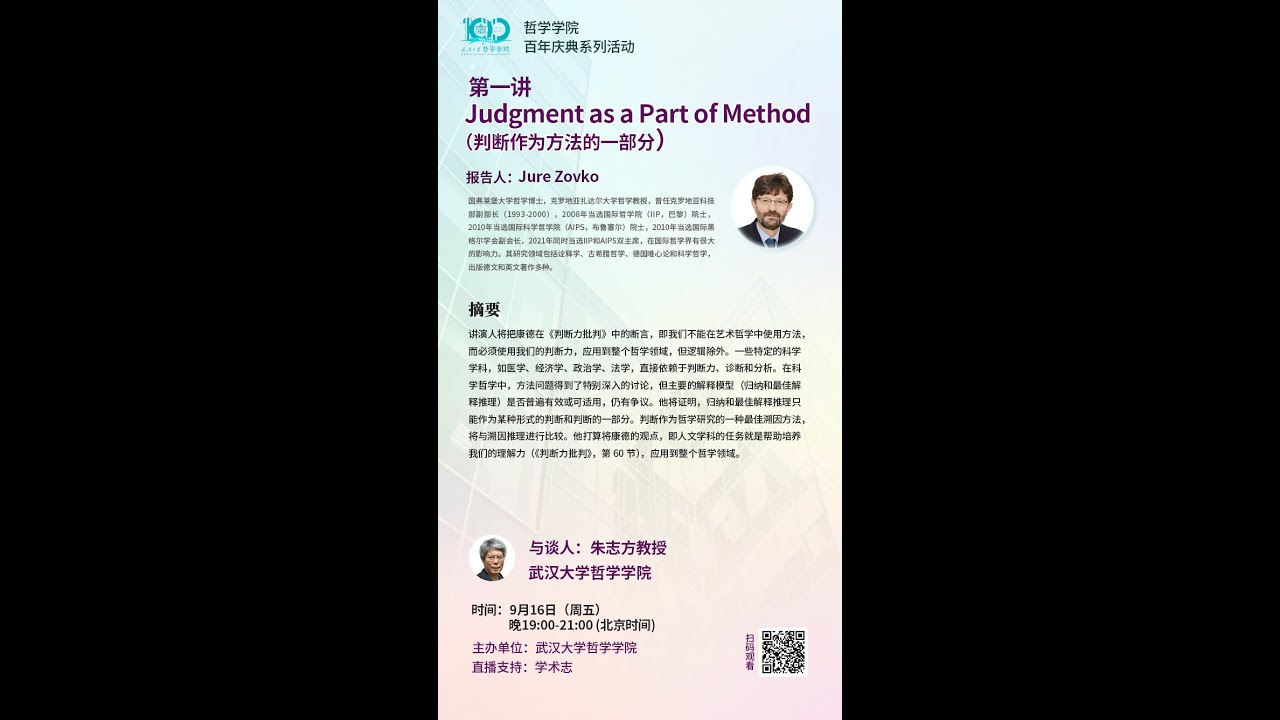
Judgment as a Part of Method
Keywords
Summary
172 words
Critical Evaluation
Value of the Information & Strength of the Argument
The lecture provides a valuable philosophical analysis of judgment, connecting classical and modern perspectives. Zovko’s argumentation is coherent and well-structured, drawing on a range of philosophical sources. He effectively demonstrates the relevance of Socratic method to contemporary debates in epistemology and philosophy of science. However, the argumentation sometimes relies on assertions without detailed justification, and the transcription errors may obscure some nuances.
Scientific Rigor, Source Quality, Title Accuracy
The lecture demonstrates a strong command of the philosophical tradition, referencing key figures such as Socrates, Plato, Kant, Peirce, and Harman. However, specific sources are not systematically cited, and the lecture relies on general references. The title accurately reflects the content, which focuses on judgment as a method. The lecture is rigorous in its philosophical analysis, but the lack of explicit citations and the transcription issues slightly reduce its overall reliability.
148 words
Title / Content Match
The title accurately reflects the central theme of the lecture, which explores judgment as a fundamental component of philosophical method.
Quality & Reliability
7/10
The lecture is delivered by a recognized expert in philosophy, with a clear and coherent argumentation. However, the transcription contains numerous errors and the content is not systematically sourced, relying on the speaker's authority and general references.
Key Moments
Markers derived by PSI from the transcript: the creator did not define chapters.
- Introduction of the speaker and the lecture topic.
- Discussion on the importance of philosophy and judgment.
- Analysis of the Socratic method as a form of judgment.
- Exploration of the connection between Socratic questioning and abduction.
- Discussion on inference to the best explanation and its criteria.
- Critique of equating abduction with inference to the best explanation.
- Examination of the role of judgment in scientific inquiry.
- Conclusion and summary of key points.
Cited Sources
- Plato's Early Dialogues — Referenced as the primary source for Socratic method and judgment.
- Kant's Critique of Pure Reason — Mentioned in relation to judgment and the principle of reason.
- Peirce's Abduction — Discussed as the process of hypothesis formation.
- Harman's Inference to the Best Explanation — Referenced in the discussion of explanatory reasoning.
Concurring Sources
- Plato's Republic — Referenced for the definition of justice and Socratic method.
- Kant's Critique of Judgment — Implied in the discussion of reflective and determinant judgment.
Dissenting Sources
- Gregory Vlastos's Interpretation of Socrates — Zovko disagrees with Vlastos's view that the Socratic method is primarily negative, arguing it has a positive aim.
Contribution & Novelties
The lecture offers a fresh perspective on the role of judgment in philosophical method, integrating Socratic and Kantian insights with contemporary debates on abduction. It provides a nuanced critique of equating abduction with inference to the best explanation, suggesting that judgment is a broader and more fundamental process.
Pour aller plus loin :
- Socratic method — Overview of the Socratic method and its philosophical significance.
- Abductive reasoning — Explanation of abduction as a form of reasoning.
- Inference to the best explanation — Discussion of this concept in philosophy of science.
90 words
Radar Profile
The radar profile shows high scores in quantity and quality of information, reflecting the lecture's depth and breadth. The technical level is moderately high, indicating a specialized audience. Reliability is slightly lower due to the lack of explicit citations and transcription issues.
💬 No comments were provided for analysis.